
Effective Odor Control Solutions for Industrial Malodor & Nuisance Complaints
YFEP manufactures professional-grade odor control equipment designed to eliminate industrial malodors and nuisance complaints from wastewater treatment facilities, food processing plants, landfill operations, and chemical manufacturing sites.
Our integrated odor abatement systems effectively remove hydrogen sulfide (H₂S), ammonia (NH₃), mercaptans, volatile organic compounds, and complex mixed malodors — achieving up to 99% removal efficiency while meeting strict emission standards.
We deliver complete odor control equipment packages spanning source analysis, process engineering, custom manufacturing, on-site installation, commissioning, and after-sales maintenance support.
Odor Types We Treat — Comprehensive Odor Control Equipment Coverage
- Hydrogen Sulfide (H₂S) — wastewater treatment, pulp & paper, food processing
- Ammonia (NH₃) — animal rendering, fertilizer production, refrigeration
- Mercaptans (Thiols) — petroleum refining, natural gas processing, rubber production
- VOCs-based Odors — painting, printing, pharmaceutical synthesis
- Organic Acids — food processing, beverage production, fermentation
- Amines — fish processing, leather tanning, chemical synthesis
Our Odor Control Technologies
Industries We Serve
WM
Waste Management
Landfill leachate treatment odor, waste transfer station exhaust, composting facility malodor control
Core Market
FP
Food Processing
Rendering plant exhaust treatment, fermentation odor abatement, fishmeal processing deodorization
Core Market
WT
Wastewater Treatment
Sewage treatment plant odor control, pump station H₂S abatement, sludge dewatering area exhaust
Growth Sector
PP
Pulp & Paper
Pulp mill process odor treatment, black liquor recovery exhaust, paper machine area ventilation
Growth Sector
When selecting odor control equipment, facilities should consider their specific odor profile alongside other common industrial gas challenges:
• For acidic or alkaline exhaust streams (HCl, SO₂, NH₃), our acid alkali waste gas treatment solutions use custom wet scrubbers to achieve 95–99.9% removal.
• If your primary concern is volatile organic compounds (VOCs) from coating, printing, or chemical processes, explore our VOCs treatment solutions covering adsorption, condensation, and thermal oxidation.
• Review real-world odor control results in our industrial odor control project cases across pharmaceutical, food processing, and wastewater sectors.
• Browse the complete air pollution control product catalog including scrubbers, towers, filters, and custom-engineered units.
• For technical background on absorption-based gas cleaning, read our guide on how packed-bed wet scrubbers capture acid and odorous gases.
• Return to our homepage for a full overview of YFEP environmental engineering capabilities.
Types of Odor Control Equipment: How Each Technology Works
Biofiltration Systems (Biological Filters)
Biofilters pass odorous air through a porous organic media bed where naturally occurring microorganisms digest odor compounds. Ideal for odor control equipment applications involving low-concentration, high-volume airflows with biodegradable gases like H₂S and NH₃. Advantages include low operating cost (no chemicals needed) and minimal energy consumption. Media replacement is typically required every 3–7 years depending on loading. Best suited for wastewater treatment plants, composting facilities, and food processing operations with consistent odor profiles.
Chemical Scrubbers (Wet Scrubbing Towers)
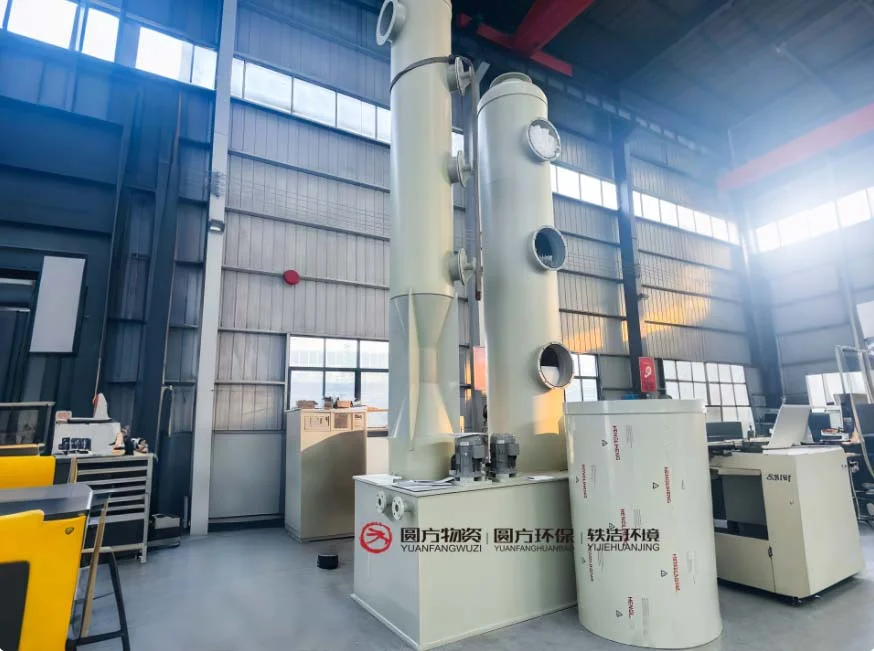
Chemical scrubbers force contaminated air through a packed tower where a liquid reagent (typically NaOH for acidic gases or dilute acid for alkaline gases like NH₃) neutralizes odorous compounds by gas-liquid absorption. This type of odor control equipment achieves 95–99.9% removal efficiency for concentrated streams and handles variable loads well. Requires continuous chemical supply and produces wastewater that must be managed. Commonly deployed in refineries, semiconductor fabs, and chemical manufacturing where removal efficiency is non-negotiable.
Activated Carbon Adsorption
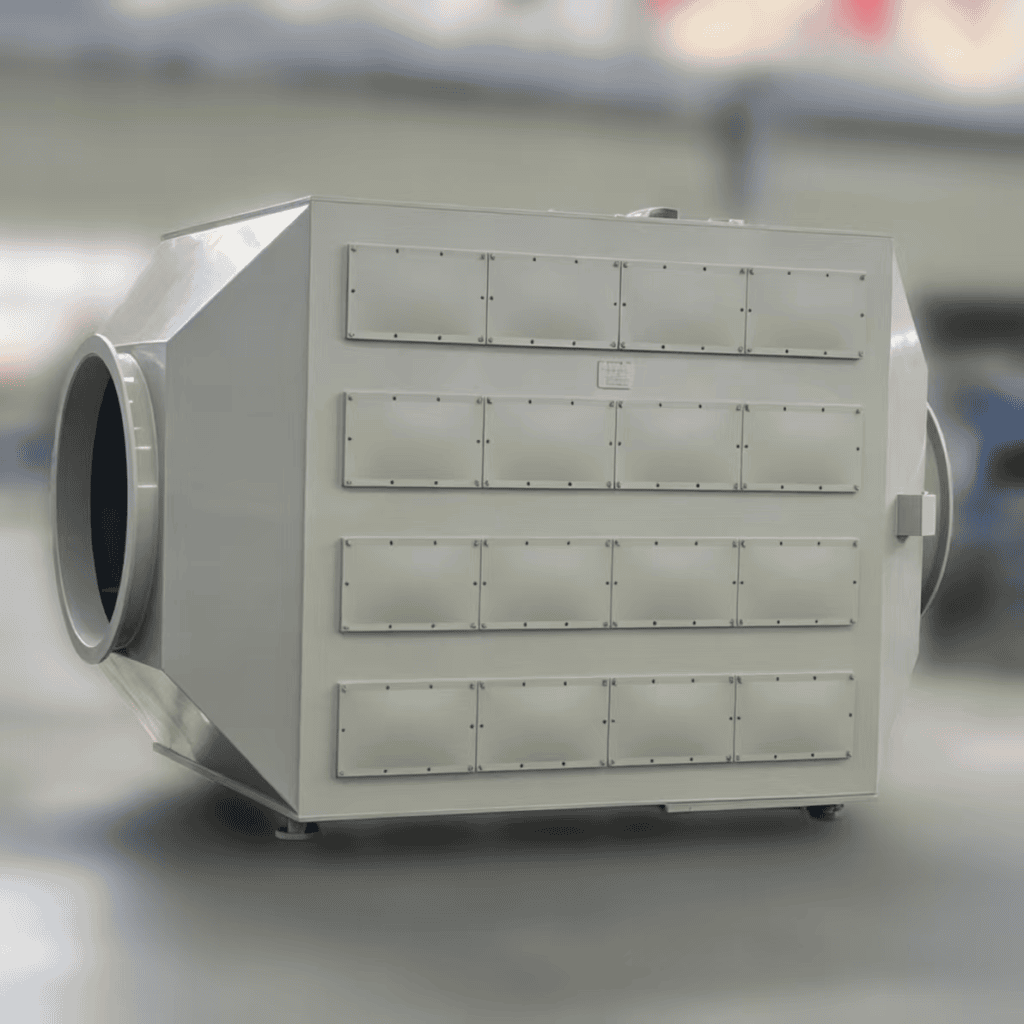
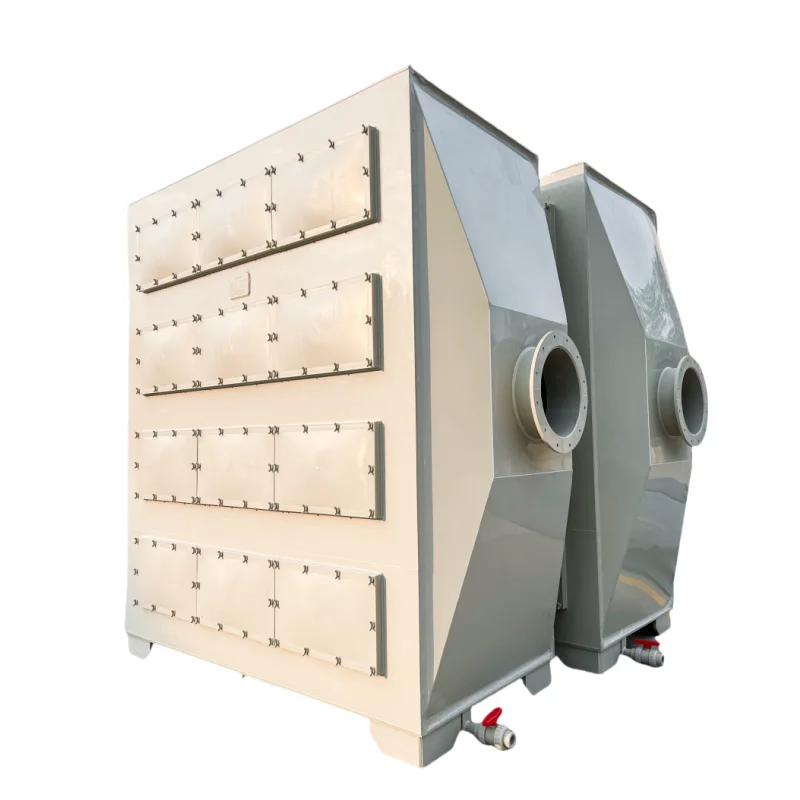
Carbon vessels trap odor molecules on high-surface-area activated carbon through physical adsorption. Effective as odor control equipment for low-concentration, multi-component odor streams including VOCs, mercaptans, and complex mixed malodors where biological or chemical methods struggle. Carbon media requires change-out every 6–18 months depending on inlet concentration. Often used as a polishing step downstream of primary treatment, or as standalone units for space-constrained facilities.
Choosing the Right Odor Control Equipment
The best technology depends on four factors: (1) odor compound type and concentration range, (2) airflow volume in m³/h, (3) available footprint and headroom at your site, and (4) operating budget for chemicals, energy, and media replacement. Many facilities achieve optimal results with hybrid systems — for example, a chemical scrubber handling peak loads followed by a carbon polisher for trace odors. Contact us for a free odor assessment and equipment recommendation tailored to your specific situation.
For authoritative information on hydrogen sulfide (H₂S) — the primary odorous compound in wastewater, pulp & paper, and food processing facilities — refer to the OSHA Hydrogen Sulfide Overview.
Why YuanFang
20+
Years of Experience
500+
Projects Delivered
99%
Compliance Rate
24h
Response Time
Struggling with Odor Complaints?
Describe your odor source and surrounding environment. Our engineers will design a compliant odor control solution within 24 hours.
Frequently Asked Questions About Selecting Odor Control Equipment
How do I choose between biofilter, chemical scrubber, and carbon adsorption?
Selection depends primarily on your odor profile and operational constraints. Use odor control equipment biofiltration for consistent, biodegradable odors (H₂S, NH₃) when you want lowest operating cost. Choose chemical scrubbers when you need guaranteed high removal (95%+) for concentrated acidic or alkaline streams and have budget for chemical consumables. Opt for activated carbon when dealing with low-concentration, complex mixed odors or when floor space is limited. Many facilities combine technologies — our engineers can design hybrid systems optimized for your specific case.
What are the ongoing operating costs for each type of odor control equipment?
Rough annual operating cost ranges (excluding labor): biofilter $3K–$8K/year (media replacement every 3–7 years, electricity for blower); chemical scrubber $15K–$60K/year (NaOH/acid reagents, pump energy, wastewater disposal); activated carbon $8K–$30K/year (carbon change-out every 6–18 months). Your actual cost depends on inlet concentration, airflow volume, and local utility/reagent pricing. We provide detailed lifecycle cost analysis during the consultation phase so you can make an informed decision.
How much space does odor control equipment require?
Footprint varies significantly by technology: biofilters need the most space (large media bed footprint, typically 20–50 m² for mid-sized facilities) but can be installed outdoors; chemical scrubbers are more compact (tower footprint 5–15 m²) and can be indoors or outdoors; carbon vessels are the smallest (individual vessels 2–4 m² each) and ideal for retrofit situations. Height clearance also matters — scrubbers typically require 4–8m headroom. During your free site assessment, we evaluate available space and recommend the best-fitting configuration.
What is the typical lead time from order to commissioning?
Standard odor control equipment projects take 5–9 weeks: Week 1–2 (site survey, odor sampling if needed, and final design), Week 3–5 (fabrication at our factory), Week 6–7 (delivery and installation), Week 8–9 (commissioning, performance testing, and operator training). Rush delivery is available for emergency compliance situations at additional cost. All equipment undergoes factory pre-testing before shipment to minimize on-site debugging time.