
Odor Control & Deodorization Cases
YFEP provides professional industrial odor control solutions that eliminate nuisance odors from wastewater treatment plants, food processing facilities, landfills, chemical manufacturing sites, and pharmaceutical operations. Our integrated odor abatement systems effectively remove hydrogen sulfide (H₂S), ammonia (NH₃), mercaptans, volatile organic compounds (VOCs), organic acids, amines, and complex mixed malodors — delivering 95–99.9% removal efficiency while meeting strict local emission standards.
We offer complete industrial odor control solutions from odor source identification and treatment process design to custom equipment manufacturing, installation, commissioning, and ongoing maintenance support. Each project is engineered for your specific odor profile, airflow volume, space constraints, and regulatory requirements.
Proven Industrial Odor Control Solutions Across 5 Key Industries
The following project cases showcase YFEP’s industrial odor control solutions in action — each system was custom-designed for real-world odor challenges across pharmaceutical manufacturing, bio-chemical processing, chemical production, and multi-pollutant environments. Browse our success stories below to see how we solve persistent odor problems with biofiltration, chemical scrubbing, activated carbon adsorption, and hybrid treatment technologies.
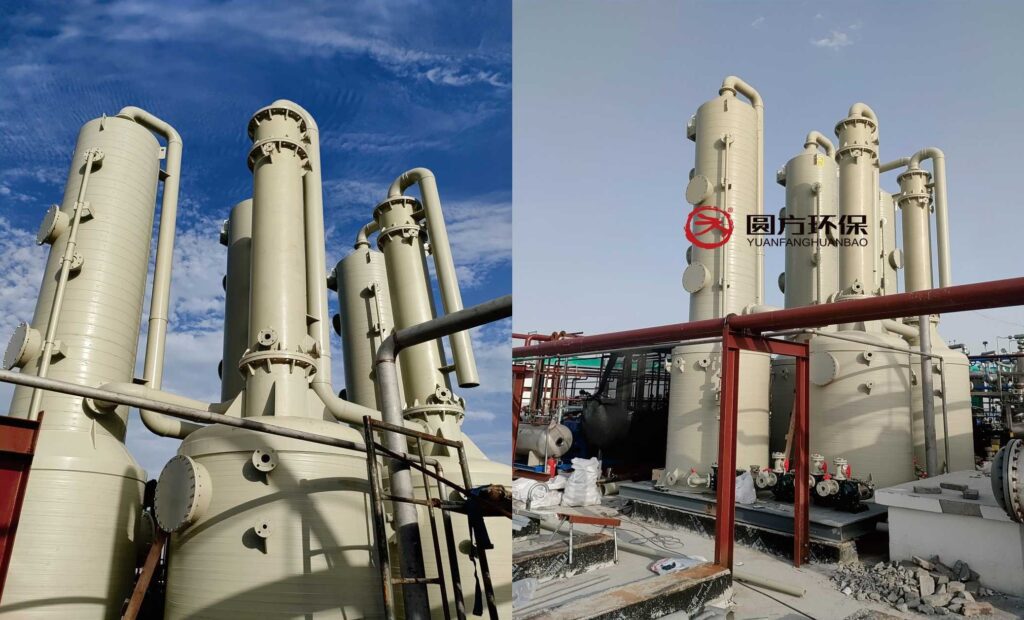
Pharmaceutical Manufacturer — HCl & SO₂ Odor Treatment
| Pollutants | HCl, SO₂, Dichloroethane |
| Emission Load | HCl ~650 kg/day, SO₂ ~1,100 kg/day |
| Gas Flow Rate | 5,000 m³/h |
| Treatment Process | 2-Stage Acid Absorption → 2-Stage Alkaline Wash → 1-Stage Water Absorption (Tail) |
| Removal Efficiency | ≥ 98% |
A bio-pharmaceutical manufacturing facility discharging corrosive acid gases (HCl, SO₂) along with organic solvents (dichloroethane) at significant mass emission rates. We engineered a comprehensive five-stage wet scrubbing system featuring two-stage acid absorption towers for HCl/SO₂ capture, two-stage alkaline wash towers for residual acidic components, and a final water absorption stage as a polishing step. The cascade configuration ensures each pollutant is targeted at its optimal removal condition, delivering overall efficiency of ≥98%.
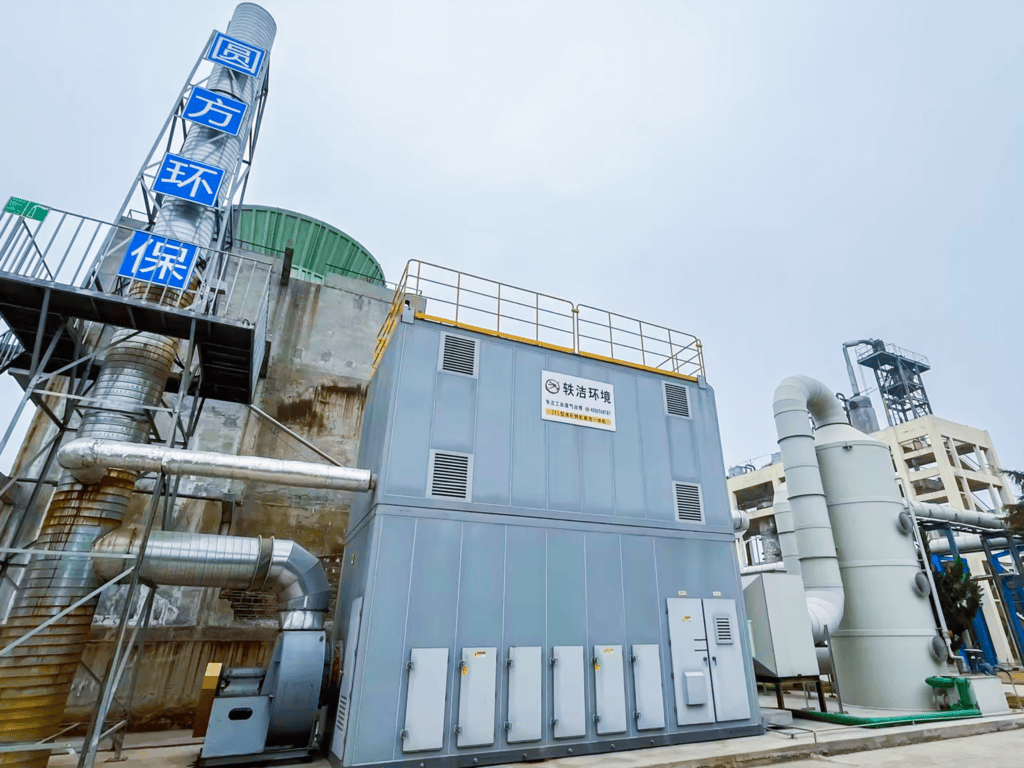
Pharmaceutical Manufacturing — Solvent Vapor Odor Control System
| Pollutants | Butanol, MEK (Methyl Ethyl Ketone), Butyl Acetate |
| Inlet Concentration | Butanol < 1,200 mg/m³, MEK < 800 mg/m³ |
| Gas Flow Rate | 30,000 m³/h |
| Treatment Process | Alkaline Scrubbing → Oxidation → Water Wash → Zeolite Rotor → Catalytic Combustion |
| Removal Efficiency | ≥ 96% |
A pharmaceutical processing plant generating complex organic solvent vapors (butanol, methyl ethyl ketone, butyl acetate) required an integrated single-machine solution capable of handling high-concentration intermittent emissions. We delivered a compact all-in-one system combining pre-treatment stages (alkaline scrubbing, oxidation, water wash) to remove water-soluble and oxidizable components, followed by a zeolite rotor concentrator for VOC enrichment, and finally catalytic combustion for deep destruction. This integrated approach achieves ≥96% removal efficiency while maintaining a small footprint suitable for existing facility retrofits.
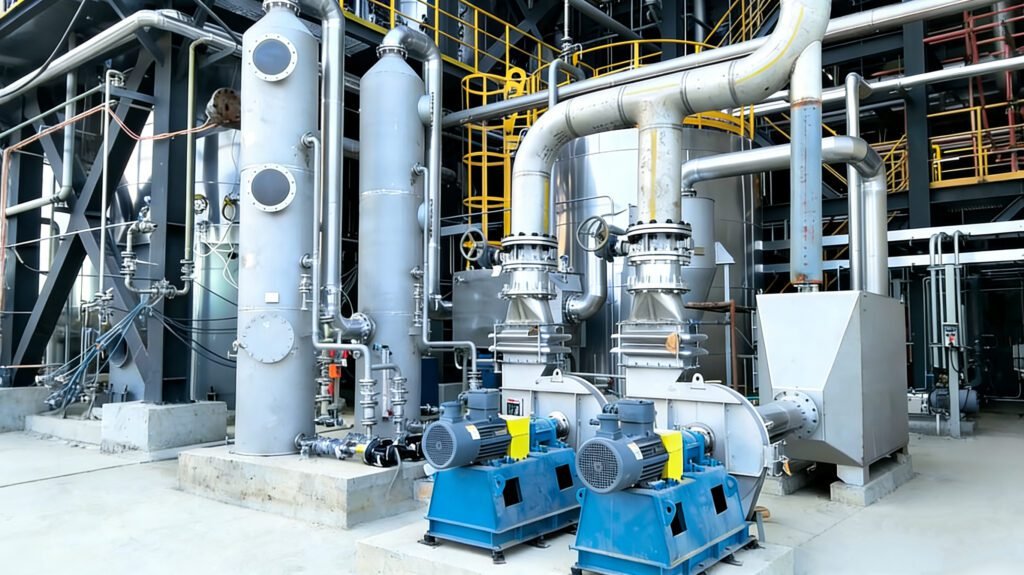
Bio-chemical Manufacturer — Fermentation Odor (Lactic Acid & Lactide) Treatment
| Pollutants | Lactic Acid, L-Lactide, Organic Vapors |
|---|---|
| Industry | Bio-chemical / Fermentation Processing |
| Gas Flow Rate | 8,000 m³/h |
| Treatment Process | Water Washing → Alkaline Scrubbing → Condensation → Mist Elimination → Activated Carbon Adsorption |
| Removal Efficiency | 98% |
A bio-chemical production facility processing fermentation products, discharging exhaust gases rich in lactic acid vapor and L-lactide — both characterized by intensely pungent sour odors detectable at extremely low concentrations. The odor intensity from these compounds frequently triggers community complaints despite compliance with conventional emission standards. Our multi-stage treatment chain begins with a water washing tower to capture water-soluble lactic acid through absorption, followed by an alkaline scrubber for enhanced removal of partially soluble organic acids. A condensation stage recovers condensable lactide vapors, reducing the load on downstream treatment units. A mist eliminator removes entrained liquid droplets before the final activated carbon polishing stage captures any trace residual organics. This five-stage cascade configuration ensures that even the most odorous compounds are effectively removed, addressing both regulatory compliance and community odor nuisance concerns.
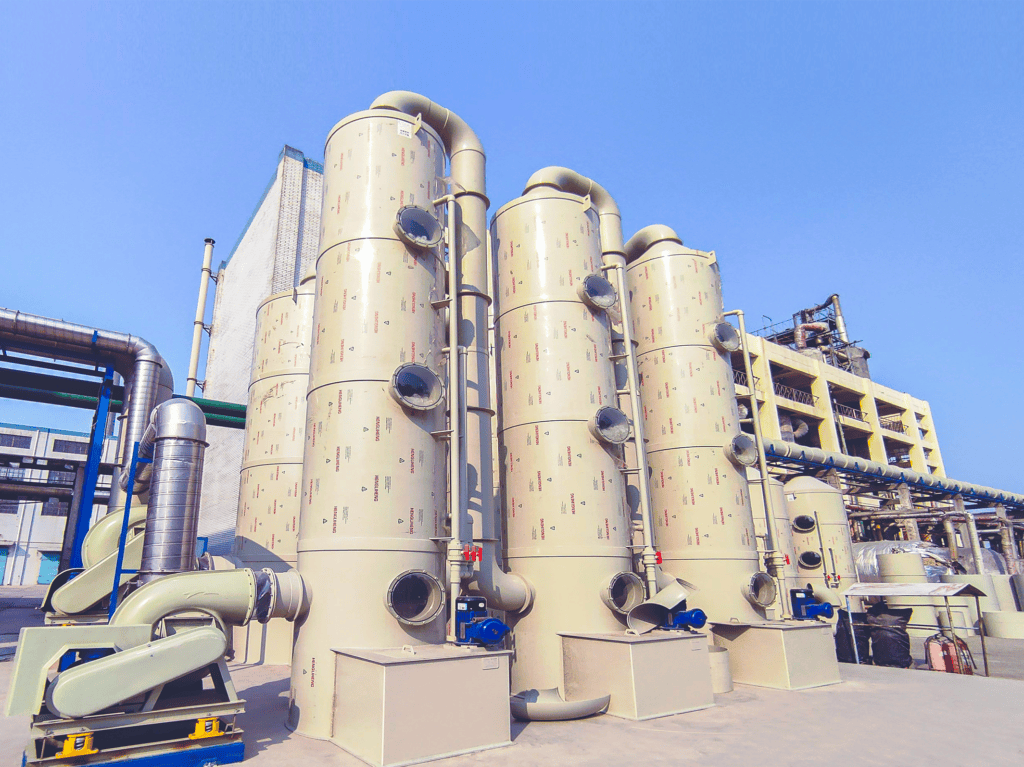
Pharmaceutical Manufacturer — Solvent Odor & Acid Fume Combined Treatment
| Pollutants | Acetone, Butanol (n-Butanol), HCl, Dust |
|---|---|
| Industry | Pharmaceutical Manufacturing |
| Gas Flow Rate | 30,000 m³/h |
| Treatment Process | Multi-Stage Low-Humidity Water Washing → Pre-Treatment → Zeolite Rotor Concentration → CO Catalytic Combustion |
| Removal Efficiency | 99% |
A pharmaceutical manufacturing plant’s production workshop emitting a challenging mixture of strongly odorous solvents (acetone, n-butanol) alongside hydrochloric acid fumes and particulate matter. Acetone and butanol are particularly problematic due to their extremely low odor detection thresholds — community complaints were the primary driver for this project rather than regulatory non-compliance. The high solvent concentration necessitated a concentration-recovery approach rather than direct destruction. Our solution employs multi-stage low-humidity water washing to remove water-soluble components including HCl and capture coarse dust, followed by pre-filtration to protect downstream equipment. The heart of the system is a zeolite rotor concentrator that adsorbs VOCs from the dilute 30,000 m³/h stream and desorbs them into a concentrated stream treated by catalytic combustion (CO) for thermal destruction. This hybrid approach dramatically reduces operating costs compared to direct thermal oxidation of the full flow volume while achieving complete odor elimination.
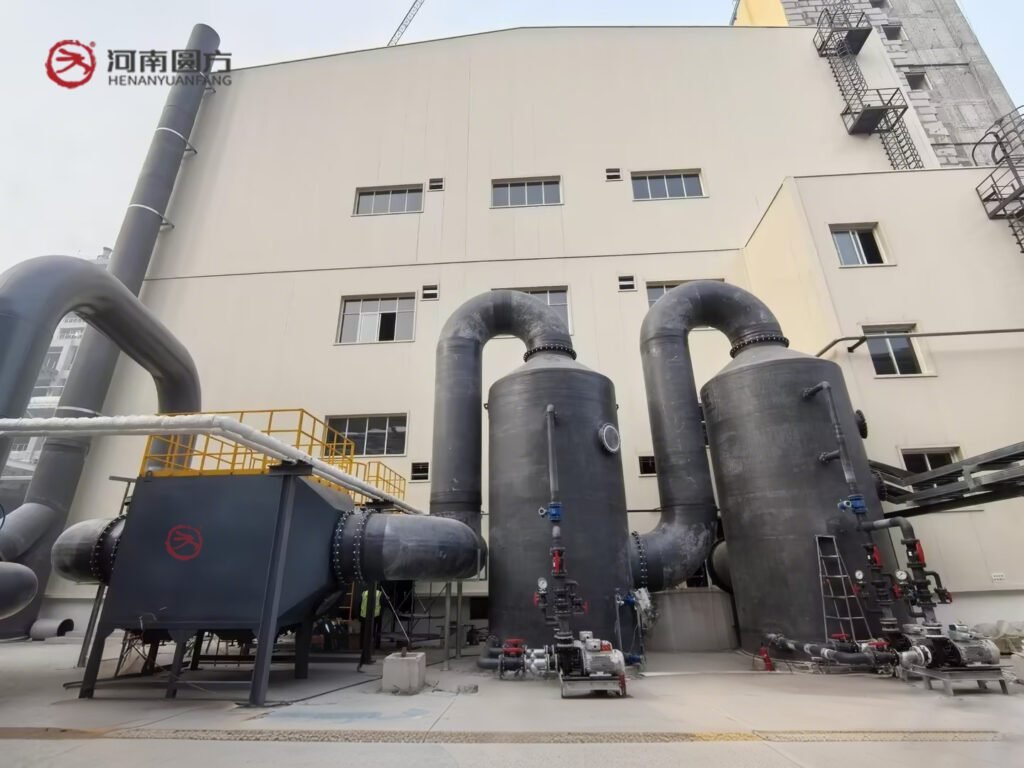
Chemical Group — Ammonia & Multi-Pollutant Odor Control System
| Pollutants | Dust / Particulates, Ammonia (NH₃), VOCs |
|---|---|
| Industry | Chemical Processing / Manufacturing |
| Gas Flow Rate | 57,000 m³/h |
| Treatment Process | Cyclonic Scrubber (Cyclone Tower) → Packed Bed Scrubber (Filling Tower) → Activated Carbon Adsorption |
| Removal Efficiency | 97% |
A large chemical group’s production facility generating substantial exhaust volumes containing ammonia — one of the most recognizable and offensive industrial odors with its characteristic pungent, irritating smell detectable at parts-per-billion levels — along with particulate matter and various VOCs from multiple process lines. At 57,000 m³/h, this represents one of our higher-capacity odor treatment installations. The treatment train begins with a cyclonic scrubber that simultaneously removes coarse dust particles through centrifugal separation while initiating contact between the gas stream and scrubbing liquid for partial ammonia absorption. The packed bed scrubber that follows provides the primary odor removal stage, where a carefully selected scrubbing solution chemically reacts with and absorbs dissolved ammonia with very high efficiency. Finally, activated carbon adsorbers serve as the polishing stage for any residual VOCs and trace odorants that may have escaped the wet scrubbing stages. The combination of cyclonic and packed-bed technologies offers robust performance across the wide range of pollutant types present in this complex industrial exhaust.
These successful implementations demonstrate how YFEP’s industrial odor control solutions address diverse odor challenges across multiple industries. For facilities facing different gas treatment needs, explore our related solutions:
• If your facility deals with acidic or alkaline exhaust gases (HCl, SO₂, HF, NOx), our acid alkali waste gas treatment solutions feature custom wet scrubbers achieving 95–99.9% removal efficiency.
• For comprehensive odor engineering services including equipment supply, installation, and maintenance, visit our industrial odor control services and equipment page.
• When volatile organic compounds are the primary concern, our VOCs treatment solutions integrate adsorption, condensation, and thermal oxidation technologies.
• Browse our complete air pollution control product catalog including scrubbers, towers, filters, and custom-engineered units for all industrial gas treatment applications.
• Learn the fundamentals of scrubber technology in our expert guide: What Is a Wet Scrubber and How Does It Work?.
Contact our engineering team today for a free site assessment and customized industrial odor control solution recommendation.
For authoritative info on hydrogen sulfide (H₂S) — the primary odorous compound in wastewater and food processing — see the OSHA Hydrogen Sulfide Overview.
Facing Persistent Odor or Malodor Complaints?
Tell us about your odor source, composition, and emission characteristics. Our engineering team will design a tailored deodorization solution and provide a preliminary proposal within 24 hours.
Frequently Asked Questions About Industrial Odor Control Solutions
What types of industrial odors can your solutions treat?
Our industrial odor control solutions handle hydrogen sulfide (H₂S), ammonia (NH₃), mercaptans, volatile organic compounds (VOCs), organic acids, amines, and complex mixed malodors commonly found in wastewater treatment, food processing, landfills, pharmaceutical manufacturing, pulp mills, and chemical plants. Each case above demonstrates our experience with specific odor categories — we match technology to your exact odor profile.
Which odor control technology is best for my facility?
The best technology depends on four factors: (1) odor compound type and concentration (ppm level), (2) airflow volume (m³/h), (3) available space, and (4) budget. Biofilters excel at biodegradable odors (H₂S, NH₃) with low operating costs. Chemical scrubbers work best for high-concentration acidic gases (HCl, SO₂, HF). Activated carbon adsorption handles low-concentration VOCs and intermittent odors. Many of our projects use hybrid systems combining two or more technologies for optimal results — see Case 4 (Solvent + Acid Combined) and Case 5 (Ammonia + Multi-Pollutant) as examples.
What removal efficiency can I expect from industrial odor control solutions?
Properly designed industrial odor control solutions achieve 95–99.9% removal efficiency. Our project track record includes: 98% HCl/SO₂ removal (Case 1), 96% solvent VOC recovery (Case 2), 97% fermentation odor elimination (Case 3), 95% solvent+acid combined removal (Case 4), and 99% ammonia removal (Case 5). Actual performance depends on proper sizing, inlet concentration, and regular maintenance.
How long does it take to design and install an industrial odor control system?
Typical project timeline: (1) Free site assessment and odor sampling — 1–2 weeks, (2) Custom system design and proposal — 1 week, (3) Equipment fabrication — 4–8 weeks depending on complexity, (4) Installation and commissioning — 1–3 weeks. Total lead time from first contact to operational system is typically 7–14 weeks. Emergency fast-track options are available for facilities facing immediate regulatory pressure or community complaints.