
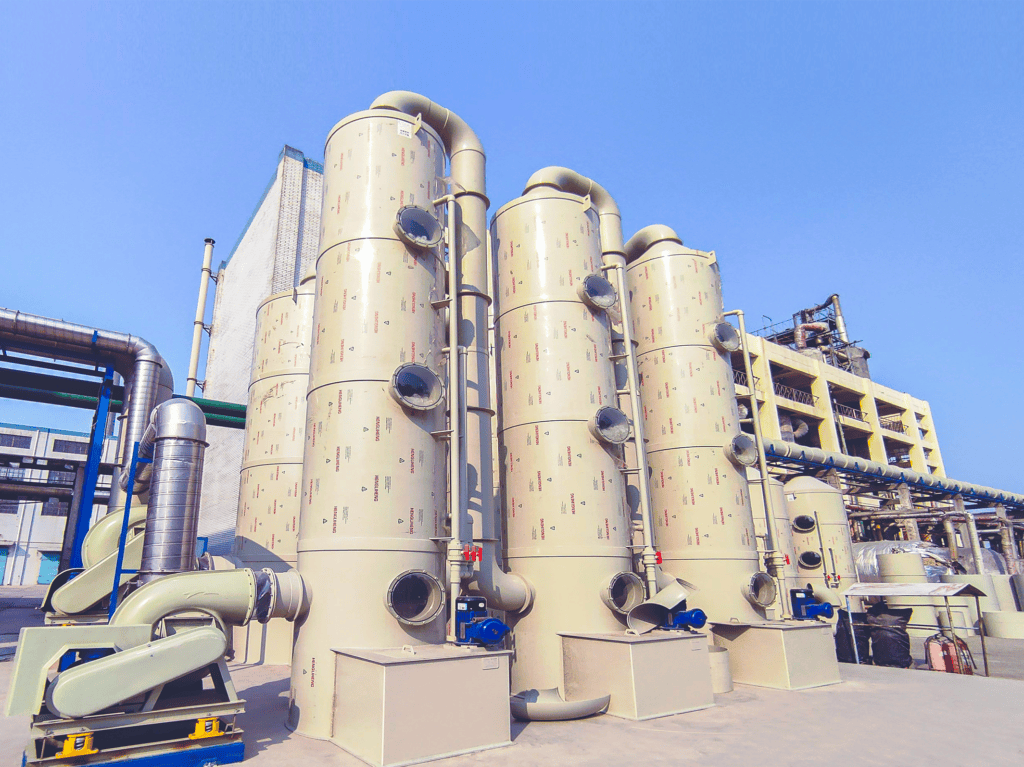
If you are specifying air-pollution control for a chemical, pharmaceutical or wastewater plant, the wet scrubber is almost certainly on your shortlist. This guide breaks down what it is, how it actually works, the main types, and — just as important — what it can and cannot pull out of your exhaust stream.
On this page
1. Wet Scrubber Definition
A wet scrubber is an air pollution control device that removes harmful contaminants — acid gases, dust, soluble VOCs and odorous compounds — from an industrial exhaust stream by bringing the dirty gas into close contact with a liquid (most commonly water, often dosed with a chemical reagent).
You will also hear it called a wet air scrubber, wet gas scrubber, gas scrubbing system or just a scrubber. The name changes; the job does not. In plain terms, the contaminant transfers from the gas phase into the liquid phase, where it is neutralized, dissolved or physically captured. That transfer step is the whole game.
Wet scrubbers earn their keep because one unit can attack both gaseous and particulate pollutants at once — a trick many dry systems cannot pull off.
2. How Does a Wet Scrubber Work?
If you have ever asked “how does a wet scrubber work?”, the short version is: dirty gas meets a sprayed or flowing liquid, pollutants move from the gas into that liquid, the cleaned gas leaves the top, and the now-polluted liquid collects at the bottom.
The sequence is straightforward:
- Gas entry. Polluted process exhaust enters the scrubber vessel (usually from the bottom or side).
- Liquid contact. A pump pushes scrubbing liquid to nozzles or a distributor, forming a fine spray, falling film or wetted packing surface.
- Pollutant capture. As gas passes through the contact zone, contaminants are absorbed into the liquid, react with a reagent, or are knocked out of the gas by impaction on droplets.
- Mist removal. A demister (mist eliminator) strips tiny liquid droplets from the cleaned gas before it exits the stack.
- Liquid recirculation / treatment. The polluted liquid drains to a sump or tank, where reagent is dosed and (in many plants) the spent liquor is partly treated and recirculated.
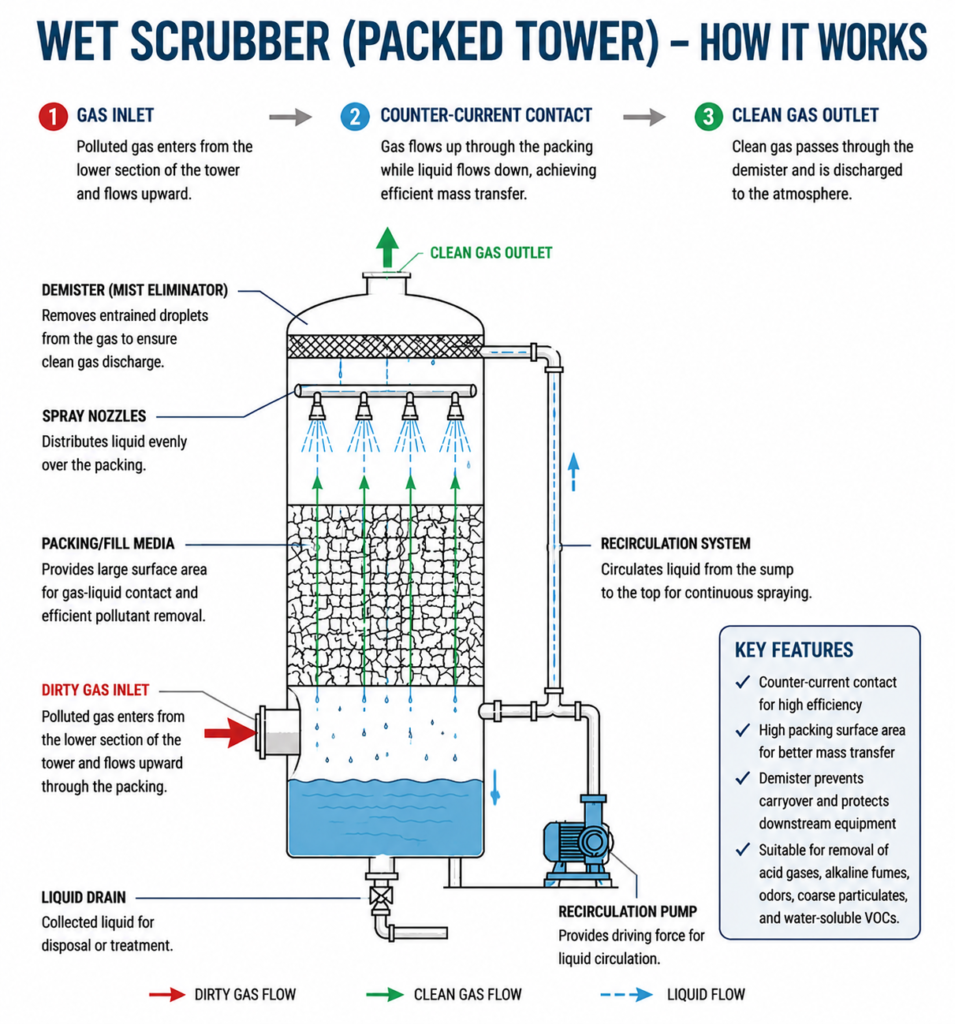
The mental model that matters: a wet scrubber does not “filter” gas the way a baghouse traps dust. It moves the pollutant from the air into the liquid — that is mass transfer. Everything in the design (packing height, spray angle, gas velocity, liquid-to-gas ratio) exists to maximize contact area, because more contact means more removal.
3. Wet Scrubber Working Principle
The wet scrubber working principle rides on three physical and chemical mechanisms working together:
a) Absorption (gas dissolving into liquid)
Soluble gases (HCl, SO₂, NH₃, Cl₂) dissolve directly into the water film. When a reagent is present, the reaction runs to completion — hydrochloric acid gas, for instance, is neutralized by sodium hydroxide:
HCl (gas) + NaOH (liquid) → NaCl + H₂O
This is why acid-gas scrubbers almost always run alkaline: the reagent keeps the absorption gradient steep and stops the liquid from saturating.
b) Inertial impaction & interception (for dust/particles)
Fine droplets act like flypaper for particles. As gas streamlines bend around a droplet, the heavier particles cannot follow the curve, hit the droplet and stick. Smaller, higher-energy contact zones (such as a venturi throat) sharply raise particle-collection efficiency.
c) Diffusion (for sub-micron and odorous molecules)
Very small pollutant molecules wander randomly to the liquid surface and are absorbed. More contact time and surface area improve this mechanism.
In short: the more gas–liquid contact area, the higher the removal efficiency. That single principle explains nearly every design choice — packing height, nozzle spray angle, gas velocity and liquid-to-gas ratio.
4. Main Components of a Wet Scrubber
- Scrubber vessel / shell — the tower body, sized for gas flow and residence time.
- Contact zone — packing, trays, a venturi throat or spray bank where gas meets liquid.
- Liquid distributor / nozzles — create even spray coverage (poor distribution = dead zones = lost efficiency).
- Recirculation pump & tank — move and store the scrubbing liquor.
- Reagent dosing system — feeds NaOH, Na₂CO₃, lime or acid to match the target pollutant.
- Mist eliminator (demister) — removes entrained droplets from the clean exhaust.
- Induced-draft / centrifugal fan — pulls or pushes gas through the system.
5. Types of Wet Scrubbers
Different contact designs suit different pollutants. The common types:
Packed-bed (packed-tower) scrubber
Gas rises through a bed of plastic or ceramic packing wetted by descending liquid. Excellent for acid-gas absorption (HCl, SO₂, HF, Cl₂) and odor. This is the workhorse for chemical and pharmaceutical exhaust.
Venturi scrubber
Gas is accelerated through a narrow throat where liquid is atomized into a fine mist. Outstanding for fine particulate and dust (metal fumes, pigment dust). Higher pressure drop, but very high efficiency.
Spray tower
Simple, open chamber with spray nozzles. Good for coarse dust and cooling hot gas; lower efficiency on difficult gases but cheap and robust.
Tray / plate scrubber
Gas bubbles through successive liquid layers on perforated trays. Good contact and easy to scale for large gas volumes.
Cyclonic / centrifugal scrubber
Swirling gas throws particles outward onto a wetted wall. Compact, often used for gritty or high-load dust streams.
Most industrial systems are packed-bed or venturi designs, and many plants combine them — for instance, a venturi pre-scrubber for dust followed by a packed tower for acid gas.
6. What Pollutants Can a Wet Scrubber Remove?
| Pollutant group | Examples | Typical removal |
|---|---|---|
| Acid gases | HCl, SO₂, HF, Cl₂, HBr | 95–99% (with alkaline reagent) |
| Alkaline / odorous gases | NH₃, amines, H₂S, mercaptans | 90–99% (with acidic reagent) |
| Particulate matter / dust | Metal fumes, pigment, process dust | Up to 99% (venturi) |
| Soluble VOCs | Alcohols, amines, some ketones | Moderate (absorption-limited) |
| Odor | Sulfur compounds, amines | High (with reagent) |
NOₓ caveat: Conventional wet scrubbers remove nitrogen oxides poorly. NO — the bulk of NOₓ — is nearly insoluble and needs oxidation or catalytic treatment (SCR/SNCR), not absorption (see EPA Emission Control Technologies, Ch. 5). If NOₓ is in your stream, plan a dedicated NOₓ stage rather than expecting the scrubber to handle it. Separately, hydrophobic VOCs (benzene, toluene) are also poorly absorbed in water alone; pair the scrubber with an activated-carbon adsorber or condenser.
7. Applications & Industries
- Chemical & petrochemical — HCl, Cl₂, SO₂ and solvent recovery vents.
- Pharmaceutical — reactor and drying exhaust, odorous amine streams.
- Metal finishing & plating — acidic fumes from pickling and etching.
- Waste-to-energy / incineration — acid-gas cleaning of flue gas.
- Wastewater & sewage — H₂S and NH₃ odor control at treatment plants.
- Food & beverage — cooking and process odor abatement.
8. Materials of Construction
Because a wet scrubber stays wet and chemically active, the shell material must resist corrosion. Common choices:
- Polypropylene (PP) / PPH — light, cost-effective, excellent for most acid-gas duties.
- PVC & CPVC — rigid, good chemical resistance; ideal for many scrubber shells and ductwork.
- FRP (fiberglass-reinforced plastic) — strong, corrosion-proof, good for large towers.
- Stainless steel / special alloys — used where high temperature or chlorine demands it.
Our PVC and PP wet scrubbers and full acid & alkali treatment equipment are engineered for continuous-duty acidic and alkaline exhaust — explore the product pages for specifications and material options.
9. How to Choose the Right Wet Scrubber
Selection starts with the pollutant profile, not the hardware. Ask:
- What is the contaminant? Gas vs. particle vs. both dictates packed-bed vs. venturi.
- What reagent chemistry? Match alkaline or acidic dosing to the gas.
- What gas flow & concentration? Sets vessel diameter, packing height and fan power.
- What discharge rules apply? Local VOC and acid-gas emission limits set the target efficiency.
- Wastewater handling. Plan for spent-liquor neutralization and sludge.
For a step-by-step walkthrough with design calculations, see our companion guide: Acid Gas Scrubber Selection Guide: HCl, SO₂, NOₓ, HF Removal.
For a plant operating in multiple jurisdictions, a wet scrubber is usually one stage within a larger compliance train rather than a standalone solution. For the full picture on VOC emission standards comparison — EU BAT-AELs, US NESHAP DRE, and Chinese GB caps — see our 2026 guide.
10. Frequently Asked Questions
What is the difference between a wet and dry scrubber?
A wet scrubber uses a liquid (usually water with a reagent) to capture pollutants, while a dry scrubber injects a dry sorbent powder or uses a dry adsorbent bed. Wet systems handle both gases and particulates and tolerate high humidity, but generate wastewater; dry systems produce a dry waste stream and are common for flue-gas desulfurization and some VOC control.
What liquid is used in a wet scrubber?
Most wet scrubbers use water. For acid-gas removal the water is dosed with an alkaline reagent such as sodium hydroxide (NaOH), sodium carbonate (Na₂CO₃), lime (Ca(OH)₂) or magnesium hydroxide. The reagent is selected from the target pollutant.
Can a wet scrubber remove VOCs?
Wet scrubbers can remove water-soluble VOCs (e.g. alcohols, amines, some ketones) by absorption, but are generally less effective on hydrophobic VOCs. For broad VOC abatement, wet scrubbing is often paired with activated-carbon adsorption or condensation.
What removal efficiency can a wet scrubber achieve?
Well-designed packed-bed scrubbers typically achieve 95–99% removal on soluble acid gases such as HCl and Cl₂, and venturi scrubbers can reach 99% on fine particulates. Actual efficiency depends on gas-liquid contact area, liquid-to-gas ratio, residence time and reagent selection.11
References
- U.S. EPA — Monitoring by Control Technique: Wet Scrubber for Gaseous Control (packed-bed scrubbers; 95–99% on inorganic gases).
- U.S. EPA — Emission Control Technologies, Chapter 5 (SCR/SNCR listed as the standard NOₓ control, not wet scrubbing).
Need a wet scrubber for your plant?
YF-EP designs and manufactures PVC & PP wet scrubbers, acid & alkali treatment systems, HCl absorption units and VOC abatement equipment for chemical, pharmaceutical and wastewater plants worldwide. Talk to our engineers for a selection and quote.