
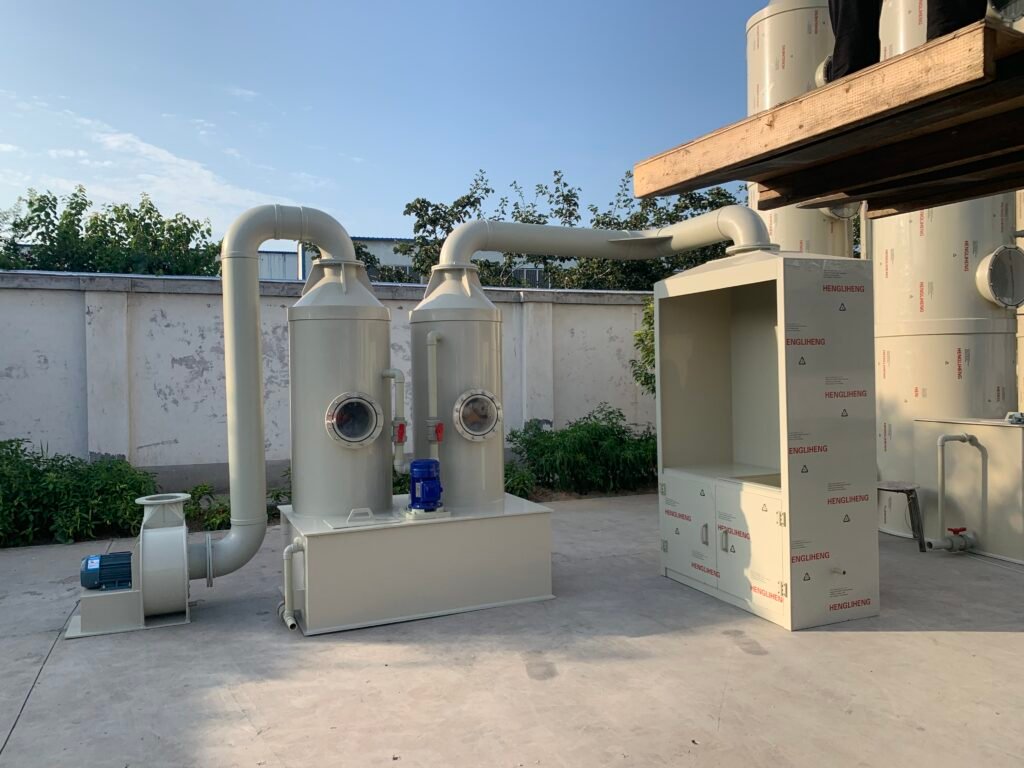
- 1. Product Overview: YF-LAB-2000 Laboratory Exhaust Scrubber
- Basic Product Information
- 2. Centralized Exhaust Treatment for Multiple Fume Hoods
- How Does the Centralized System Work?
- Important Design Considerations
- 3. Wet Scrubbing Process for Laboratory Acid Fumes
- Packed Scrubber Tower
- Circulation Liquid System
- Mist Elimination
- Exhaust Fan
- 4. Acidic Exhaust Gas Applications
- Hydrochloric Acid (HCl) Exhaust
- Hydrofluoric Acid (HF) Exhaust
- Nitric Acid (HNO3) Exhaust
- Mixed Acid Exhaust
- 5. Standardized Skid-Mounted Laboratory Exhaust Scrubber with Customized Engineering
- Optional Configuration
- 6. Skid-Mounted Design for Easier Installation
- 7. How to Select the Right Laboratory Exhaust Scrubber
- 8. Why Choose YF-EP for Laboratory Exhaust Treatment Equipment?
- 9. Frequently Asked Questions
- 10. Request a Laboratory Exhaust Scrubber Proposal
Skid Mounted Laboratory Exhaust Scrubber
Centralized Acid Fume Treatment for Multiple Laboratory Fume Hoods
Chemical laboratories require reliable exhaust ventilation and appropriate air pollution control to manage hazardous gases generated during experiments, sample preparation, chemical digestion, and testing.
When multiple fume hoods operate within the same laboratory facility, a centralized laboratory exhaust treatment system can provide an integrated solution for collecting and treating contaminated air.
The YF-LAB-2000 Skid-Mounted Laboratory Exhaust Scrubber is a standardized equipment platform under development by Henan Yuanfang Environmental Protection Equipment Co., Ltd. (YF-EP). With a reference design airflow of 2,000 m³/h, it is intended for selected laboratory acid fume treatment applications involving hydrochloric acid (HCl), hydrofluoric acid (HF), nitric acid (HNO3), and other compatible acidic exhaust streams.
The packaged equipment concept integrates a wet scrubber tower, circulation system, exhaust fan, piping connections, and electrical control components on a common skid structure.
The final equipment configuration is engineered according to actual gas composition, inlet concentration, operating conditions, and required emission limits.
1. Product Overview: YF-LAB-2000 Laboratory Exhaust Scrubber
The YF-LAB-2000 is designed around a standardized mechanical platform with configurable process components.
Its purpose is to simplify equipment manufacturing, transportation, installation, and maintenance while retaining the flexibility required for different laboratory exhaust applications.
Basic Product Information
| Item | Description |
|---|---|
| Product Model | YF-LAB-2000 |
| Equipment Type | Skid-Mounted Laboratory Exhaust Scrubber |
| Reference Design Airflow | 2,000 m³/h |
| Main Treatment Process | Packed-Bed Wet Scrubbing |
| Primary Applications | Laboratory Acid Fume Treatment |
| Typical Pollutants | HCl, HF, HNO3 and selected compatible acidic exhaust streams |
| Tower Material | PP / PPH or other suitable materials |
| Installation Type | Skid-Mounted Package |
| Control System | Customized Electrical Control System |
| Configuration | Engineered to Project Requirements |
Note: The above describes the product development platform. Final dimensions, materials, equipment specifications, and performance guarantees will be determined after engineering evaluation and validation.
2. Centralized Exhaust Treatment for Multiple Fume Hoods
The YF-LAB-2000 is intended for laboratory facilities where exhaust from multiple fume hoods is collected and conveyed to a common treatment unit.
A typical centralized laboratory exhaust system includes:
- Laboratory fume hoods
- Individual exhaust branch ducts
- Main exhaust duct
- Wet scrubber tower
- Circulation pump and liquid tank
- Mist eliminator
- Corrosion-resistant exhaust fan
- Treated gas discharge duct
- Electrical control and monitoring system
How Does the Centralized System Work?
Exhaust air generated inside each fume hood is collected through individual branch ducts and conveyed into the main exhaust duct.
The combined exhaust stream enters the wet scrubber, where it contacts circulating absorbent liquid through a packed-bed and spray distribution system.
Target pollutants transfer from the gas phase into the liquid phase, subject to their chemical properties and the selected absorption process.
A mist eliminator is installed downstream of the scrubbing section to reduce liquid droplet carryover.
The treated gas is then conveyed by the exhaust fan to the designated discharge point.
Important Design Considerations
Connecting multiple fume hoods to one treatment system requires more than simply adding up the airflow ratings.
The engineering design should evaluate:
- Number and size of connected fume hoods
- Individual exhaust airflow requirements
- Simultaneous operating conditions
- Main duct and branch duct resistance
- Airflow balancing and pressure distribution
- Compatibility of mixed exhaust gases
- Fan operating point and total system pressure drop
Certain chemicals and incompatible exhaust streams may require separate collection and treatment systems. High-risk or special applications must be assessed before connection to a common exhaust duct.
3. Wet Scrubbing Process for Laboratory Acid Fumes
Wet scrubbing is a commonly used treatment technology for selected water-soluble acidic gases and acid mists.
The YF-LAB-2000 platform uses a packed-bed wet scrubber concept to establish gas-liquid contact.
Its main process components include:
Packed Scrubber Tower
The scrubber tower provides the main gas-liquid contact area.
Depending on the application, the tower may incorporate:
- Chemical-resistant packing
- Packing support grids
- Spray nozzles and distribution pipes
- Mist eliminator
- Gas inlet and outlet connections
- Inspection and maintenance openings
Packing type, tower diameter, packing height, and spray arrangement are selected according to gas velocity, mass transfer requirements, pressure drop, and liquid distribution.
Circulation Liquid System
The circulation system delivers absorbent liquid to the spray section.
Its configuration can include:
- Chemical-resistant circulation pump
- Liquid storage tank or integrated sump
- Spray distribution piping
- Valves and fittings
- Liquid level monitoring
- pH and circulation flow monitoring where required
The circulation flow rate and pump head must be calculated according to the process design rather than selected solely from the nominal airflow.
Mist Elimination
A mist eliminator helps reduce liquid droplets carried out of the scrubber.
Its design should consider gas velocity, droplet characteristics, liquid loading, and allowable pressure drop.
Exhaust Fan
The exhaust fan is selected based on the required operating airflow and total system resistance.
The calculation should include the scrubber, mist eliminator, ductwork, fittings, and other connected components.
4. Acidic Exhaust Gas Applications
Different acidic pollutants have different chemical properties and treatment requirements. A suitable laboratory acid fume scrubber must therefore be configured according to the actual exhaust composition.
Hydrochloric Acid (HCl) Exhaust
HCl-containing exhaust may be generated during acid preparation, chemical testing, and sample digestion.
Wet scrubbing with a suitable absorbent is a potential treatment method.
Design considerations include inlet concentration, gas temperature, liquid-to-gas ratio, absorbent chemistry, and the required outlet concentration.
Hydrofluoric Acid (HF) Exhaust
HF applications require particular attention to material compatibility and chemical safety.
Tower materials, packing, spray components, pumps, valves, and piping must be evaluated for the specific HF concentration and operating conditions.
Material selection should not be based on general acid resistance alone.
Nitric Acid (HNO3) Exhaust
Nitric acid processes may generate acid mist and nitrogen-containing exhaust components.
The treatment design must distinguish between nitric acid mist and gaseous nitrogen oxides (NOx).
These pollutants have different treatment characteristics, and a conventional acid mist scrubber should not automatically be considered suitable for all NOx-containing exhaust streams.
Mixed Acid Exhaust
Some laboratories generate exhaust containing several acidic compounds.
For mixed acid applications, YF-EP evaluates:
- Individual pollutant concentrations
- Maximum combined pollutant loading
- Gas temperature and humidity
- Chemical compatibility
- Potential reactions between exhaust components
- Absorbent selection
- Required emission limits
The final treatment process and equipment materials are determined according to the engineering assessment.
5. Standardized Skid-Mounted Laboratory Exhaust Scrubber with Customized Engineering
One of the main development objectives of YF-LAB-2000 is to combine standardized manufacturing with application-specific process design.
Not every laboratory requires an entirely new equipment structure. However, critical process parameters must be adjusted to meet the actual treatment requirements.
| Standardized Equipment Modules | Parameters Requiring Engineering Evaluation |
|---|---|
| Skid base and equipment arrangement | Overall dimensions and loading |
| Main tower structural platform | Tower diameter and height |
| Standard connection interfaces | Packing type and packing height |
| Basic piping arrangement | Circulation flow and pump head |
| Electrical control architecture | Monitoring and interlock requirements |
| Maintenance access structure | Inspection and cleaning requirements |
| Equipment assembly procedures | Material compatibility and corrosion protection |
This modular approach helps improve manufacturing consistency and allows YF-EP to develop different configurations using a common equipment platform.
Optional Configuration
Depending on the project requirements, the system may be equipped with:
- Automatic chemical dosing
- pH monitoring and control
- Differential pressure monitoring
- Circulation flow monitoring
- Liquid level alarms
- Variable-frequency fan control
- Additional treatment stages where technically required
Optional functions are selected according to process requirements and project specifications.
6. Skid-Mounted Design for Easier Installation
The YF-LAB-2000 adopts a packaged skid-mounted equipment concept.
Major equipment components can be arranged on a common supporting base to simplify factory assembly and on-site installation.
Potential advantages include:
Factory Assembly
Major equipment and piping components can be pre-installed and inspected before shipment.
Simplified Site Connections
Standardized connection interfaces help organize connections between the packaged equipment and external ductwork, utilities, and drainage systems.
Compact Equipment Arrangement
The equipment layout is developed with consideration for available installation space, maintenance access, and transportation limitations.
Maintenance Accessibility
Pumps, valves, spray systems, and other serviceable components should be arranged to facilitate inspection and maintenance.
The final skid dimensions, total weight, lifting points, and transportation configuration are confirmed during detailed engineering.
7. How to Select the Right Laboratory Exhaust Scrubber
Before specifying a 2,000 m³/h laboratory exhaust treatment system, the following technical information should be provided.
1. Exhaust Airflow
Provide the required total airflow and individual fume hood airflow.
2. Number of Fume Hoods
Identify how many fume hoods will be connected and whether they operate simultaneously.
3. Exhaust Gas Composition
List all expected pollutants, such as HCl, HF, HNO3, acid mist, alkaline gases, and other compounds.
4. Inlet Concentration
Provide normal and maximum pollutant concentrations whenever available.
5. Operating Temperature and Humidity
These parameters influence equipment material selection and treatment performance.
6. Required Outlet Emission Limits
Specify the applicable local environmental regulations and project emission requirements.
7. Installation Conditions
Provide the available equipment space, ductwork layout, electrical supply, water supply, and drainage conditions.
With this information, YF-EP can evaluate the suitable equipment configuration and prepare a technical proposal.
8. Why Choose YF-EP for Laboratory Exhaust Treatment Equipment?
Henan Yuanfang Environmental Protection Equipment Co., Ltd. (YF-EP) is an environmental protection equipment manufacturer specializing in industrial waste gas treatment equipment and engineering solutions.
Our manufacturing and engineering capabilities include:
- PP and PPH wet scrubber manufacturing
- Acid and alkaline exhaust gas treatment equipment
- Corrosion-resistant chemical tanks and piping systems
- Customized industrial exhaust treatment equipment
- Equipment assembly and project engineering support
- Application-based material and process selection
We focus on practical equipment design, corrosion resistance, manufacturing quality, and maintainability.
For laboratory exhaust applications, our approach is to evaluate the actual operating conditions before determining the appropriate treatment configuration.
9. Frequently Asked Questions
Q1: Can one 2,000 m³/h scrubber serve multiple laboratory fume hoods?
Yes, provided that the combined design airflow, ductwork resistance, simultaneous operating conditions, airflow balance, and exhaust gas compatibility are properly evaluated.
Q2: Can the YF-LAB-2000 treat HCl, HF, and HNO3?
The platform is intended for selected acidic exhaust applications involving these pollutants. However, the process configuration and materials must be evaluated individually. Different pollutants may require different absorbents, materials, and operating conditions.
Q3: Is a wet scrubber suitable for VOC exhaust?
Not necessarily. Conventional wet scrubbing is suitable for selected water-soluble gases and certain mists. Many VOC applications require other treatment technologies, such as activated carbon adsorption or thermal oxidation, depending on the compounds and operating conditions.
Q4: Can the system be customized?
Yes. The standardized platform can be adapted through engineering changes to equipment dimensions, materials, process components, pump specifications, fan selection, and control functions.
Q5: What is the actual treatment efficiency?
Treatment efficiency depends on pollutant composition, inlet concentration, gas-liquid contact conditions, absorbent chemistry, and equipment design. A specific performance guarantee must be established through engineering calculations and agreed verification tests.
Q6: What information is required for a quotation?
Please provide the design airflow, number of fume hoods, exhaust gas composition, inlet concentration, operating temperature, target outlet limits, installation space, and project location.
10. Request a Laboratory Exhaust Scrubber Proposal
Are you planning a new chemical laboratory or upgrading an existing fume hood exhaust treatment system?
YF-EP welcomes inquiries from laboratory owners, engineering contractors, laboratory equipment suppliers, and EPC companies.
Send us your laboratory exhaust specifications, and our engineering team can evaluate a suitable treatment configuration.
Henan Yuanfang Environmental Protection Equipment Co., Ltd. (YF-EP)
WE ENGINEER CLEAN INDUSTRY.