
VOCs Treatment Methods Compared: A Practical Selection Guide for Industrial Engineers
Choosing the wrong abatement train can cost a chemical plant six figures in penalties and rework. That is the real stakes behind any VOCs treatment methods compared exercise: you are not picking equipment, you are betting the plant’s permit on a process decision. VOC abatement is the engineering practice of reducing volatile organic compound emissions from industrial exhaust to permitted levels. It uses recovery methods (adsorption, absorption, condensation) or destruction methods (thermal/catalytic oxidation, biological treatment), selected by concentration, airflow, and the compound’s physicochemical properties.
This guide puts the major VOC treatment methods side by side so you can read the whole field in one table, then drills into the trade-offs that actually decide compliance and cost. If you already have your stream’s concentration and airflow measured, our process engineers can pressure-test your shortlist before you size anything — see our custom engineering services.
Key takeaways
– No single technology wins. The right call is set by three variables: concentration, airflow, and physicochemical properties (solubility, adsorbability, halogen/sulfur/silicon content).
– Wet scrubbers and falling film absorbers are pretreatment, not primary VOC destruction. They work on water-soluble and acidic fractions only; a scrubber alone will not meet a strict VOC limit.
– Activated carbon adsorption and absorption are the methods we engineer and supply. They are the compliant answer for easily-adsorbed VOCs and for water-soluble/acidic VOC streams respectively.
– High-temperature oxidation (RTO/RCO) and zeolite concentration are listed for objective comparison only — these are not products we offer.
– The compliant train for many chemical and pharmaceutical vents is pretreatment (scrubber/absorber) + activated carbon polishing.
Here is the failure mode we keep seeing, and it frames everything below. A mid-size chemical producer commissioned a single wet scrubber on a mixed vent carrying both water-soluble HCl and poorly soluble aromatic VOCs. The scrubber knocked the acid down cleanly. The aromatics sailed straight through. The first quarterly stack test failed, the regulator issued a penalty plus a corrective-action order, and the plant had to retrofit an activated carbon polisher downstream under deadline. The lesson is the spine of this article: a scrubber is a pretreatment device, not a VOC permit.
Table of Contents
VOCs Treatment Methods Compared: Quick Comparison Table
The fastest way to read the field is one table. “Best-fit” reflects the concentration and airflow window where each method is economically and technically sound. Efficiency is expressed as destruction-and-removal efficiency (DRE) for oxidative methods and as outlet removal for recovery methods. CAPEX and OPEX are relative.
| Method | Principle | Best-fit (concentration & airflow) | Efficiency | CAPEX | OPEX | Limitation |
|---|---|---|---|---|---|---|
| RTO (Regenerative Thermal Oxidizer) | Thermal oxidation with ceramic heat recovery | High airflow (5,000–500,000 scfm), low–mid conc (often <1,000 ppmv, up to ~25% LEL) | 95–99% DRE | High | Low–Mod (fuel-free at low VOC load) | Needs halogen/Si removal upstream |
| RCO (Regenerative Catalytic Oxidizer) | Catalytic oxidation at lower temperature | Similar to RTO, lower temp duty | 90–99% DRE | High | Lower fuel than RTO | Catalyst poisoning by Si/P/halogens |
| Zeolite Rotor Concentrator | Adsorption concentration of dilute stream | Very high volume, very low conc (pre-concentrate only) | 10–20× concentration; needs downstream oxidizer | High | Mod | Concentrator, not destruction |
| Activated Carbon Adsorption | Physisorption on fixed carbon bed | Low–mid conc, large airflow, easily-adsorbed VOCs | 25–95% (optimized bed >90%) | Mod | Mod (replace/regenerate) | Humidity & halogen sensitivity; spent carbon is hazardous waste |
| Absorption (Wet Scrubber / Falling Film) | Gas–liquid mass transfer | Soluble/acidic VOCs; usually pretreatment | Limited for VOCs (strong on soluble/acidic) | Low–Mod | Low–Mod | Poor for non-soluble VOCs; pretreatment only |
| Condensation | Cooling to dew point | High conc (>5,000–10,000 ppmv), recoverable solvents | 50–95% (conc-dependent) | Mod–High | Low (if waste heat used) | Only economic at high concentration |
| Biological (biofilter/biotrickling) | Microbial degradation | Low conc, biodegradable VOCs, large airflow | 70–95% (compound-dependent) | Low–Mod | Low | Narrow compound range; large footprint; no halogenated |
Sources: EPA Air Pollution Control Technology Fact Sheet — Regenerative Incinerator; Anguil, Overview of Emission Control Technologies; ScienceDirect review on VOC abatement (recovery vs destruction classification). Oxidation and concentration technologies are shown for comparison only and are not supplied by us.
How VOCs Are Classified for Treatment Selection
Before comparing hardware, you have to classify the problem. Industrial VOC control methods split along two axes — what you do to the molecule, and what the molecule is. Get either wrong and the rest of the selection is wasted effort.
Destructive vs Recovery Methods
Add-on control techniques fall into two families — a split that the literature on gaseous VOC abatement, including ScienceDirect reviews, consistently reinforces:
- Destruction methods convert the VOC to CO₂ and H₂O (or simpler species). Thermal oxidation (RTO/RCO), catalytic oxidation, plasma, and biological treatment belong here. They eliminate the compound but consume energy and can form NOₓ or other byproducts.
- Recovery methods separate and concentrate the VOC so it can be reused or disposed of as a stream. Adsorption (activated carbon), absorption (scrubber/falling film), condensation, and membrane separation belong here. They are often more economical and less energy-intensive when the compound has value or is merely separated rather than burned.
The choice between destruction and recovery is your first fork. A recoverable solvent in a pharmaceutical stream usually argues for adsorption or absorption; a poorly recoverable, mixed, dilute vent often argues for oxidation or biological destruction.
The Three Parameters That Decide Everything — Concentration, Airflow, Physicochemical Properties
Every credible selection framework, including Anguil’s emission control handbook, sizes the system around four stream facts: emission constituents, concentration, temperature, and airflow volume. For VOC selection we compress those into three decision drivers:
- Concentration (ppmv or % LEL). Low-concentration, high-volume streams favor adsorption, biological, or concentrated-then-oxidized trains. High-concentration streams make condensation and thermal oxidation economically attractive. Concentration also sets explosion limits — oxidation vendors size to roughly 25% of LEL for safety.
- Airflow (scfm / m³/h). Large airflow pushes you toward low-pressure-drop, high-throughput devices (biofilters, carbon beds, RTO) and away from small, expensive units sized per cubic meter.
- Physicochemical properties. This is where many selections live or die:
- Solubility — water-soluble and acidic VOCs (HCl, ammonia, alcohols, some ketones) are candidates for absorption.
- Adsorbability — non-polar, higher-boiling VOCs (benzene, toluene, xylene, hexane) load well on activated carbon.
- Halogen / sulfur / silicon content — chlorinated VOCs form acid gases in oxidizers and poison RCO catalysts; silicones foul ceramic media. These contaminants dictate pretreatment and sometimes rule oxidation out.
Hold these three parameters. The rest of this article is just applying them.
VOCs Treatment Methods Compared: Method-by-Method Breakdown
Here is where the major VOC abatement technologies get their honest, method-by-method treatment. We lead with the recovery methods we supply, then cover oxidation and concentration technologies for objective comparison.
Thermal & Catalytic Oxidation (RTO / RCO)
Regenerative thermal oxidizers destroy VOCs by heating the stream to roughly 760–1,100°C in a ceramic-packed chamber, recovering heat between cycles. The EPA Air Pollution Control Technology Fact Sheet reports typical regenerative incinerator design efficiencies of 95–99% DRE, with thermal energy recovery around 95–98%. RCO drops the operating temperature to roughly 300–450°C using a precious-metal catalyst, trading catalyst cost and sensitivity for lower fuel use; EPA cites RCO efficiencies in the 90–99% range.
Two cautions matter for chemical and pharmaceutical engineers:
- Halogenated, sulfur-, and silicon-bearing VOCs produce acid gases (HCl, SOₓ) and can poison RCO catalysts or corrode downstream equipment. They demand upstream pretreatment and scrubbing.
- CAPEX is high, though OPEX can be low — an RTO can run fuel-free once the VOC load sustains combustion.
These are powerful, mature technologies. They are also not products we offer; we list them so your comparison is complete and your compliant train can reference them where appropriate.
Zeolite Rotor Concentration
A zeolite rotor concentrator is an adsorption front-end that takes a huge, dilute stream and squeezes it into a small, rich one — typically a 10–20× concentration ratio. The concentrated slip then feeds a smaller, cheaper oxidizer. It is a concentration technology, not a destruction technology: by itself it does nothing to the VOC except move it.
For a plant with very high airflow and very low concentration, a rotor plus oxidizer is often the only economical destructive path. Again, we do not supply rotors or oxidizers; we note them because they frequently sit upstream or downstream of the recovery equipment we do build.
Activated Carbon Adsorption
Activated carbon adsorption is a recovery method that captures VOC molecules on the vast internal surface of a carbon bed by physisorption. It is our core offering for VOC control and the right answer for many low-to-mid concentration, high-airflow streams carrying easily-adsorbed VOCs — aromatics (BTEX), aliphatics, many ketones, and chlorinated solvents.
Performance depends heavily on the compound and conditions. Well-designed fixed-bed systems for favorable VOCs routinely exceed 90% removal; the broader published envelope of 25–95% reflects how strongly results vary with VOC type, bed design, humidity, and contact time. Two sensitivities decide success:
- Humidity. High relative humidity competes for adsorption sites and degrades capacity, so pre-drying or careful bed sizing matters.
- Halogenated and high-boiling compounds. Some chlorinated VOCs adsorb well but make spent carbon a hazardous waste, driving regeneration or disposal cost.
A representative pharmaceutical case: a solvent-recovery vent carrying toluene and isopropanol was routed through fixed-bed activated carbon adsorbers sized for the measured load and turndown. Removal held above 90%, recovered solvent retained value, and the spent carbon was regenerated off-site under a managed plan. The plant stayed inside permit and turned a waste stream into recovered material.
Our activated carbon adsorber line is engineered for exactly these streams. The dedicated carbon-adsorber product page is pending, so we scope and size these units directly through our engineering team rather than linking to an unconfirmed page. For the monitoring basis engineers use to size these beds, see the EPA’s activated carbon adsorber monitoring guidance.
Absorption — Wet Scrubber & Falling Film Absorber
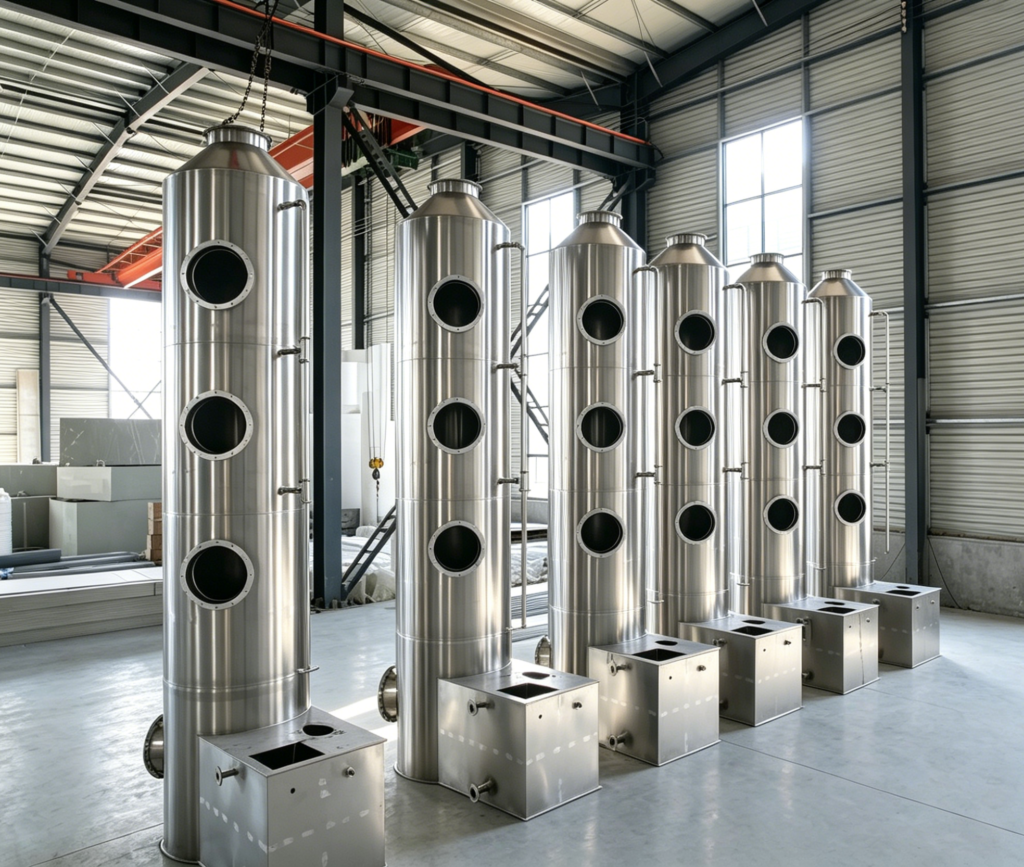
Absorption is a gas–liquid mass-transfer method: the VOC dissolves or reacts into a contacting liquid. It is highly effective for water-soluble and acidic VOCs (HCl, ammonia, alcohols, some ketones, acidic organic fractions) and is the method we supply through two devices:
- A wet scrubber / packed or spray tower for emission control on soluble and acidic components. For the underlying mass-transfer basis, see what a wet scrubber is and how it works, and for design trade-offs our spray tower selection guide (key design parameters).
- A falling film absorber for strongly exothermic, water-soluble streams where you want simultaneous absorption and cooling — most relevant for acidic VOC and acid-gas recovery. The VOC absorption method works best precisely on these soluble/acidic fractions; for construction details and the published HCl absorption system design example, our engineers size both the absorber and its supporting scrubber together.
Absorption is, by its physics, limited to compounds that transfer into the liquid phase. Non-soluble aromatics and aliphatics barely move across the interface, which is precisely why absorption is a pretreatment step in a VOC train, not the final compliance device.
Condensation & Membrane Separation
Condensation cools the stream to or below the VOC dew point so the compound liquefies and separates. It is economically attractive only at high concentration (often >5,000–10,000 ppmv) where the recovered solvent pays for the cooling duty; efficiency of 50–95% is concentration-dependent and tails off as you approach the residual vapor pressure. Membrane separation uses selective permeation to enrich one component; it fits niche recovery duties but is capital-intensive and compound-specific. Neither is a general-purpose VOC solution, but both earn their place in high-concentration recovery trains.
Biological Treatment
Biofilters and biotrickling filters use microbes to oxidize VOCs to CO₂, water, and biomass. They shine on low-concentration, biodegradable, high-airflow streams and offer low CAPEX and very low OPEX. The catch is compound range: readily biodegradable species (some alcohols, esters, organic acids) do well, while halogenated and recalcitrant compounds do not. Footprint is large, and performance is sensitive to humidity, pH, and nutrient balance.
Adsorption vs Absorption for VOCs: Which Recovery Method?
| Adsorption (activated carbon) | Absorption (wet scrubber / falling film) | |
|---|---|---|
| Mechanism | Physisorption onto a solid carbon surface | Gas–liquid mass transfer into a contacting liquid |
| Best-fit VOC | Non-polar, higher-boiling, easily-adsorbed (BTEX, aliphatics, ketones, chlorinated solvents) | Water-soluble and acidic (HCl, ammonia, alcohols, acidic organics) |
| Main limitation | Humidity & halogen sensitivity; spent carbon is hazardous waste | Only compounds that transfer into the liquid phase; pretreatment only |
The practical rule: adsorption is the polisher for the adsorbable tail, and absorption is the front-end for the soluble/acidic fraction. Most compliant chemical and pharmaceutical trains use both.
Where Scrubbers & Absorption Fit: Pretreatment, Not Primary VOC Destruction
This is the compliance core of the article, and the section we most need engineers to read before they specify equipment.
Why a Wet Scrubber Alone Cannot Meet Strict VOC Limits
A wet scrubber is superb at removing water-soluble and acidic gases. It is not, by itself, a VOC destruction device. Most VOCs in chemical and pharmaceutical vents — aromatics, aliphatics, many chlorinated compounds — have low water solubility and simply pass through a scrubber’s liquid film. Even where some removal occurs, it rarely reaches the 90%+ destruction-and-removal efficiency that modern permits and MACT-style limits demand.
The honest statement every specifier should internalize: a wet scrubber alone cannot meet strict VOC limits for a mixed or poorly soluble VOC stream. It can, however, be the perfect front-end that strips the soluble and acidic fraction, protecting and simplifying the device that follows. For an integrated package on acidic components, our acid gas scrubbing system bundles the scrubber with tail-gas treatment.
Falling Film Absorber for Water-Soluble / Acidic VOC Streams
Where the VOC is genuinely water-soluble and the duty is exothermic — HCl, readily soluble acidic organics — a falling film absorber is the right absorption machine. Its co-current, film-thin contact with integral shell-side cooling lets you absorb and remove heat in one pass, reaching useful product strength rather than just knocking the peak down. This is recovery-grade absorption, not mere scrubbing; for the hardware see our falling film absorption tower, and it pairs naturally with the published HCl absorption system design approach. The boundary still holds: it handles the soluble/acidic fraction only.
The Compliant Train — Pretreatment (Scrubber/Absorber) + Activated Carbon for Final Compliance
The pattern that passes audits combines the two recovery methods we supply into a single compliant train:
- Pretreatment: a wet scrubber or falling film absorber strips water-soluble and acidic VOCs, cools the stream, and protects the downstream bed from corrosive or fouling loads.
- Polishing: an activated carbon adsorber captures the residual, easily-adsorbed VOCs that the scrubber cannot touch, delivering the final removal efficiency the permit requires.
A representative fine-chemical case: a process vent carried HCl plus a soluble acidic organic fraction and a tail of aromatic VOCs. A falling film absorber removed the acidic, water-soluble load; an activated carbon bed polished the aromatic residual. The combined train passed its compliance audit on the first attempt, with the scrubber protecting the carbon from acid fouling and extending its service life.
Want a compliant train mapped to your specific stream? Our engineers size the pretreatment and polishing stages together so the units are validated as one system — see our acid gas scrubbing system for the integrated package.
Selection Decision Framework
Reduce the decision to a matrix built on the three parameters. Read your stream across concentration, airflow, and physicochemical properties, then follow the branch:
- Low concentration + high airflow + easily-adsorbed VOC (BTEX, aliphatics) → activated carbon adsorption. First choice for recoverable, adsorbable solvents.
- Water-soluble / acidic VOC (HCl, ammonia, soluble organics) → absorption: wet scrubber or falling film absorber, as pretreatment or recovery; add carbon polishing for any residual adsorbable fraction.
- Mid-to-high concentration + recoverable solvent → condensation (often with absorption/adsorption polishing).
- Very high airflow + very low concentration → zeolite rotor concentrator + oxidizer is the typical economical destructive route.
- Low concentration + biodegradable VOC + land available → biological treatment.
- Mid-to-high concentration + non-recoverable mixed VOC → RTO/RCO oxidationfor high DRE.
The matrix is not a ranking; it is a filter. Most real chemical and pharmaceutical vents are mixed, so the answer is rarely one box — it is a train, and the recovery methods we supply usually occupy the soluble/acidic and adsorbable seats.
Matching the Method to Your Industry — Chemical & Pharmaceutical Focus
This guide is written for chemical and pharmaceutical process engineers, EPC contractors, and environmental equipment buyers. Those two industries generate the soluble acidic streams, solvent vents, and mixed organic emissions where absorption and adsorption shine, and where our supplied equipment — wet scrubbers, falling film absorbers, activated carbon adsorbers — delivers compliant, economical results.
We deliberately scope this article to chemical and pharmaceutical applications. We do not cover battery manufacturing exhaust or painting/spraying (coating) booth VOC treatment; those involve different stream chemistries, fire-code constraints, and equipment packages outside the product lines discussed here. If your operation is chemical or pharmaceutical, the methods above map directly to your vents.
From Comparison to Your Process
Comparing VOC removal methods on paper is useful; applying them to your specific stream is where compliance is won or lost. The variables that decide the train — concentration profile, airflow range, humidity, halogen/sulfur/silicon content, and your emission limit — are measured facts, not catalog choices. A short, well-documented data package (gas flow and range, composition, utilities, and permitted limit) turns a generic comparison into a sized, compliant design.
Our process engineers turn that data into a layout and a quote, not a guess. Whether your stream needs a falling film absorber for the acidic fraction, an activated carbon bed for the adsorbable tail, or a combined pretreatment-plus-polishing train, we size the stages to work together from day one. Start the conversation with our custom engineering services.
Conclusion
Three points to carry out of this VOCs treatment methods compared guide:
- Selection is driven by concentration, airflow, and physicochemical properties — not by brand or habit. Classify the stream before you classify the equipment.
- Wet scrubbers and falling film absorbers are pretreatment, not primary VOC destruction. They earn their place on water-soluble and acidic fractions; a scrubber alone will not meet a strict VOC limit.
- The compliant train for most chemical and pharmaceutical vents combines absorption pretreatment with activated carbon polishing — the two recovery methods we engineer and supply.
Your next step is concrete: gather your stream’s flow, composition, and permitted limit, then let our engineers map a train that passes audit on the first attempt. Explore our falling film absorber and activated carbon solutions →
For the regulatory context behind each technology choice discussed above, see our 2026 VOC compliance standards EU/US/China comparison guide — it maps BAT-AELs, NESHAP destruction-and-removal efficiency, and Chinese GB caps onto the equipment selections laid out here.
Frequently Asked Questions
Q: Activated carbon vs RTO for VOC removal — which is better?
Neither is universally better; they solve different problems. Activated carbon adsorption is a recovery method ideal for low-to-mid concentration, high-airflow streams of easily-adsorbed VOCs, with moderate CAPEX and the bonus of solvent recovery. RTO is a destruction method giving 95–99% DRE on a wide compound range, with high CAPEX but low OPEX at sufficient VOC load. If your VOC is adsorbable and recoverable, carbon usually wins on cost; if the stream is mixed, dilute, and non-recoverable, RTO is often the compliant choice.
Q: Can a wet scrubber remove VOCs?
Partially, and only for water-soluble or acidic VOCs. A wet scrubber excels at HCl, ammonia, and soluble organics, but most VOCs (aromatics, aliphatics, many chlorinated compounds) have low water solubility and pass through. A wet scrubber alone cannot meet strict VOC limits for a mixed stream; it belongs as pretreatment ahead of an activated carbon polisher. We supply scrubbers and falling film absorbers for exactly this pretreatment role.
Q: What is the best VOC method for low concentration, high volume streams?
For easily-adsorbed VOCs, activated carbon adsorption is typically the most economical recovery route. For very high volume with very low concentration and non-recoverable mix, a zeolite rotor concentrator feeding an oxidizer is the common destructive solution. Biological treatment fits biodegradable low-concentration streams where land is available. The “best” method follows your compound class, not the airflow alone.