
Project Overview
This project is a 57,000 m³/h coal grinding exhaust gas treatment system for a chemical new materials project in Xinxiang, Henan, China.
The system was designed to treat high-volume, humid exhaust gas generated by three coal grinding mills. The treatment configuration integrates FRP wet scrubbing, water washing and demisting, and activated carbon adsorption to address multiple pollutants including non-methane hydrocarbons (NMHC), methanol, hydrogen sulfide (H₂S), ammonia (NH₃), dust, coal particles and odorous compounds.
The system is designed for continuous industrial operation at approximately 57,000 m³/h and combines gas collection, wet scrubbing, demisting, activated carbon adsorption, piping, electrical and control systems into one integrated exhaust gas treatment solution.
Project Design Data
| Parameter | Project Data |
|---|---|
| Project Type | Coal Grinding Exhaust Gas Treatment |
| Industry | Chemical New Materials |
| Location | Xinxiang, Henan, China |
| Number of Coal Mills | 3 |
| Design Air Volume | 57,000 m³/h |
| Exhaust Volume per Mill | Approx. 13,000 m³/h |
| Operating Temperature | 30–80°C |
| Operation | Continuous |
| Operating Schedule | 24 hours/day, approximately 8,000 hours/year |
| Main Treatment Technologies | Wet Scrubbing + Demisting + Activated Carbon Adsorption |
Project Background
A chemical new materials project in Xinxiang, Henan required an exhaust gas treatment system for three coal grinding mills.
During the coal grinding and slurry preparation process, raw coal and grinding water are processed inside the mills. As the grinding water temperature rises to approximately 48–50°C, various pollutants and odorous substances can be released from the coal slurry and carried out with the exhaust gas.
The original ventilation system could discharge the exhaust gas outdoors, but it could not effectively remove the pollutants before emission.
The exhaust gas contained a combination of non-methane hydrocarbons (NMHC), methanol, hydrogen sulfide (H₂S), ammonia (NH₃), dust, coal particles, odorous compounds, moisture and entrained droplets.
The project therefore required a treatment system capable of handling high-volume, continuous and humid exhaust gas containing multiple pollutants.
Target Pollutant Concentrations
| Pollutant | Inlet Concentration | Target Outlet Concentration |
|---|---|---|
| Non-methane hydrocarbons | 100–500 mg/m³ | <50 mg/m³ |
| Methanol | 100–500 mg/m³ | <30 mg/m³ |
| H₂S | 0–10 mg/m³ | <2 mg/m³ |
| Ammonia | 53–150 mg/m³ | <20 mg/m³ |
| Dust | Approx. 50 mg/m³ | <10 mg/m³ |
| Odor | — | <1,000 |
Treatment Process
The project adopts a multi-stage treatment process consisting of primary wet scrubbing, secondary water washing and demisting, and final activated carbon adsorption.
FRP Cyclone Plate Scrubber
The exhaust gas first enters the primary FRP cyclone plate scrubber.
This stage provides several functions, including the removal of suspended dust and coal particles, absorption of water-soluble pollutants, preliminary removal of ammonia and H₂S, and reduction of pollutant loading to the downstream adsorption system.
The cyclone plate structure enhances gas-liquid contact and helps separate particulate matter from the gas stream. The collected liquid and particles are discharged to the scrubber circulation tank.
FRP Water-Wash & Demisting Tower
After primary scrubbing, the gas passes through a secondary water-washing and demisting tower.
This stage further washes residual soluble pollutants and removes entrained droplets from the gas stream. Reducing moisture before activated carbon adsorption is important because excessive moisture can negatively affect adsorption performance.
The demisting stage therefore helps protect the downstream adsorption media and improves the overall treatment process.
Activated Carbon Adsorption System
After scrubbing and demisting, the pre-treated gas enters the activated carbon adsorption system.
The activated carbon unit provides final polishing treatment for residual organic compounds and odor-causing substances.
The adsorption system is equipped with a bypass arrangement and manual isolation valves, allowing the ventilation route to be switched when the carbon unit requires inspection or carbon replacement. Activated carbon is replaced manually according to operating conditions and adsorption performance.
Equipment Configuration
The complete exhaust gas treatment system includes:
• FRP Wet Scrubber
• FRP Demisting Tower
• Activated Carbon Adsorption Unit
• Complete Exhaust Piping System
• Electrical & Control System
The FRP wet scrubber is designed for high-volume gas washing and removal of soluble pollutants and particulate matter.
The FRP demisting tower reduces entrained droplets and helps protect the downstream adsorption system.
The activated carbon adsorption unit provides final adsorption treatment for residual VOCs and odor-causing substances.
The complete piping, electrical and control systems are integrated according to the required air volume, equipment arrangement and site conditions.
Project Installation
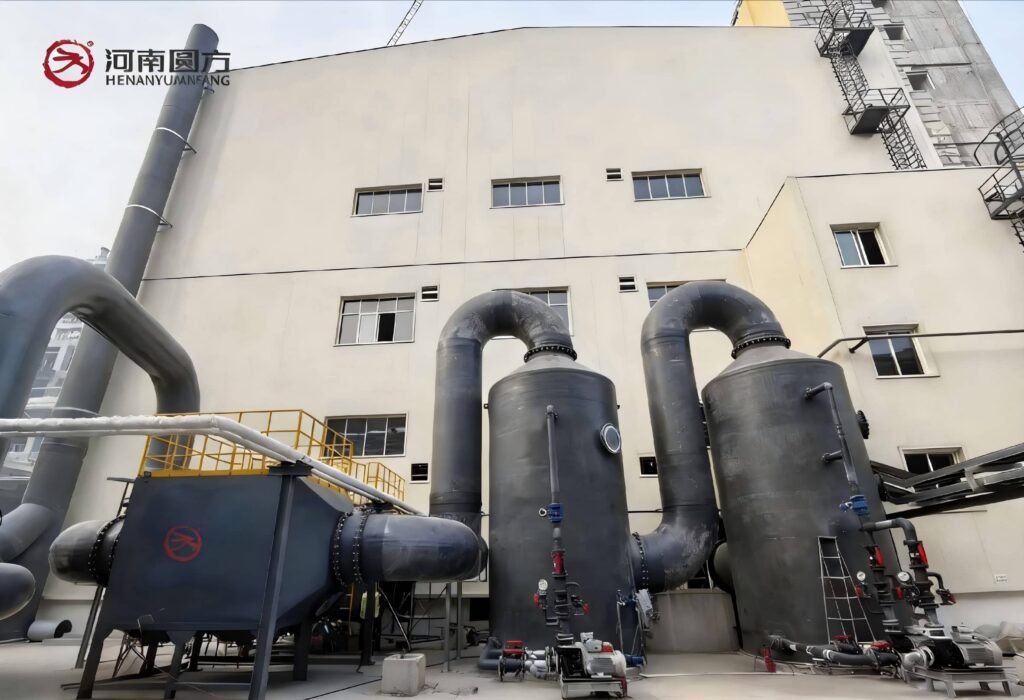
Installed exhaust gas treatment equipment for a 57,000 m³/h coal grinding exhaust treatment system.
Why Multi-Stage Treatment?
For this type of exhaust gas, using activated carbon alone is not an ideal treatment approach.
The gas contains dust, moisture, ammonia, H₂S, organic compounds and odor, while pollutant concentrations and temperature can fluctuate with coal mill operating conditions.
Directly sending untreated gas into an activated carbon unit can result in excessive dust loading, high moisture, reduced adsorption efficiency, faster carbon saturation and more frequent maintenance.
Therefore, the treatment system follows the principle of:
Pre-treatment → Demisting → Final Adsorption
This configuration separates different treatment functions and helps protect the final adsorption stage.
Engineering Approach
For industrial exhaust gas treatment, equipment selection should not be based on airflow alone.
Gas composition, temperature, moisture, dust concentration, pollutant concentration and operating conditions all influence the treatment process.
For this project, the engineering team considered the complete gas-treatment sequence from the coal mill exhaust source to the final discharge rather than treating the activated carbon unit as an independent piece of equipment.
The resulting integrated system combines:
Gas Collection + Wet Scrubbing + Demisting + Activated Carbon Adsorption + Piping + Electrical & Control
Looking for a Similar Exhaust Gas Treatment Solution?
If your plant has exhaust gas from coal grinding or coal mill systems, coal slurry preparation, chemical new materials production, chemical processing, high-humidity VOC sources, H₂S and ammonia-containing exhaust, or industrial odor sources, the treatment process may require a combination of technologies rather than a single treatment unit.
Henan Yuanfang Environmental Protection Equipment Co., Ltd. provides customized industrial exhaust gas treatment equipment and engineering solutions based on actual gas conditions, including wet scrubbers, FRP/PPH towers, demisting systems, activated carbon adsorption units and integrated exhaust gas treatment systems.
Have a similar exhaust gas problem? Share your gas volume, temperature and main pollutants with us. We can discuss a suitable treatment configuration for your application.