
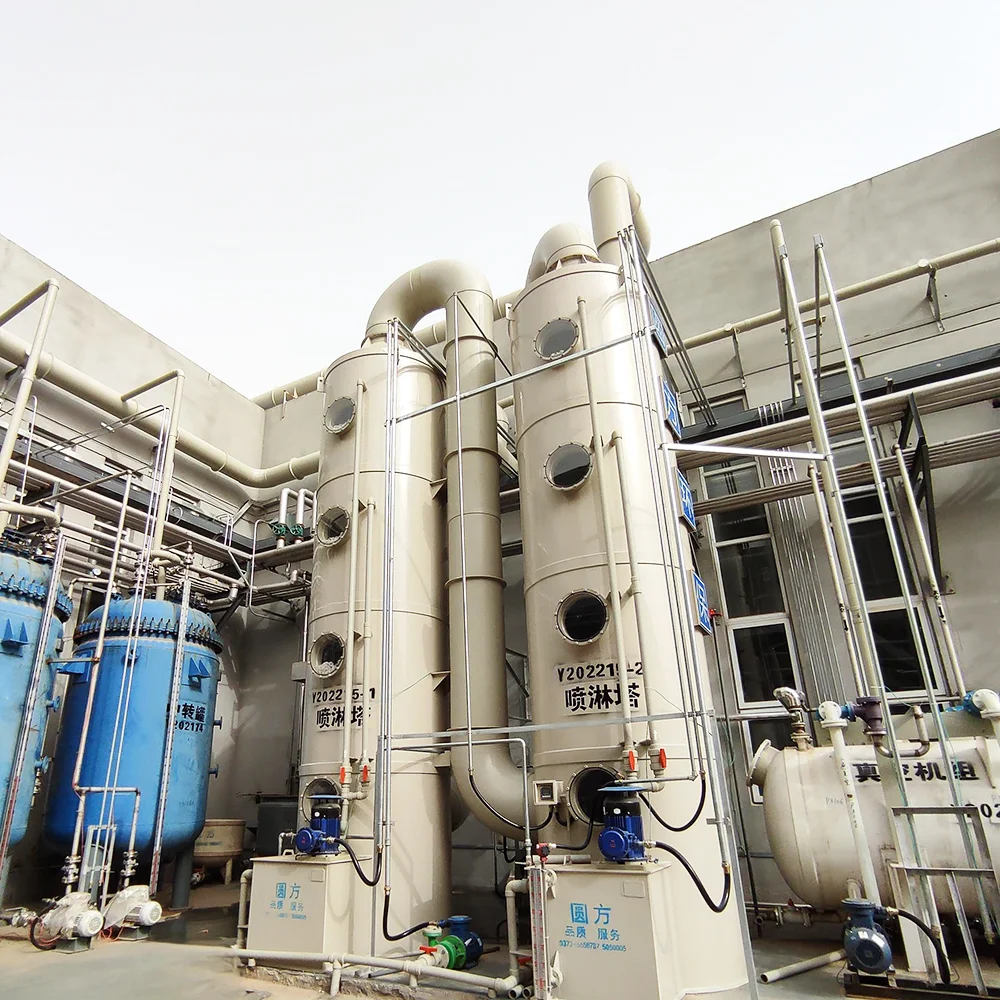
An acid gas scrubber cleans industrial exhaust. It pulls acidic gases — hydrogen chloride (HCl), sulfur dioxide (SO₂), nitrogen oxides (NOₓ), and hydrogen fluoride (HF) — out of the stream by washing them with a neutralizing alkaline liquid inside a packed, sprayed, or falling-film tower.
Table of Contents
Introduction: The Real Cost of a Wrong Choice
A single wrong material choice can take an entire exhaust system offline. One battery-recycling plant specified a 316L stainless-steel dump tank on an HCl-rich duty and watched pinholes open at the waterline within 18–24 months. Others have passed mechanical acceptance only to fail their first stack test because the packing height was sized for a different gas. If you are specifying an acid gas scrubber, these are the failures you are trying to avoid.
Choosing the right acid gas scrubber is not about buying the most expensive tower or the one with the biggest “efficiency” number on the brochure. The four gases most buyers ask about — HCl, SO₂, HF, and NOₓ — dissolve, react, and corrode in completely different ways. A design that crushes HCl can struggle with NOₓ, and a material that shrugs off sulfuric acid can be eaten alive by trace HF. When you compare acid scrubber systems on price alone, you miss the chemistry that decides whether the unit will pass its first stack test. The classic wet acid gas scrubber is a packed tower, but the family spans spray, venturi, tray, and dry designs.
If your plant runs a plating line, an acid fume scrubber there is just a specialized packed bed facing the same HCl chemistry — only the capture point differs. If you need a refresher on the underlying mass-transfer principle, our guide on how wet scrubbers work explains the neutralization mechanism in plain terms.
This article gives you a repeatable method: match the gas to its chemistry, pick the scrubber type, choose the material, set the design parameters, and avoid the six mistakes that cause most field failures. By the end you will have a decision matrix you can drop straight into an RFQ.
Key Takeaways – HCl and SO₂ are highly water-soluble and are best removed in a counter-current packed bed at pH 7–9 (95–99.9% typical). – HF is highly water-soluble but a weak acid that resists neutralization — it needs pH 10–12 to stay as fluoride, and it attacks silica and 316L stainless by pitting; specify a wet packed bed at pH 10–12 or a dry lime system, and reserve Hastelloy C-276 for severe duty. – NOₓ is poorly soluble as NO; oxidize it with H₂O₂ or treat it by SNCR/SCR rather than relying on a plain absorber. – Packed-bed pressure drop runs 300–500 Pa, venturi 1,000–2,500 Pa, and spray tower 150–300 Pa — size the fan to match. – Match material to chemistry: PP covers roughly 80% of duty, FRP for large or outdoor units, 316L only where justified, and Hastelloy C-276 for high chloride or trace-HF service.
5 Steps to Select the Right Acid Gas Scrubber
Before the deep dive, here is the method at a glance. Work through these five steps in order — each one feeds the next, and skipping any of them is how most RFQs end up specifying the wrong hardware.
- Identify the gas mix and permit limits. List every acidic component in the stream (HCl, SO₂, NOₓ, HF, and any others) with inlet concentrations and the actual outlet number you must hit. A system sized for “acid fumes” rather than a named gas and a permit limit will miss.
- Let the chemistry pick the reagent and pH. Soluble strong acids (HCl, SO₂) neutralize cleanly at pH 7–9; HF needs pH 10–12 to stay as fluoride; NOₓ needs oxidation or catalytic reduction. The gas, not the brochure, sets the liquor.
- Pick the scrubber type by gas and duty. Counter-current packed bed for soluble gases, venturi when particulate rides along, tray for high SO₂ or slurry duty, falling-film to recover HCl, and dry lime where water is scarce or HF dominates.
- Choose the material to match the chemistry. PP covers most duty; step up to FRP for large outdoor shells, and reserve 316L and Hastelloy C-276 for the chloride- and HF-rich services that defeat ordinary plastics.
- Set the design parameters from the five vendor inputs. Lock in the L/G ratio, pressure drop, packing height (from NTU × HETP), and capture velocity so the vendor quotes a buildable system instead of a catalog number.
Acid Gas Scrubber Basics (A Brief Recap)
At its core, a wet acid gas scrubber is a gas–liquid contactor. Polluted air moves up while an alkaline liquid moves down, so acid molecules transfer into the liquid film on the packing or droplets — a mass-transfer step governed by the gas’s solubility — and react with the alkali. Sodium hydroxide (NaOH) is the common reagent: it converts HCl to NaCl, SO₂ to Na₂SO₃, and HF to NaF. A mist eliminator then strips carryover droplets before the cleaned gas exits. Every wet acid gas scrubber lives or dies by how well that contact step is designed.
Most acid scrubber systems follow this same contact-and-neutralize loop; what changes from plant to plant is the reagent, the packing, and the material — decisions we make from the gas chemistry, not from habit.
The 4 Acid Gases — Why Chemistry Dictates Design
Most selection errors start here: treating all acid gases as if they behave the same. They do not. Solubility and reactivity decide which scrubber type, reagent pH, and construction material will actually work. CECO Industrial Air’s acid-gas overview and EPA’s Control Cost Manual both frame the four target gases by how they dissolve and react — and that single fact drives everything downstream.
Hydrogen Chloride (HCl)
HCl is highly water-soluble and a strong acid. It reacts with water rather than merely dissolving, so its solubility far exceeds what Henry’s law would predict (see LibreTexts, Factors Affecting Solubility). A counter-current packed bed strips it efficiently even at low liquid rates, which is why a dedicated HCl scrubber is almost always a packed tower. Neutralization is straightforward at pH 7–9:
HCl + NaOH → NaCl + H₂O
Packed-bed removal of 95–99.9% is routine. An acid fume scrubber on a pickling or metal-finishing line is really an HCl scrubber by another name — the capture challenge at the tank is what differs, not the chemistry. A well-tuned HCl scrubber also trims reagent use, because tight pH control means you are not over-dosing caustic to compensate for a short tower. For plants that want to recover rather than just neutralize, a falling-film absorption tower can yield up to ~37% by-weight HCl as a saleable by-product.
Sulfur Dioxide (SO₂)
SO₂ is also highly water-soluble and reacts readily with alkali:
SO₂ + 2NaOH → Na₂SO₃ + H₂O
Lime (Ca(OH)₂) is often used where OPEX matters more than footprint, forming calcium sulfite/sulfate. Packed beds and tray towers both handle SO₂ well; for high loads or strict limits, a two-stage arrangement is common. Wet FGD practice (EPA Control Cost Manual) reports 90–99% sulfur capture. SO₂ is the “easy” gas of the four — the risk is under-sizing for peak load, not chemistry.
Hydrogen Fluoride (HF)
HF is the awkward one: highly water-soluble but a weak acid that resists neutralization, so it needs pH 10–12 to stay as fluoride — and it attacks silica, glass, and 316L stainless by pitting. JN Alloys documents how even trace HF with high chlorides can defeat ordinary stainless in FGD service. The fix is to push the liquor to pH 10–12 to hold HF as fluoride, and to keep silica packing and 316L out of the wetted path. A wet packed bed at high pH removes 90–99%; very high HF loads or water-scarce sites favor dry lime. Severe duty calls for Hastelloy C-276.
Nitrogen Oxides (NOₓ)
NOₓ is the hardest of the four because NO — typically 90%+ of stack NOₓ — is barely soluble, so a plain absorber barely dents it. Two routes exist: wet oxidation (inject H₂O₂ to convert NO to the more soluble NO₂, then absorb in alkaline liquor), or selective reduction (SNCR/SCR using urea or ammonia to make nitrogen). CECO’s acid-gas guidance puts wet oxidation at 70–95% while SCR exceeds 90%. Our engineering services team specifies the hybrid SNCR-plus-scrubber route for NOₓ-heavy streams.
Scrubber Type Selection by Gas & Duty
Once the chemistry sets the reagent and pH, the gas-and-duty profile sets the hardware. Here is how the main types sort out.
Packed Bed / Packed Tower
The workhorse for pure acid gases, with counter-current flow, 25–50 mm PP Pall rings, and a demister on top. Soluble gases transfer fast, so a packed bed delivers 95–99.9% on HCl, SO₂, and HF at modest liquid rates. It is the default in the decision matrix below and the backbone of our chemical and packed-bed scrubber range.
Spray Tower
A large open vessel where liquid is sprayed across a rising gas stream. Pressure drop is low (150–300 Pa), but removal runs a more moderate 90–95% because gas–liquid contact is less intimate than in packing. For a spray-tower-specific spec sheet, see our spray tower selection guide and the Spray Tower Scrubber product page.
Venturi Scrubber
A venturi throat accelerates the gas so it shears the liquid into a fine fog — excellent when the stream carries heavy particulate and acid (battery recycling, foundries, metal finishing). The trade-off is high pressure drop (1,000–2,500 Pa) and higher fan power. Use it as a pre-stage ahead of a packed bed when dust loading is significant, not as a standalone acid polisher.
Tray / Sieve Tower
A series of perforated trays forces the gas to bubble through thin liquid layers. Trays handle large volumes and high SO₂ or HF loads well, and they tolerate slurries (lime) better than random packing, which can blind. They are common in FGD and large combustion sources.
Falling-Film Absorption
A specialty for HCl recovery rather than disposal. Gas flows down tubes wetted with weak acid or water; HCl absorbs into a thin film and concentrates to roughly 37% acid. No packing, minimal liquid inventory, and a valuable product out the bottom. Ideal for chlor-alkali, PVC, and pickling operations that want to close the loop. Details on the Falling-Film Absorption Tower page.
Dry Scrubber
For HF or water-scarce sites, a dry system injects lime or sodium bicarbonate powder and collects the reacted dust in a baghouse or electrostatic precipitator. No wastewater, but you trade the high single-pass efficiency of a wet packed bed for a dry by-product stream. Our PP/PPH dry scrubber covers this niche for HF and odor control.
The Acid Gas Scrubber Decision Matrix
Use this table as the spine of your specification. It maps each target gas to a recommended type, reagent and pH, best material, and a realistic removal range from the sources noted in the references.
| Target gas | Recommended type | Reagent & pH | Best material | Typical removal | Notes |
|---|---|---|---|---|---|
| HCl | Counter-current packed bed (falling-film for recovery) | NaOH / Na₂CO₃, pH 7–9 | PP / PPH | 95–99.9% | Highly soluble; falling-film recovers up to ~37% HCl |
| SO₂ | Packed bed or tray (2-stage for high load) | NaOH / Na₂CO₃ / lime, pH 7–9 | PP / FRP / 316L* | 90–98% | Highly soluble; lime cuts OPEX |
| HF | Wet packed bed at pH 10–12, or dry lime | NaOH high-alkali / lime, pH 10–12 | PP / PPH; Hastelloy C-276 for severe duty | 90–99% | Highly soluble but a weak acid; attacks silica & 316L |
| NOₓ | Wet + oxidant (H₂O₂), or SNCR/SCR | Oxidant + NaOH; or urea/NH₃ catalyst | PP / FRP / SS (SCR) | 70–95% (wet ox); >90% (SCR) | NO needs oxidation; plain absorber is weak |
| Mixed (HCl+HF+NOₓ) | Staged packed bed, staged pH | NaOH, staged pH 7–9 then 10–12 | PP / PPH | 90–99% | Stage order matters; HF stage runs last |
*316L only where chlorides are low and temperature justifies it — never in chloride-rich or HF service.
Material Selection — PP vs FRP vs Stainless vs Hastelloy
Material choice is where under-specification becomes a leak, and over-specification becomes wasted budget. The goal is to match the plastic or alloy to the actual chemistry and temperature. Most acid scrubber systems earn their keep by matching the shell to the liquor, not by over-building it.
- Polypropylene (PP). The default for roughly 80% of acid-scrubber duty. It resists HCl, SO₂, and most acid liquors up to about 80 °C, and it is cheap and easy to fabricate. For hotter or larger units, PPH buys higher temperature and stiffness.
- FRP (fiber-reinforced plastic). The choice for large, outdoor, or structurally loaded shells where a freestanding PP tower would need heavy framing. Vinyl-ester resin gives good resistance in aggressive service.
- 316L stainless steel. Justified only where the stream is essentially chloride-free and temperatures exceed what plastics allow. It is a poor pick for HCl or HF duty — 316L pits readily in both.
- Hastelloy C-276. The severe-service alloy. JN Alloys documents its resistance to mixed chlorides and trace HF in FGD and complex acid streams. Specify it only where PP/FRP cannot survive the concentration and temperature, because the cost premium is steep.
- PVC / CPVC. Common for ducting and small wetted parts where temperature stays low; CPVC extends the ceiling modestly above PVC.
An acid fume scrubber on a plating or pickling line is usually all-PP for this reason — hood and duct sit in the same corrosion envelope. A wet acid gas scrubber in severe chloride-plus-HF service is the one place where stepping up to Hastelloy pays back.
The dump-tank failure mode worth memorizing: the recirculation tank is where many systems quietly die. A PP tank lasts 15–20 years on acid duty, while a 304 or 316L stainless tank on HCl service develops pinholes at the waterline in 18–24 months because that is exactly where chlorides concentrate and pit. If your spec says “stainless tank,” ask which stainless and which gas — the answer often reveals the error before installation.
Key Design Parameters You Must Specify
A vendor cannot size a system from “we need an acid gas scrubber.” These are the numbers that turn a vague request into a buildable RFQ.
Liquid-to-Gas (L/G) Ratio
The L/G ratio drives soluble-gas removal: more liquid film means more interfacial area, so HCl and SO₂ respond well to moderate L/G. Set it too low and the tower misses the target outlet; too high wastes pump power and makes mist. Treat L/G as a design input to negotiate with the vendor.
Pressure Drop by Type
Pressure drop sets fan size and operating cost. Typical industry design ranges:
- Packed bed: 300–500 Pa
- Spray tower: 150–300 Pa
- Venturi: 1,000–2,500 Pa
Size the blower for the as-specified drop plus a fouling margin, or the real system will under-flow and miss its removal target.
Packing Height & Residence Time
Packing height is not a guess — it follows from the required removal efficiency. Express the target as a number of transfer units:
NTU = −ln(1 − η) where η is fractional efficiency (e.g., 0.99).
Then multiply by the packing’s height per transfer unit:
Z = HETP × NTU
So a 99% HCl target needs NTU ≈ 4.6; at a typical HETP of 0.3–0.6 m the packing depth lands around 1.5–3.0 m. Under-specifying this depth is the classic cause of a passed-installation, failed-stack-test unit. The EPA Control Cost Manual presents the same packed-tower absorber methodology.
pH Control & Reagent Dosing
Automated pH control is not optional on a permitted unit — it is what keeps you inside limit between operator rounds. Strong acids (HCl, SO₂) neutralize cleanly at pH 7–9. HF needs pH 10–12 to stay in solution as fluoride. A single fixed setpoint cannot serve a mixed HCl+HF stream — you need staged dosing, with the HF stage held high. Manual “dump-and-check” pH is the reason many plants drift out of permit between operator rounds.
Capture Velocity & Hood Design
For tank or open-source emissions, capture velocity at the source decides whether the gas even reaches the scrubber. ACGIH’s Industrial Ventilation guidance sets capture velocity by cross-draft conditions (still air ≈0.25–0.5 m/s) with a 1.2–1.5 safety factor; size the hood opening to the source, not to a fixed width table. Undersize the hood and fugitive emissions escape.
The 5 Inputs Every Vendor Needs to Size Your System
Give your vendor these five inputs for a real quote, not a catalog number:
- Gas flow — m³/h (or CFM) at operating or standard conditions.
- Inlet temperature — drives material and reagent choice.
- Inlet concentration — ppmv or mg/Nm³ for each gas present.
- Required outlet / permit limit — the actual number you must hit.
- Pressure-drop budget — what your existing fan or duct can absorb.
Common Acid Scrubber Specification Mistakes
Six errors cause most field failures in real acid gas scrubbing projects. Check your spec against this list before release:
- Under-specifying packing height. Setting depth for a different gas or a lower efficiency leaves you one NTU short of permit — and no upgrade is cheap once the shell is built.
- Wrong material for the chemistry. Specifying 304/316L on HCl or HF duty is the fastest route to pinholes and a replacement tank.
- One pH setpoint for a mixed HCl+HF stream. HCl neutralizes at 7–9; HF needs 10–12. A single value lets one of them escape.
- Ignoring particulate loads. Acid gas with dust needs a venturi or pre-stage; a packed bed will blind and choke.
- No automated pH control. Manual dosing drifts, and drift is how permits get exceeded between shift checks.
- Undersized fan or blower. A fan sized to nameplate (not to operating pressure drop plus fouling margin) starves the tower of face velocity.
Real-World Selection Examples
Two of the following are drawn from published references; the first is a composite of typical metal-finishing retrofits. Enough theory. Here is how the method plays out in three real plants.
Electroplating HCl mist — PP packed bed, caustic. A metal-finishing shop generated HCl mist from pickling and was hand-dosing a small scrubber that drifted out of permit. The fix was a PP counter-current packed bed on NaOH at pH 7–9 with automated pH dosing and a hood sized at 0.4 m/s. Removal settled at 98–99% and the PP dump tank removed the stainless pinhole risk entirely — chemistry matched to material, no exotic alloy.
Semiconductor HF / SO₂ / HCl — PP packed bed. Monroe Environmental documented a 30,000 CFM PP packed-bed system reaching 98% removal across HF, SO₂, and HCl. The key was staged alkaline dosing: a 7–9 stage for HCl and SO₂ followed by a high-pH stage holding HF in solution. The compact footprint fit a low-clearance roof, proving the matrix adapts to layout, not just chemistry.
Gold-refining mixed NOₓ / Cl₂ / HF — staged system. Our own acid gas scrubbing system case covers a refinery vent containing NOₓ, chlorine, and HF. Because NO does not absorb well, the design combined an oxidation stage with staged alkaline packed beds and reserved high-pH detailing for the HF portion. A single plain absorber would have failed the NOₓ limit — staging made the permit achievable.
Acid Gas Scrubber FAQ
1. What is an acid gas scrubber and how does it work? It is an air-pollution-control device that removes acidic gases (HCl, SO₂, NOₓ, HF) from exhaust by contacting them with a neutralizing alkaline liquid inside a packed, sprayed, or falling-film tower, then stripping mist before discharge.
2. Which scrubber type is best for HCl / SO₂ / HF / NOₓ removal? HCl and SO₂: counter-current packed bed. HF: wet packed bed at pH 10–12 or dry lime. NOₓ: wet oxidation (H₂O₂) or SNCR/SCR. See the decision matrix above for the full mapping.
3. What is the difference between a packed bed, venturi, and spray tower scrubber? A packed bed forces gas through wetted packing for high efficiency (95–99.9%); a venturi shears liquid into fog for gas-plus-particulate at high pressure drop (1,000–2,500 Pa); a spray tower sprays liquid in an open vessel for low drop (150–300 Pa) and moderate removal (90–95%).
4. What material should an acid gas scrubber be made of — PP, FRP, or stainless steel? PP covers about 80% of duty under ~80 °C. FRP suits large or outdoor shells. 316L is justified only for chloride-free, high-temperature streams. Hastelloy C-276 is reserved for severe HF/high-chloride service. Avoid stainless on HCl or HF.
5. What reagents are used (NaOH, lime, Na₂CO₃) and at what pH? NaOH and Na₂CO₃ are common for HCl/SO₂ at pH 7–9; lime is used for SO₂ and dry HF at low OPEX; HF needs pH 10–12. NOₓ wet oxidation adds H₂O₂, while SCR/SNCR uses urea or ammonia.
6. Can one scrubber remove multiple acid gases at once? Yes. A staged packed bed with staged pH handles HCl+HF+NOₓ together — HCl and SO₂ at pH 7–9, then an HF stage at pH 10–12, with oxidation or SCR for the NOₓ fraction. Stage order and pH matter.
7. How efficient are acid gas scrubbers? Efficiency is gas-dependent: 95–99.9% for soluble gases (HCl, SO₂, HF) in a packed bed, 90–95% for spray towers, 70–95% for wet NOₓ oxidation, and >90% for SCR. The brochure “99%” claim only means something once the gas is named.
8. How is an acid gas scrubber sized — what is the liquid-to-gas ratio? Sizing starts from gas flow, inlet concentration, target outlet, temperature, and pressure-drop budget. The L/G ratio sets interfacial area for soluble gases; packing height follows from NTU = −ln(1−η) times HETP.
9. Wet vs dry scrubber — when should I choose dry? Choose dry for HF or water-scarce sites: lime or sodium-bicarbonate injection with a baghouse avoids wastewater entirely. Choose wet when you need the highest single-pass efficiency (95–99.9%) on soluble acids and can handle the scrubbing liquor.
10. How much does an acid gas scrubber cost over its lifetime? Lifetime cost is dominated by material longevity and OPEX, not just purchase price. A PP tank lasts 15–20 years versus 18–24 months for a misapplied stainless tank, and automated pH dosing cuts reagent waste. TCO favors right-sizing over over-specifying alloys.
11. Can HF be removed in a wet scrubber or does it need dry? Both work. A wet packed bed at pH 10–12 reaches 90–99% on HF, provided silica packing and 316L are excluded. Dry lime suits very high HF loads or water-scarce sites. Severe combined HF/high-chloride duty calls for Hastelloy C-276.
Conclusion: Pick by Chemistry, Then by Hardware
Selecting the right acid gas scrubber starts with chemistry, then lets duty and footprint pick the hardware. HCl and SO₂ are highly soluble and fall to a packed bed at pH 7–9; HF needs high pH and HF-resistant material; NOₓ needs oxidation or reduction, not a plain absorber. The hardware then follows the duty — packed bed for efficiency, spray or tray for volume, venturi for dust, falling-film for HCl recovery, dry for water-scarce HF.
Get those two steps right and your first stack test is far more likely to pass first time.
Ready to turn this matrix into a buildable specification? Our process engineering team will size the system from your five inputs and recommend the right packed-bed or chemical scrubber for your gas mix. Request a quote and we will return a compliant design, not a catalog number.
If your operation supplies into multiple jurisdictions, the strictest applicable emission limit defines your scrubber’s design target. Our cross-jurisdiction VOC limits comparison walks through the EU, US, and China frameworks you should design to.
References
- U.S. EPA — Wet and Dry Scrubbers for Acid Gas Control, Control Cost Manual 7th Ed., Ch.1 (2021).
- CECO Environmental — What Is A Wet Scrubber?
- CECO Industrial Air — Acid Gas and Fume Control.
- Monroe Environmental — Packed Bed Scrubber Solves Toxic Gas Issues (semiconductor case, 30,000 CFM / 98%).
- LibreTexts — 13.3: Factors Affecting Solubility.
- JN Alloys — Hastelloy C276 in Flue Gas Desulfurization (corrosion/HF data).