
VOC Emission Standards EU, US & China: 2026 Comparison
VOC emission standards across the EU, US and China set three different compliance targets for the same chemical or pharma exhaust stream. The EU publishes the lowest TVOC limit figure of any jurisdiction (a 1 mg/m³ BAT-associated level for the chemical sector). The US mandates 95–98% destruction removal efficiency. China caps concentration at 60–100 mg/m³ nationally while local standards in Shanghai and Hebei go tighter. Exporting one production line to all three markets means designing to the strictest applicable limit, not the easiest one.
If you run environmental, engineering or EHS at a chemical or pharma plant, you already feel this pressure. You need hard numbers you can design to, not vague principles. This guide gives you a side-by-side numerical comparison, the 2026 regulatory updates landing this year, and a map from each limit to the treatment equipment that meets it. We cover why the limits matter, how each region regulates, a direct comparison table, treatment-train fit, this year’s deadlines, and a step-by-step compliance path.
Before you pick any equipment, our VOC treatment methods compared guide breaks down which technology fits which limit. Keep it open as you read.
Key Takeaways
– The EU’s chemical-sector BAT conclusions set a TVOC level of 1 mg/m³ at the lower end of its BAT-AEL range, effective December 2026. No other jurisdiction currently publishes a lower TVOC limit figure.
– US NESHAP and MACT rules require 95–98% destruction removal efficiency, with the CMAS NESHAP final rule landing on 28 March 2026.
– China’s GB 37823-2019 caps pharma NMHC at 100 mg/m³ (general) or 60 mg/m³ (special), while local DB standards in Beijing, Shanghai and Hebei reach 20–30 mg/m³.
– Shanghai’s revised DB31/933-2025 (published November 2025) adds a minimum NMHC treatment-efficiency mandate and combustion-device limits, effective March 2026 for new sources.
– No single technology satisfies all three frameworks. A multi-stage train combining acid-gas pretreatment, VOC polishing and concentration plus oxidation is the norm.
– 2026 is a convergence year: new EU BAT conclusions, the updated US NESHAP, Hebei DB13/2322-2025 and Shanghai DB31/933-2025 all take effect within months of each other.
Why VOC Emission Standards Matter for Chemical & Pharmaceutical Manufacturers
Volatile organic compounds are a business-critical compliance variable, not just an environmental concern. The limit you design to decides whether your plant can operate, export, and stay on a global buyer’s approved-supplier list.
The Compliance Stakes: Permits, Fines and Supply-Chain Qualification
Non-compliance costs more than a regulatory fine. In the EU, operating without a valid permit under the Industrial Emissions Directive can trigger immediate production suspension. In the US, Clean Air Act violations carry civil penalties of up to $124,426 per day per violation, based on EPA’s inflation-adjusted maximum under 40 CFR Part 19 for 2025–2026. In China, exceeding a GB standard can force production limits, a 30-day rectification order, and a place on the national environmental credit blacklist. That blacklist directly affects your ability to secure bank loans and government contracts.
The larger financial risk usually comes from supply-chain qualification. Major pharma and chemical buyers now require suppliers to prove active compliance with all applicable industrial VOC limits before they will tender. One failed environmental audit can cost a multi-year contract worth millions.
Consider a mid-sized API manufacturer in Zhejiang. In late 2024, it spent ¥2.8 million upgrading VOC treatment to the national GB 37823-2019 standard (NMHC ≤ 100 mg/m³). Six months later, a Shanghai-based multinational client audited the plant and applied the stricter Shanghai local standard, DB31/933-2015, which caps organized NMHC at 30 mg/m³. The original system could not meet it. The company lost the contract, spent another ¥4.5 million on a zeolite rotor concentrator retrofit, and waited eight months to re-qualify. The lesson holds: design to the strictest applicable limit, not the national baseline.
How Standards Drive Your Treatment-Train Selection
VOC emission standards set your entire treatment architecture. A plant facing the EU’s 1 mg/m³ target needs different equipment than one facing a 100 mg/m³ Chinese GB limit. The standard decides four things:
– Whether you need pretreatment (acid-gas scrubbing before carbon adsorption to protect the media)
– Whether single-stage treatment is enough or you need a multi-stage train
– Whether activated carbon alone works or you need concentration plus thermal oxidation
– Your monitoring requirements (CEMS versus periodic stack testing)
How Each Region Defines and Regulates VOCs
Each regulatory system approaches VOC control from a different angle. Understanding these differences is the foundation for designing a compliant system.
VOC Emission Standards in the EU: IED 2010/75/EU and the WGC BREF
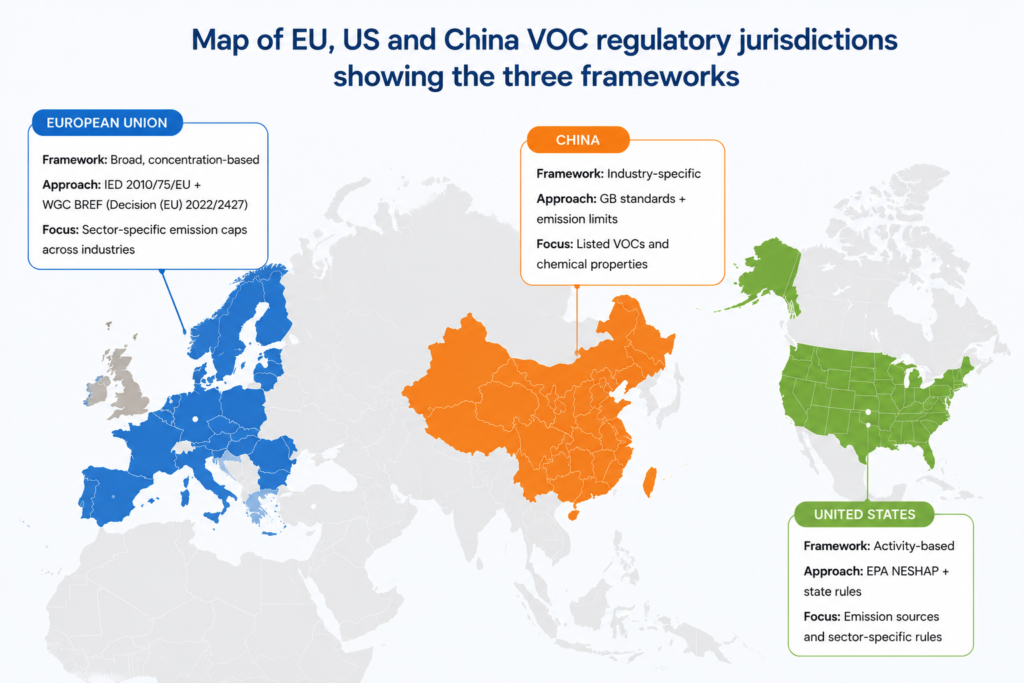
The EU regulates VOCs mainly through the Industrial Emissions Directive 2010/75/EU, which sets organic solvent emission limits from 20 to 150 mg C/Nm³ by sector and solvent type (Annex VII). For pharma manufacturing, the IED sets a total emission limit of 5% of solvent input for new installations or 15% for existing ones. That is a mass-balance approach, not a pure concentration cap.
The change arriving in December 2026 comes from the chemical-sector waste-gas BAT conclusions. These were adopted as Commission Implementing Decision (EU) 2022/2427 on 6 December 2022 and published in the Official Journal on 12 December 2022. Member states must transpose the BAT-associated emission levels (BAT-AELs) into permits within four years, so December 2026 is the practical deadline. The key stack levels include:
– TVOC: 1 mg/m³ (daily average) at the lower end of the BAT-AEL range
– Benzene and toluene: 0.5 mg/m³ each
– Chlorinated solvents: 0.5 mg/m³
– Ammonia (NH₃): 2 mg/m³
– Hydrogen sulphide (H₂S): 1 mg/m³
A clarification that trips up many engineers: these BAT-AELs are associated levels, not a single unified legal floor. The TVOC BAT-AEL spans roughly 1–20 mg/Nm³ across the range, with 1 mg/m³ representing the best-performing plants. No other jurisdiction currently publishes a lower TVOC limit figure, which is why the EU is widely seen as the strictest on concentration. The IED 2.0 revision (Directive (EU) 2024/1785) adds an obligation to aim for the lower end of the BAT-AEL range by default. One timing caveat: the WGC BREF was published in 2022, before IED 2.0, so that default-to-the-lower-end duty does not attach to it automatically. Both are now in force, and competent authorities can still apply the stricter reading.
VOC Emission Standards in the US: Clean Air Act, NESHAP and MACT
The US takes a technology-forcing path under the Clean Air Act. Rather than (or in addition to) a concentration cap, the EPA mandates destruction and removal efficiency of 95–98% for hazardous air pollutants from major sources. This is enforced through National Emission Standards for Hazardous Air Pollutants (NESHAP) and Maximum Achievable Control Technology (MACT) standards under 40 CFR Part 63.
For chemical manufacturing, the central rule is the Chemical Manufacturing Area Sources NESHAP (40 CFR Part 63, Subpart VVVVVV). The EPA issued the updated final rule on 28 March 2026, tightening requirements for area sources around leak detection and repair (LDAR), storage vessel controls, and wastewater treatment emissions. For pharma manufacturing, Subpart GGGGGG applies, requiring 95% DRE for process vents and transfer operations.
The US framework is less about hitting one mg/m³ number and more about proving your treatment achieves the mandated removal efficiency under defined operating conditions.
VOC Emission Standards in China: GB National Standards and Local DB Rules
China runs a two-tier system. National GB standards set the floor, and provincial or municipal DB (地方) standards regularly go stricter. For pharma plants, GB 37823-2019 sets the baseline (pharmaceutical industry only):
| Parameter | General Limit (mg/m³) | Special Emission Limit (mg/m³) |
|---|---|---|
| NMHC | 100 | 60 |
| TVOC | 150 | 100 |
| Benzene series | 60 | 40 |
| Formaldehyde | 5 | 5 |
| HCl | 30 | 30 |
| Ammonia | 30 | 30 |
GB 37824-2019 covers coatings, inks and adhesives manufacturing with similar thresholds: NMHC at 100/60 mg/m³, TVOC at 120/80 mg/m³, and benzene series at 60/40 mg/m³. GB 37822-2019 governs fugitive (unorganized) emissions, setting plant-boundary limits that are often the hardest to control: NMHC 1-hour average of 6 mg/m³ in-plant, with a maximum single reading of 20 mg/m³. At the boundary fence line, benzene stays below 0.1 mg/m³, benzene series below 1.0 mg/m³, and formaldehyde below 0.2 mg/m³.
Local DB standards go further. Beijing caps printing and auto-repair NMHC at ≤20 mg/m³. Shanghai’s revised DB31/933-2025 (published November 2025) keeps organized NMHC at 30 mg/m³ while adding a minimum treatment-efficiency mandate and combustion-device limits, effective March 2026 for new sources and March 2027 for existing ones. Hebei’s DB13/2322-2025, effective January 2026, imposes some of the country’s strictest limits for chemical and pharma sectors. When local standards tighten by this much, a single-stage treatment strategy rarely survives the next revision — most operators end up retrofitting a wet scrubber or adsorber to handle the tighter ceiling.
Side-by-Side: VOC Emission Limits Across the EU, US and China
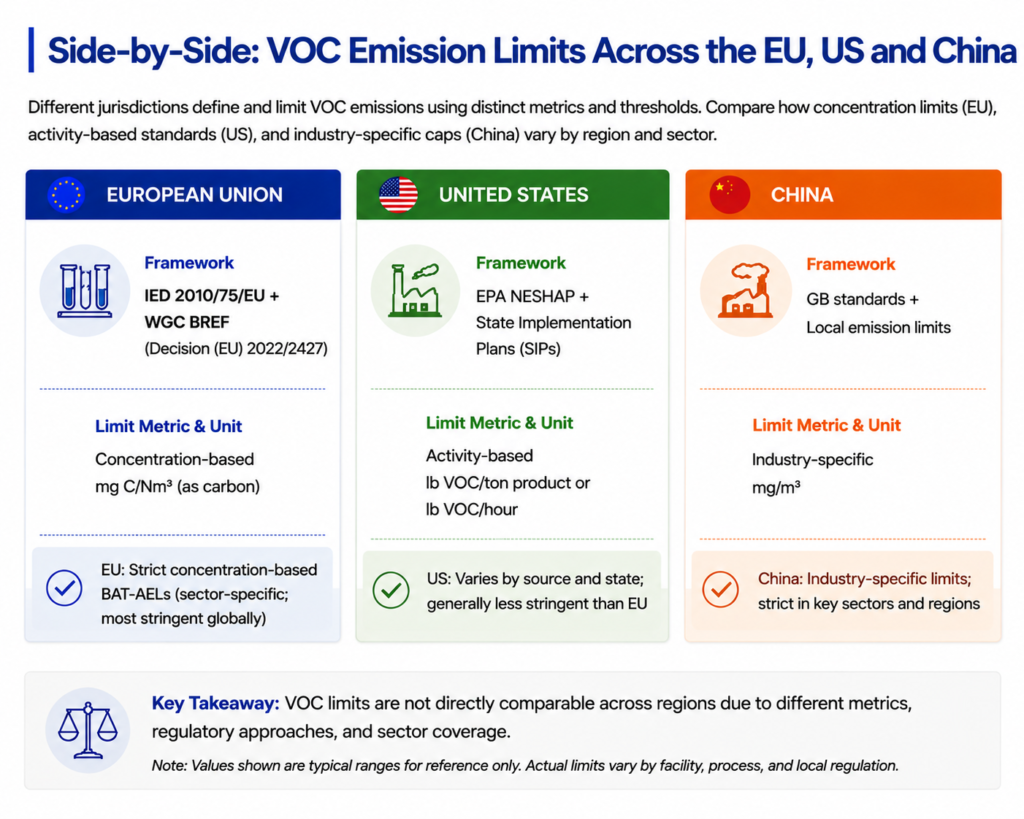
This is the comparison chemical and pharma engineers ask for most. Organized by region, it shows the strictest applicable limit for each jurisdiction at a glance.
Quick-Reference Speed Table
| Region | Key Instrument | Typical VOC Limit Style | Enforcement |
|---|---|---|---|
| EU | IED 2010/75/EU + chemical-sector BAT conclusions (Decision (EU) 2022/2427) | BAT-AEL: 1 mg/m³ TVOC at the lower end of the range (Dec 2026) | Permit-based under the IED |
| US | Clean Air Act, NESHAP/MACT (40 CFR Part 63) | 95–98% DRE, no single fixed mg/m³ | EPA permits, LDAR, recordkeeping |
| China | GB 37823 + local DB standards | Concentration caps: 60–100 mg/m³ (GB), 20–30 mg/m³ (local DB) | MEE permits, CEMS in key regions |
Concentrated Comparison Table (mg/m³ unless noted)
| Parameter | EU (IED + WGC BAT-AEL) | US (NESHAP/MACT) | China GB 37823 | China local (Shanghai DB31/933) |
|---|---|---|---|---|
| TVOC | 20–150 mg C/Nm³ (IED); 1 mg/m³ BAT-AEL lower end (Dec 2026) | 95–98% DRE (no fixed mg/m³) | 150 / 100 mg/m³ (general / special) | 30 mg/m³ |
| NMHC | Not set as a single EU figure | Not set as a single US figure | 100 / 60 mg/m³ (general / special) | 30 mg/m³ |
| Benzene / Toluene | Sector-specific; 0.5 mg/m³ BAT-AEL each | Risk-based | 60 / 40 mg/m³ (benzene series) | Not separately listed |
| Chlorinated solvents | Sector-specific; 0.5 mg/m³ BAT-AEL | Risk-based | Not listed | Not listed |
| Formaldehyde | Not a primary EU waste-gas BAT figure | Not a primary US figure | 5 mg/m³ | Not listed |
Reading the table: the EU BAT-AEL column is the future state for any plant operating in Europe after December 2026. China’s special emission limit applies in designated key regions (Beijing-Tianjin-Hebei, Yangtze River Delta, Pearl River Delta, and other State Council-notified areas). If your plant sits in one of those regions, the special limit and likely a stricter local DB standard bind you.
Destruction and Removal Efficiency
The US framework is the only one built around a percentage-based removal efficiency rather than (or alongside) a concentration ceiling. Under NESHAP/MACT for major sources, the mandate is 95–98% DRE (40 CFR Part 63, sector-specific subparts). The EU instead uses a mass-balance approach for pharma: 5% of solvent input for new installations, 15% for existing ones (IED Annex VII). China does not express compliance as DRE; it uses concentration limits.
The practical effect is worth noting: a US-regulated plant might hit 96% DRE yet still need to confirm the residual concentration meets any applicable state limit. A Chinese plant meeting 60 mg/m³ NMHC might not know its true DRE without extra calculation, which matters when multinational buyers ask for both metrics.
Fugitive Emissions and Plant-Boundary Limits
Fugitive emissions, leaks from valves, flanges, pumps and storage tanks, often make up a large share of a plant’s total VOC footprint. In France, diffuse sources have been reported to account for the large majority of chemical-sector NMVOC emissions. All three jurisdictions regulate fugitive emissions, but differently:
– EU: the IED requires a Solvent Management Plan and LDAR programs. The chemical-sector BAT conclusions extend monitoring to fugitive sources.
– US: NESHAP requires LDAR for equipment leaks. The 2026 CMAS update is expected to widen the equipment scope and tighten repair timelines.
– China: GB 37822-2019 sets hard numeric plant-boundary limits, something neither the EU nor the US does as explicitly.
| Parameter | Plant Area (1h avg) | Plant Area (single reading) | Boundary Fence Line |
|---|---|---|---|
| NMHC | 6 mg/m³ | 20 mg/m³ | Not separately capped |
| Benzene | Not listed | Not listed | 0.1 mg/m³ |
| Benzene series | Not listed | Not listed | 1.0 mg/m³ |
| Formaldehyde | Not listed | Not listed | 0.2 mg/m³ |
Meeting these boundary limits requires more than stack controls. It takes comprehensive fugitive management: sealed storage tanks, vapor recovery, and regular LDAR surveys.
What These Limits Mean for Your Treatment-Train Design
Knowing the numbers is half the work. The other half is translating them into a physical system that meets compliance under real operating conditions. Here is how the limits map to equipment.
Acid-Gas Pretreatment: Wet Scrubbers and Falling-Film Absorbers
Many chemical and pharma exhaust streams carry acid gases, HCl, HF, Cl₂ and SO₂, alongside VOCs. Send that mixture straight to a carbon bed or oxidizer and the acid gases corrode equipment, poison catalysts, and destroy adsorption media within weeks.
This is where pretreatment belongs. A wet scrubber removes acid gases by counter-current contact with an alkaline solution, typically NaOH at 5–15% concentration. Our acid gas scrubber selection guide explains how to size these units for your stream.
For high-concentration HCl, common in pharma chlorination reactions, a falling film absorber is the preferred choice. It reaches 95%+ absorption on HCl while yielding recoverable hydrochloric acid as a byproduct. If your stream is corrosive enough that materials become the deciding factor, our HCl absorption system materials and design guide covers graphite, PP and PVDF selection in detail.
Positioning note: wet scrubbers and packed towers have limited effect on VOCs themselves. They are acid-gas and acid-mist pretreatment devices, not primary VOC abatement. Using them as your only VOC treatment will not meet any standard in this article.
VOC Polishing: Activated Carbon Adsorbers
After acid-gas pretreatment, the stream flows to VOC polishing. An activated carbon adsorber is the workhorse here. It handles a broad VOC spectrum, runs simply, and can reach outlet concentrations below 10 mg/m³ when sized and maintained well.
For the Chinese GB 37823 general limit (NMHC ≤ 100 mg/m³), a well-designed carbon system after acid-gas pretreatment often achieves compliance on moderate streams. For Shanghai’s DB31/933-2025 (30 mg/m³ NMHC plus a minimum efficiency mandate), the EU BAT-AEL (1 mg/m³), or the US 95–98% DRE on high inlet concentrations, carbon alone usually falls short. You then pair it with concentration and oxidation.
A specialty chemical plant in Hebei learned this the hard way. The plant installed a two-stage activated carbon system in 2023, aimed at the GB 37823 general NMHC limit of 100 mg/m³. It worked, with stack tests showing 65–80 mg/m³. But when Hebei’s DB13/2322-2025 (effective January 2026) dropped the limit to 50 mg/m³ for its process category, the carbon system could not keep up. Carbon breakthrough came within 90 days of the new standard taking effect. The plant is now adding a zeolite rotor concentrator upstream of the carbon beds to extend media life and hit the tighter limit. Had it designed to the strictest foreseeable limit from the start, the retrofit cost would have been substantially lower.
When Concentration Plus Oxidation Is Needed
For high-concentration streams or very tight limits (EU 1 mg/m³, US 98% DRE, or Chinese special and local limits), you need a stage beyond adsorption. Two main approaches exist:
– Zeolite rotor concentrator plus catalytic combustion (CO/RCO): the rotor concentrates dilute VOCs (typically 100–1,000 mg/m³) into a smaller, high-concentration stream (10–15×), then oxidizes it catalytically at 250–400°C. This suits large-volume, low-concentration exhaust typical of pharma and chemical plants.
– Regenerative thermal oxidizer (RTO): for higher-concentration streams or halogenated compounds, RTOs reach 99%+ DRE at 800–1,000°C. When acid gases are present, alkaline scrubbing of the RTO exhaust removes secondary acid gases (HCl, HF) formed during thermal oxidation of chlorinated or fluorinated VOCs.
The choice depends on inlet concentration, flow rate, VOC species, and the target limit. For streams above roughly 25% of the lower explosive limit (LEL), direct thermal oxidation may fit better than a catalytic route. For a full technology comparison, see our treatment guide.
Odor and Biofilter Applications
Some chemical and pharma processes, especially those with sulfur compounds, amines, or fermentation-derived VOCs, create odor issues that draw separate regulatory scrutiny even when total VOC mass is within limits. Biofiltration gives a low-operating-cost answer for these odor-intensive, low-concentration streams. It uses microorganisms on organic media to biodegrade VOCs and odor compounds. Biofilters normally serve as a polishing stage after primary treatment, not as a standalone fix for regulated stack limits.
2026 Regulatory Updates You Cannot Ignore
Four major developments converge in 2026, each with direct implications for chemical and pharma plants.
1. EU Chemical-Sector BAT Conclusions: Effective December 2026
The TVOC level of 1 mg/m³ becomes binding for new installations and for existing ones at permit renewal. If your EU permit comes up for renewal after December 2026, you must show compliance with the BAT-AELs, including 0.5 mg/m³ for benzene, toluene and chlorinated solvents. Continuous emission monitoring of TVOC, NOx, SO₂ and CO becomes mandatory at any emission point above the 200–500 g/h mass-flow threshold.
2. US CMAS NESHAP Final Rule: March 2026
The EPA’s updated Chemical Manufacturing Area Sources NESHAP tightens LDAR, storage vessel controls and wastewater emission standards for area sources. If your plant is an area source rather than a major source, review your status now. The rule may add monitoring and recordkeeping you did not have before.
3. China Hebei DB13/2322-2025: Effective January 2026
Hebei’s new local standard imposes stricter limits on chemical and pharma VOC emissions than the national GB, especially for plants in the Beijing-Tianjin-Hebei region. Other provinces are expected to follow with similar tightening through 2026–2027.
4. Shanghai DB31/933-2025: Effective March 2026 (New) / March 2027 (Existing)
Shanghai’s revised Integrated Air Pollutant Emission Standard was published on 20 November 2025 and replaces the 2015 version. It changes the NMHC organized limit, tightens in-plant fugitive thresholds, and, critically for designers, adds two requirements: a minimum NMHC treatment-efficiency mandate and emission limits for VOC combustion (incineration or oxidation) devices. New, modified and expanded sources must comply from 1 March 2026; existing sources from 1 March 2027. If you operate or supply into Shanghai, verify both the new concentration ceiling and the new efficiency floor. A system that meets the old 30 mg/m³ number but misses the removal-efficiency floor can now fail compliance.
A chemical intermediates producer in Texas found how these deadlines collide. The company supplied intermediates to European, Hebei-based and Shanghai-based pharma clients. In 2025, its EU client asked for proof of BAT-AEL readiness as part of a supply-chain ESG audit, eight months before the upgrade was planned. At the same time, its Hebei client demanded DB13/2322-2025 compliance by Q2 2026, and its Shanghai client signaled it would require DB31/933-2025 readiness (including the new efficiency floor) ahead of the March 2026 new-source deadline. Caught between three tightening timelines, the company rushed a multi-jurisdiction retrofit that cost substantially more than a planned, phased upgrade would have. The takeaway: if you supply multiple jurisdictions, map all 2026 deadlines now, not when the audit team arrives.
The practical rule: if you run in several jurisdictions, design to the strictest applicable limit across all your facilities. This avoids costly retrofits at the next update and positions you well when multinational clients audit your compliance. If you are unsure which equipment combination meets your strictest limit, browse our activated carbon adsorbers range — these are the workhorses for VOC polishing across all three frameworks.
How to Build a Compliance-Ready VOC Treatment System
Building a system that meets industrial VOC limits across multiple jurisdictions takes a structured approach. Here is the step-by-step path, written as section headings rather than a single long list so each stage is easy to scan.
Step 1: Characterize Your Exhaust
Collect complete data on your exhaust stream: flow rate (Nm³/h), temperature, VOC species and concentrations (mg/m³), acid-gas content (HCl, HF, SO₂, Cl₂), particulate loading and moisture. Do not estimate; measure. Inlet characterization errors are the number one cause of treatment-system underperformance.
Step 2: Map to the Strictest Applicable Limit
Identify every rule that applies: national standards (GB, IED, NESHAP), local or regional standards (DB, state implementation plans, member-state transpositions), and any client-imposed requirement. Design to the strictest one. If you export to the EU, the 1 mg/m³ TVOC BAT-AEL is your target even when your local standard is more lenient.
Step 3: Select Pretreatment
If your exhaust carries acid gases (HCl above 5 mg/m³, or any HF or Cl₂), you need acid-gas pretreatment before downstream VOC treatment. Wet scrubbers handle general acid-gas loads; falling-film absorbers suit high-concentration HCl. Size the pretreatment to cut acid gases below 5 mg/m³ at the outlet, which protects carbon and oxidation catalysts from rapid breakdown. Our acid gas scrubber selection guide covers the sizing method.
Step 4: Select Main VOC Treatment
Match your main technology to the inlet concentration and target outlet limit:
| Inlet VOC Concentration | Target Outlet | Recommended Main Treatment |
|---|---|---|
| Below 50 mg/m³ (low) | ≤ 100 mg/m³ (GB general) | Activated carbon adsorber |
| 50–500 mg/m³ (medium) | ≤ 30–60 mg/m³ (GB special or local) | Activated carbon with periodic replacement, or zeolite rotor plus CO |
| 500–2,000 mg/m³ (medium-high) | ≤ 1 mg/m³ (EU BAT-AEL) or 95–98% DRE (US) | Zeolite rotor concentrator plus catalytic combustion (RCO) |
| Above 2,000 mg/m³ or above 25% LEL (high) | 99%+ DRE | Regenerative thermal oxidizer (RTO) |
Step 5: Size for CEMS and Monitoring
All three frameworks require continuous emission monitoring for major sources. In China, CEMS is mandatory for plants in key regions above set capacity thresholds. In the EU, BAT-AEL compliance requires continuous TVOC monitoring at points above 200–500 g/h mass flow. In the US, NESHAP compliance needs periodic performance testing and, for some subparts, continuous parametric monitoring. Build your design with sample ports, a CEMS platform, and data acquisition sized to the strictest monitoring requirement across your jurisdictions.
Want a second opinion on your stream profile? We size treatment trains for multi-jurisdiction compliance every week — share your inlet data and we will return a shortlist.
Frequently Asked Questions
Which region has the strictest VOC emission standards?
It depends on the metric. On stack concentration, no other jurisdiction currently publishes a lower TVOC limit figure than the EU’s 1 mg/m³ BAT-AEL (the lower end of its range, effective December 2026). The US leads on destruction removal efficiency, mandating 95–98% DRE. China’s national GB caps sit higher, but local DB standards in Shanghai and Hebei reach 20–30 mg/m³, which can be stricter than a US site’s residual concentration in practice. Design to the strictest applicable limit for your specific plant.
Do VOC emission standards apply to imported equipment?
The standards regulate emissions from an installation’s operations, not the equipment as a physical product. Importing a scrubber, adsorber or oxidizer is not itself restricted. What matters is that the importing facility’s exhaust meets the local emission limit once the equipment is running. A device compliant in one country may still need pretreatment or polishing to clear another region’s limit.
How do limits for a specific chemical compare across the three regions?
Take benzene. The EU sets a BAT-AEL of 0.5 mg/m³. The US uses a risk-based approach under NESHAP rather than a fixed benzene concentration, with 95–98% DRE as the control benchmark. China’s GB 37823 caps the benzene series at 60 mg/m³ (general) or 40 mg/m³ (special), and Shanghai’s DB31/933 adds further constraints. The same molecule therefore faces three different compliance tests.
How much are US VOC violation penalties?
Under the Clean Air Act, civil penalties can reach $124,426 per day per violation, based on EPA’s inflation-adjusted maximum in 40 CFR Part 19 for 2025–2026. Each day of continued violation can count separately, so the total escalates quickly for persistent non-compliance.
How often are VOC emission standards updated?
On different cycles. The EU revises BAT conclusions roughly every 8–10 years, with a four-year transposition window. The US updates NESHAP through rulemaking, as seen with the March 2026 CMAS final rule. China revises GB standards periodically and, more actively, tightens local DB standards almost every year in leading provinces.
Are the standards consistent across all industries?
No. Each region uses sector-specific rules. The US splits NESHAP into subparts by industry (for example, pharma Subpart GGGGGG, chemical area sources Subpart VVVVVV). The EU sets solvent limits by sector in IED Annex VII. China’s GB 37823 covers pharma specifically, while GB 37824 covers coatings, inks and adhesives. Always confirm the subpart or sub-standard for your exact process.
Conclusion
Navigating industrial VOC limits across the EU, US and China is no longer optional. It is a prerequisite for operating in the global chemical and pharma markets. Remember the essentials:
– The EU sets the concentration benchmark with its chemical-sector BAT-AEL of 1 mg/m³ TVOC, effective December 2026. If you export to Europe, that is your design target.
– The US focuses on removal efficiency, 95–98% DRE, with the CMAS NESHAP final rule tightening rules in March 2026.
– China pairs concentration caps with local tightening. GB 37823 sets the floor at 60–100 mg/m³, but local DB standards in Beijing, Shanghai and Hebei reach 20–30 mg/m³.
– No single technology meets all limits. A multi-stage train, acid-gas pretreatment, VOC polishing, and concentration plus oxidation where needed, is the path to multi-jurisdiction compliance.
– 2026 is the year to act. With three major updates landing within months of each other, plants that wait risk shutdowns and lost contracts.
The plants that win in 2026 will not be the ones with the cheapest system. They will be the ones that designed for the strictest applicable limit from day one. Start with our VOC treatment methods compared guide to map your limits to compliant equipment.
References
– European Union. Directive 2010/75/EU (Industrial Emissions Directive). EUR-Lex. https://eur-lex.europa.eu/legal-content/EN/TXT/?uri=CELEX:32010L0075
– European Commission. Implementing Decision (EU) 2022/2427 of 6 December 2022 on BAT conclusions for the chemical sector (waste gas). EUR-Lex. https://eur-lex.europa.eu/legal-content/EN/TXT/?uri=CELEX:32022D2427
– US EPA. Chemical Manufacturing Area Sources NESHAP, 40 CFR Part 63, Subpart VVVVVV (final rule 28 March 2026). https://www.epa.gov/stationary-sources-air-pollution/chemical-manufacturing-area-sources-national-emission-standards
– US EPA. 40 CFR Part 19, Civil Penalty Inflation Adjustments (CAA maximum, 2025–2026). https://www.federalregister.gov/select-citation/2019/02/06/40-CFR-19
– Ministry of Ecology and Environment of China. GB 37823-2019, Emission Standard of Air Pollutants for Pharmaceutical Industry. https://www.mee.gov.cn/ywgz/fgbz/bz/bzwb/dqhjbh/dqgdwrywrwpfbz/201906/W020190606592479623239.pdf