
Table of Contents
- 1. Key Performance Indicators for EPA Compliance
- 2. Core Chemistry & Neutralization Dynamics
- Critical Chemical Control Factors:
- 3. Engineering Architecture & Redundancy
- 4. Materials of Construction (Corrosion Resistance)Emergency Chlorine Scrubber System
- Need a Custom Emergency Chlorine Scrubber System Design?
When managing liquid chlorine in water treatment, chlor-alkali, or pharmaceutical manufacturing facilities, safety and regulatory compliance are non-negotiable. Chlorine ($\text{Cl}_2$) is an extremely toxic chemical with a low odor threshold and severe health hazards even at trace concentrations. Under US EPA RMP (Risk Management Plan, 40 CFR Part 68) and OSHA PSM (Process Safety Management, 29 CFR 1910.119), facilities handling threshold quantities of chlorine must implement robust emergency mitigation systems.
An Emergency Chlorine Scrubber System is your last line of defense against catastrophic cylinder leaks or line ruptures. This guide outlines the key engineering parameters required to design a reliable, EPA-compliant scrubbing system that guarantees rapid neutralization and compliance.
1. Key Performance Indicators for EPA Compliance
To satisfy EPA RMP and local environmental air quality standards, an Emergency Chlorine Scrubber System must meet three core benchmarks:
- Single-Pass Destruction Efficiency: $>99.9\%$ removal of chlorine gas during a full-bore discharge.
- Outlet Emission Concentration: Stack emissions must be reduced to $<5 \text{ mg/Nm}^3$ ($<1.5 \text{ ppm}$), far below hazardous levels.
- Response Time: Automated system activation within $<30 \text{ seconds}$ of gas detection in the storage or dosing room.
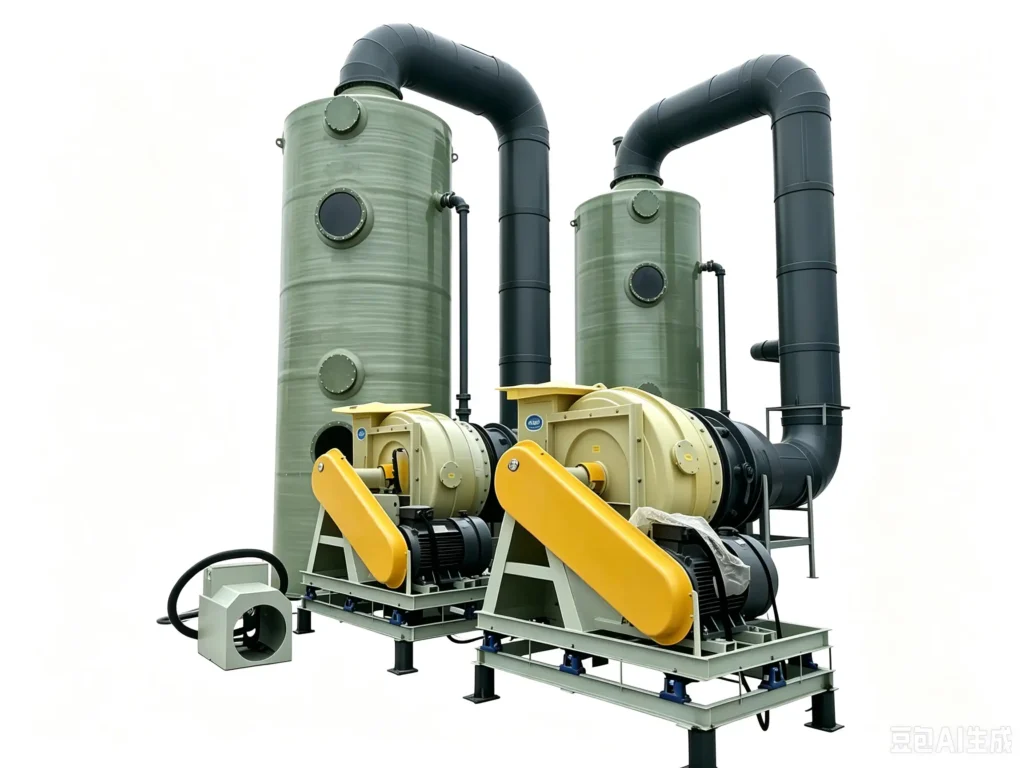
Emergency Chlorine Scrubber System
2. Core Chemistry & Neutralization Dynamics
The primary mechanism for emergency chlorine gas destruction is wet scrubbing using a sodium hydroxide ($\text{NaOH}$) solution.
$$\text{Cl}_2 + 2\text{NaOH} \rightarrow \text{NaClO} + \text{NaCl} + \text{H}_2\text{O}$$
Critical Chemical Control Factors:
- Caustic Concentration: Maintain a $15\%–20\%$ $\text{NaOH}$ concentration in the recirculation tank. Higher concentrations can cause salt precipitation, while lower levels reduce absorption kinetics.
- Temperature & Exothermic Management: The neutralization reaction is highly exothermic. System design must incorporate sufficient liquid volume and heat dissipation to prevent the recirculation liquor from exceeding $55^\circ\text{C}$ ($131^\circ\text{F}$), which degrades scrubbing efficiency and damages FRP vessel integrity.
- Dual-Parameter Monitoring: Implement real-time pH and ORP (Oxidation-Reduction Potential) sensors to monitor caustic strength continuously.
3. Engineering Architecture & Redundancy
In a catastrophic leak scenario, equipment failure is not an option. An EPA-compliant system requires strict redundant design:
- Two-Stage Packed Tower Configuration: A counter-current packed tower utilizing high-efficiency random or structured packing (e.g., PP or PVDF Pall Rings) ensures maximum gas-liquid contact area with minimal pressure drop.
- Dual-Tank / Auto-Switching System: Dual chemical storage sumps with automatic switching valves prevent treatment interruption if the primary caustic supply runs low.
- Mechanical Redundancy:
- $1\text{ Duty} + 1\text{ Standby}$ corrosion-resistant pumps (magnetic drive or seal-less).
- Explosion-proof (ATEX / Class I, Div 2) induced draft fans.
- Uninterruptible Power Supply (UPS) integration to ensure 30+ minutes of operation during plant power outages.
4. Materials of Construction (Corrosion Resistance)Emergency Chlorine Scrubber System
Moist chlorine gas combined with strong caustic solutions creates one of the most corrosive environments in chemical processing. Materials must be selected carefully:
- Scrubber Vessel & Ductwork: Premium Vinyl Ester Resin Fiberglass Reinforced Plastic (FRP) or High-Density Polypropylene (PP-H).
- Internal Packing & Nozzles: PVDF or Pure PP for high chemical resistance and thermal stability.
- Mist Eliminators: High-efficiency chevron or mesh pad demisters mounted at the column top to prevent caustic liquid carryover into the stack.
Need a Custom Emergency Chlorine Scrubber System Design?
At YF Environmental, we specialize in engineered-to-order industrial waste gas systems. From HAZOP analysis to full-scale skid fabrication, our engineering team delivers compliant, reliable emergency treatment systems tailored to your facility’s specific storage capacity.
- Looking for technical specifications or PFD engineering drawings?
- Explore our custom [Liquid Chlorine Emergency Scrubbing System] solutions.
- Contact our engineering team directly at yfep@yf-ep.com or via WhatsApp.