
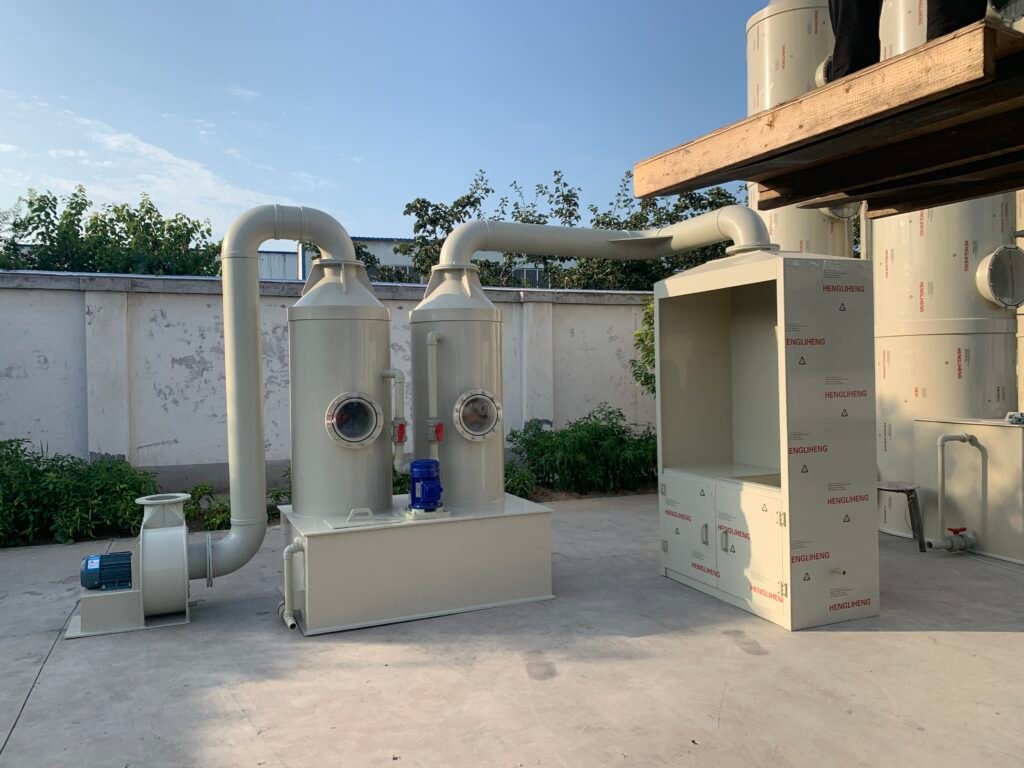
- What Is a Laboratory Exhaust Gas Treatment System?
- Why Does Laboratory Exhaust Need Treatment?
- Acidic Fumes
- Alkaline Gases
- Toxic and Reactive Gases
- VOCs and Solvent Vapors
- Wet Scrubber
- Activated Carbon Adsorption
- PP / PPH
- FRP
- Stainless Steel
- 1. Airflow Rate
- 2. Gas Composition
- 3. Inlet Concentration
- 4. Gas Temperature
- 5. Operating Conditions
- 6. Available Installation Space
- 7. Required Outlet Standard
- Undersized Equipment
- Oversized Equipment
- 1. Fume Hood
- 2. Exhaust Duct
- 3. Wet Scrubber
- 4. Packing
- 5. Demister
- 6. Circulation Pump
- 7. Chemical Dosing System
- 8. pH Control
- 9. Exhaust Fan
- 10. Exhaust Stack
Laboratories generate a wide range of chemical fumes, vapors, odors, and particulate pollutants during research, testing, analysis, and production activities.
A laboratory fume hood can effectively capture hazardous contaminants at the source, but capturing laboratory exhaust is only the first step. Depending on the chemicals involved and local environmental requirements, the exhaust air may also need to be treated before being discharged into the atmosphere.
A properly designed laboratory exhaust gas treatment system combines ventilation, ductwork, an exhaust fan, air pollution control equipment, and a suitable discharge system to safely remove and treat contaminated air.
For laboratories handling corrosive or hazardous chemicals, a laboratory exhaust scrubber or other gas treatment technology can be an important part of the overall ventilation system.
What Is a Laboratory Exhaust Gas Treatment System?
A laboratory exhaust gas treatment system is an engineered system designed to capture, transport, treat, and discharge contaminated air generated by laboratory processes.
A typical system may include:
- Laboratory fume hoods
- Local exhaust ventilation
- Chemical-resistant exhaust ductwork
- Exhaust fan
- Wet scrubber or dry adsorption unit
- Demister / mist eliminator
- Circulation pump and chemical dosing system
- pH monitoring and control
- Exhaust stack
- Control panel and safety interlocks
The exact configuration depends on the airflow rate, contaminants, concentration, temperature, material compatibility, required removal efficiency, and installation conditions.
Laboratory ventilation systems are designed not only to remove contaminants but also to maintain appropriate airflow and pressure relationships within the laboratory. ASHRAE notes that laboratory exhaust systems may require filtration, scrubbing, or other emission control depending on the hazardous materials present.
Why Does Laboratory Exhaust Need Treatment?
Not every laboratory exhaust stream requires the same level of treatment.
Some laboratory processes may generate relatively low-risk vapors that can be discharged through a properly designed exhaust system. Other processes may generate corrosive, toxic, odorous, or environmentally hazardous pollutants.
Common laboratory exhaust contaminants include:
Acidic Fumes
Laboratories may use:
- Hydrochloric acid (HCl)
- Hydrofluoric acid (HF)
- Nitric acid (HNO₃)
- Sulfuric acid (H₂SO₄)
- Perchloric acid
- Phosphoric acid
These substances can generate corrosive acid fumes during heating, digestion, reaction, or sample preparation.
Alkaline Gases
Typical alkaline contaminants include:
- Ammonia (NH₃)
- Amines
- Alkaline chemical vapors
Toxic and Reactive Gases
Depending on the laboratory application, exhaust may contain:
- Chlorine (Cl₂)
- Hydrogen sulfide (H₂S)
- Sulfur dioxide (SO₂)
- Nitrogen oxides (NOx)
- Hydrogen chloride (HCl)
VOCs and Solvent Vapors
Chemical and pharmaceutical laboratories may also generate volatile organic compounds from solvents and other chemicals.
Examples include:
- Acetone
- Ethanol
- Methanol
- Toluene
- Xylene
- Other organic solvent vapors
Different pollutants require different treatment technologies. Therefore, a laboratory exhaust system should be designed according to the actual gas composition rather than simply selecting a standard scrubber based on airflow.
How Does a Laboratory Exhaust Treatment System Work?
A typical system follows this process:
Fume Hood → Exhaust Duct → Scrubber / Treatment Unit → Demister / Filter → Exhaust Fan → Stack
The fume hood captures contaminants at the source.
The exhaust duct transports the contaminated air to the treatment equipment.
The treatment unit removes or neutralizes the target pollutants.
The treated air passes through a mist eliminator or other final-stage filtration device.
The exhaust fan maintains the required airflow and negative pressure.
Finally, the treated air is discharged through the exhaust stack.
For systems using wet scrubbing, the gas and scrubbing liquid are brought into contact inside the scrubber. EPA guidance describes wet scrubbers as systems that use a scrubbing liquid to capture hazardous substances from fume hood exhaust, with mist eliminators used to prevent scrubber liquid from being carried out with the treated air.
Laboratory Exhaust Scrubber: When Is It Required?
A laboratory exhaust scrubber is commonly considered when the exhaust contains water-soluble, corrosive, or reactive gaseous pollutants.
For example:
| Contaminant | Typical Treatment |
|---|---|
| HCl | Alkaline wet scrubber |
| HF | Alkaline wet scrubber |
| HNO₃ | Wet scrubber |
| SO₂ | Alkaline wet scrubber |
| Cl₂ | Alkaline wet scrubber |
| NH₃ | Acidic wet scrubber |
| Acid mist | Wet scrubber |
| Some VOCs | Activated carbon adsorption / other technologies |
| Particulate matter | Filtration / wet collection |
The treatment method should always be selected based on the actual process conditions.
For example, an HCl laboratory exhaust system and an ammonia exhaust system may require completely different scrubbing solutions.
EPA engineering guidance also recommends counter-current flow in scrubbers where used, together with appropriate sump, recirculation, liquid-level and pH controls.
Wet Scrubber vs. Activated Carbon for Laboratory Exhaust
One of the most common questions is whether a laboratory should use a wet scrubber or activated carbon adsorption.
The answer depends on the pollutant.
Wet Scrubber
A wet scrubber is particularly suitable for many:
- Acid gases
- Alkaline gases
- Water-soluble gases
- Inorganic gases
- Acid mist
Advantages include:
- Continuous operation
- Suitable for corrosive gases
- Chemical neutralization
- High gas-liquid contact area
- Suitable for relatively large exhaust volumes
Activated Carbon Adsorption
Activated carbon systems are often considered for:
- Certain VOCs
- Organic solvent vapors
- Odors
- Low-concentration gaseous pollutants
However, carbon selection must be based on the actual chemical composition. Standard activated carbon is not automatically suitable for every laboratory chemical.
For some laboratory applications, a multi-stage treatment system may be more appropriate.
For example:
Pre-filter → Wet Scrubber → Demister → Activated Carbon → Fan → Stack
The final configuration should be determined by the contaminant characteristics and required emission performance.
Choosing the Right Material for a Laboratory Exhaust Scrubber
Material selection is particularly important for laboratory exhaust systems because chemical fumes can be highly corrosive.
Common materials include:
PP / PPH
Polypropylene and PPH are widely used for corrosive chemical exhaust applications.
They can be suitable for many:
- Acid fumes
- Alkali fumes
- Chemical laboratories
- Pharmaceutical laboratories
- Research laboratories
PPH is especially attractive for applications requiring good chemical resistance and fabricated plastic equipment.
FRP
FRP can also be used for chemical exhaust treatment systems where its chemical resistance and structural characteristics are appropriate.
Stainless Steel
Stainless steel may be selected for specific applications where higher temperature resistance, mechanical strength, or compatibility with particular chemicals is required.
The correct material cannot be selected simply by looking at the airflow.
Chemical composition + concentration + temperature + operating conditions should all be considered.
Laboratory Exhaust System Design: What Information Is Required?
Before designing a laboratory exhaust treatment system, an experienced supplier should normally request several key parameters.
1. Airflow Rate
For example:
1,500 m³/h
or
3,000 m³/h
The airflow determines the basic size of the scrubber, ductwork, fan, and other components.
2. Gas Composition
The supplier needs to know what contaminants are present.
For example:
- HCl
- HF
- HNO₃
- NH₃
- Cl₂
- VOCs
- Acid mist
3. Inlet Concentration
The concentration of the pollutants is important for determining:
- Scrubbing liquid
- Chemical dosage
- Equipment size
- Number of treatment stages
- Expected removal efficiency
4. Gas Temperature
Temperature can significantly affect:
- Material selection
- Scrubbing performance
- Fan selection
- Condensation
- Duct design
5. Operating Conditions
The supplier should understand whether the system operates:
- Continuously
- Intermittently
- During laboratory shifts
- Only during specific experiments
- In emergency conditions
6. Available Installation Space
Laboratories often have limited mechanical-room or rooftop space.
Therefore, equipment dimensions and maintenance access should be considered during the initial design.
7. Required Outlet Standard
The required outlet concentration should be confirmed based on the applicable local regulations and project requirements.
Example: Laboratory Acid Fume Treatment System
Consider a laboratory where acid digestion is carried out inside several fume hoods.
The process may involve:
HCl + HNO₃ + HF
The laboratory exhaust system could be configured as:
Fume Hood → PP/FRP Duct → Wet Scrubber → Demister → Exhaust Fan → Stack
For this application, a chemical-resistant wet scrubber can provide gas-liquid contact between the contaminated air and an appropriate scrubbing solution.
If HF is present, material compatibility becomes especially important.
The supplier should also consider:
- HF concentration
- Gas temperature
- Water quality
- Scrubbing reagent
- Corrosion resistance
- Packing material
- Mist elimination
- Fan material
- Drainage
- Maintenance access
This is why laboratory exhaust treatment should be treated as an engineering project rather than a standard equipment purchase.
Laboratory Fume Hood Exhaust System and Scrubber Design
A fume hood is the primary containment device that captures contaminants generated during laboratory operations.
The exhaust treatment system is downstream of the hood.
These two systems should therefore be considered together.
ASHRAE describes laboratory airflow control as a combination of exhaust systems, air supply systems, containment devices, and laboratory airflow conditions. It also notes that fume hood performance depends on factors such as face velocity, sash position, hood configuration, exhaust ports, room airflow, and other conditions.
A poorly designed exhaust system can therefore create problems even when the scrubber itself is correctly sized.
Important design considerations include:
- Required hood airflow
- Duct pressure loss
- Scrubber pressure drop
- Fan static pressure
- Laboratory negative pressure
- Makeup air
- Exhaust stack location
- Maintenance requirements
The exhaust discharge location is also important. ASHRAE notes that laboratory exhaust stacks should be designed to minimize the possibility of exhaust being re-entrained into outdoor air intakes or other building openings.
Why a Customized Laboratory Exhaust Treatment System Is Better
There is no universal “laboratory scrubber” that is suitable for every laboratory.
A university chemistry laboratory, pharmaceutical R&D laboratory, environmental testing laboratory, and industrial quality-control laboratory may have completely different exhaust characteristics.
A customized system allows the equipment to be selected according to:
Gas → Airflow → Concentration → Temperature → Material → Removal target → Installation conditions
This approach can help avoid two common problems:
Undersized Equipment
An undersized scrubber may not provide sufficient gas-liquid contact or treatment capacity.
Oversized Equipment
An oversized system may increase:
- Equipment cost
- Fan power consumption
- Footprint
- Chemical consumption
- Maintenance requirements
The objective should therefore be the right treatment system for the actual process, rather than simply choosing the largest available equipment.
Laboratory Exhaust Treatment System Components
A complete system may include the following:
1. Fume Hood
Captures contaminants at the source.
2. Exhaust Duct
Transfers contaminated air from the laboratory to the treatment equipment.
3. Wet Scrubber
Provides gas-liquid contact and removes soluble or reactive pollutants.
4. Packing
In packed scrubbers, packing increases the gas-liquid contact area.
5. Demister
Removes entrained droplets from the treated gas.
6. Circulation Pump
Circulates the scrubbing liquid.
7. Chemical Dosing System
Adds neutralizing chemicals when required.
8. pH Control
Monitors and controls the scrubbing solution.
9. Exhaust Fan
Provides the required airflow and system pressure.
10. Exhaust Stack
Discharges treated air safely.
A complete package can therefore be supplied as a laboratory exhaust gas treatment system, rather than as an isolated scrubber.
Laboratory Exhaust Treatment System Maintenance
Regular maintenance is essential for stable performance.
Typical inspection items include:
- Scrubbing liquid level
- pH value
- Pump condition
- Spray nozzles
- Packing condition
- Demister condition
- Fan vibration
- Fan motor
- Duct leakage
- Differential pressure
- Chemical dosing system
- Exhaust airflow
For wet scrubbers, the scrubbing liquid may require periodic replacement or blowdown, while makeup water and chemical reagents may be required to maintain operating conditions. EPA guidance specifically identifies liquid level and pH control as important scrubber control functions.
A preventive maintenance schedule can help maintain stable treatment performance and extend equipment service life.
How to Select a Laboratory Exhaust Treatment System Manufacturer
When comparing suppliers, price should not be the only consideration.
A qualified supplier should be able to understand the relationship between:
Laboratory Process → Contaminant → Ventilation → Treatment → Discharge
Before requesting a quotation, provide as much of the following information as possible:
- Exhaust airflow
- Gas composition
- Inlet concentration
- Gas temperature
- Operating hours
- Required outlet concentration
- Fume hood quantity
- Duct size
- Available installation space
- Local environmental requirements
- Preferred material
- Power supply
An experienced manufacturer should then be able to recommend:
- Scrubber type
- Equipment dimensions
- Material
- Fan capacity
- Pump capacity
- Chemical dosing method
- Duct configuration
- Stack arrangement
- Control system
Custom Laboratory Exhaust Gas Treatment Systems from YF-EP
At Henan Yuanfang Environmental Protection Equipment Co., Ltd., we design and manufacture customized industrial exhaust gas treatment equipment for chemical and laboratory applications.
Our equipment manufacturing capabilities include:
- PP / PPH scrubbers
- FRP scrubbers
- Stainless steel scrubbers
- Packed-bed wet scrubbers
- Acid and alkali gas treatment systems
- Activated carbon adsorption systems
- Chemical exhaust treatment equipment
- Corrosion-resistant ducts and piping
- Exhaust fans
- Chemical dosing systems
Our approach starts with the actual gas conditions rather than a standard equipment model.
For laboratory projects, we can evaluate the system based on:
Airflow + Gas Composition + Concentration + Temperature + Material Compatibility + Required Treatment Performance
This allows the laboratory exhaust treatment system to be designed around the actual process and installation conditions.
Need a Laboratory Exhaust Treatment System?
If you are planning a new laboratory, upgrading an existing fume hood exhaust system, or looking for a laboratory exhaust scrubber, send us your basic project information.
We can evaluate the preliminary configuration based on:
Airflow: ___ m³/h
Gas composition: ___
Inlet concentration: ___ mg/Nm³
Temperature: ___ °C
Number of fume hoods: ___
Required outlet concentration: ___
Available installation space: ___
Our engineering team can then recommend a suitable laboratory exhaust gas treatment system, including the scrubber, fan, ductwork, chemical dosing, and other required components.
Tell us what your laboratory is handling, and we will help you determine the right exhaust treatment solution.