
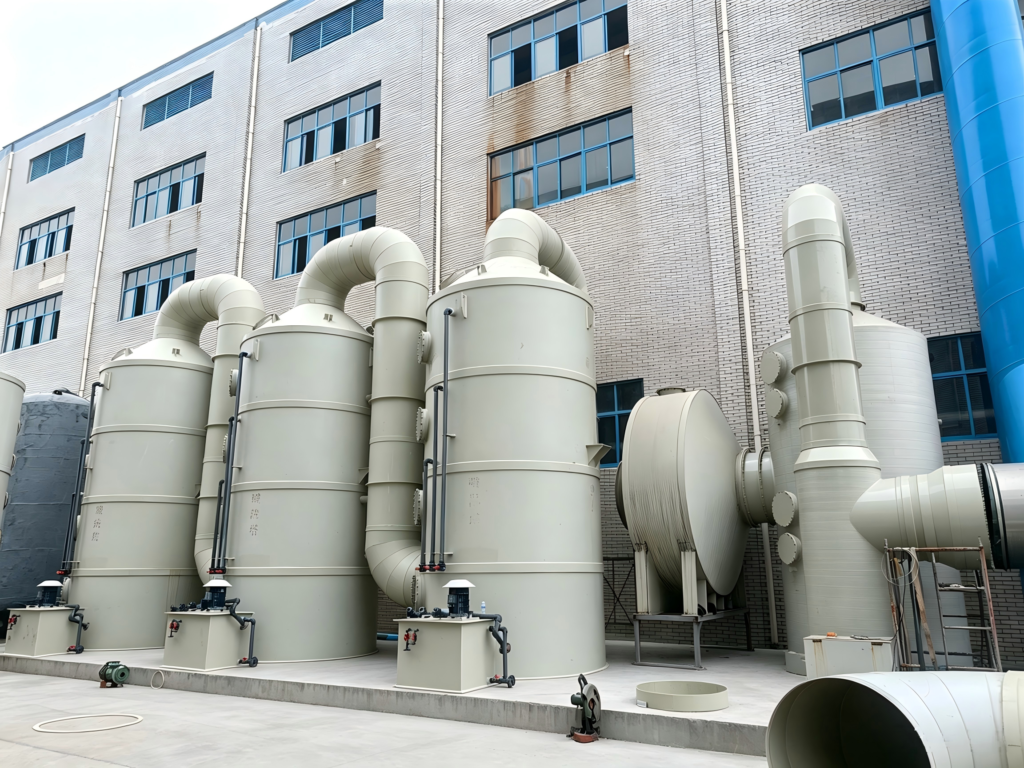
- Why Three-Stage Treatment for Pharmaceutical Emissions
- Stage 1: Spray Tower — Bulk Acid Gas Removal
- Column Sizing and Hydraulics
- Recirculation Chemistry Control
- Stage 2: Oxidation Tower — VOC and Odor Destruction
- Sodium Hypochlorite Wet Oxidation
- ORP-Controlled Oxidant Dosing
- Off-Gas Scrubbing Integration
- Stage 3: Alkaline Scrubber — Polishing and Compliance Assurance
- Packing Media and Bed Configuration
- Mist Elimination
- Cost Optimization Strategies Across the Three-Stage System
- Chemical Consumption
- Energy Efficiency
- Maintenance Cost Reduction
- Design Case: 25,000 m³/h Pharma API Facility
- Key Takeaways for Engineers
Pharmaceutical manufacturing generates complex acid-alkaline waste gas streams that single-stage scrubbing systems often fail to treat adequately. From API synthesis and fermentation to tablet coating and solvent recovery, each process unit releases a distinct cocktail of acidic mists—hydrogen chloride, sulfur dioxide, nitrogen oxides, and trace organic acids—combined with alkaline vapors and volatile organic compounds (VOCs). A properly engineered three-stage treatment system integrating a spray tower, oxidation tower, and alkaline scrubber delivers removal efficiencies exceeding 98% while maintaining manageable operating costs. This article examines the design rationale, key process parameters, and cost optimization strategies for pharmaceutical acid waste gas treatment.
Why Three-Stage Treatment for Pharmaceutical Emissions
Pharmaceutical exhaust streams present three compounding challenges that single-stage scrubbers are poorly equipped to handle:
- Multi-phase pollutant profiles: The same exhaust duct may carry acid mist (HCl, H₂SO₄), alkaline aerosols (NH₃, amines), and moderately soluble VOCs (methanol, acetone, dichloromethane). A spray tower alone neutralizes acidic components but passes both alkaline vapors and hydrophobic organics through untreated.
- Fluctuating concentrations: Batch production cycles in pharmaceutical plants cause exhaust concentrations to swing by factors of 5-10× within a single shift. Fixed-bed scrubbers sized for peak loads operate at low efficiency during off-peak periods, wasting reagent and energy.
- Regulatory thresholds tightening: China’s GB 37823-2019 and the EU’s Industrial Emissions Directive (IED) now require pharmaceutical plants to demonstrate consistent compliance for acid gases, odor compounds, and VOCs simultaneously—a requirement that demands multi-barrier treatment.
A three-stage approach addresses each layer independently: the spray tower handles bulk acid removal, the oxidation tower breaks down VOCs and odorants, and the alkaline scrubber polishes residual acid gases while neutralizing any acidic oxidation byproducts. This staged architecture ensures that each unit operates within its optimal performance envelope rather than compromising across incompatible treatment objectives.
Stage 1: Spray Tower — Bulk Acid Gas Removal
The spray tower serves as the first line of defense, designed to capture the dominant acid species through counter-current gas-liquid contact. For pharmaceutical applications, the following design parameters are critical:
Column Sizing and Hydraulics
The tower diameter is determined by the superficial gas velocity, typically maintained between 1.2 and 2.5 m/s for open spray towers treating pharma exhaust. Operating above 2.5 m/s risks entrainment carryover into downstream units, while velocities below 1.0 m/s result in poor liquid distribution and dead zones. For a typical pharmaceutical plant exhausting 15,000–30,000 m³/h, this yields a tower diameter of 1.6–2.4 meters.
The liquid-to-gas ratio (L/G) is the single most influential parameter for acid removal efficiency. For HCl-dominated streams, an L/G of 2.0–3.5 L/m³ is sufficient; for H₂SO₄ mist with submicron droplet sizes, the ratio should increase to 4.0–6.0 L/m³ to compensate for the lower mass transfer coefficient of fine aerosols. The spray nozzle selection—hollow cone vs. full cone, with droplet Sauter mean diameters of 500–1,200 μm—directly impacts both mass transfer surface area and pumping energy consumption.
Recirculation Chemistry Control
Maintaining the scrubbing liquor pH between 6.5 and 8.0 ensures adequate neutralization capacity without excessive caustic consumption. A pH controller with a dosing pump feeding 30% NaOH solution provides responsive chemistry management. The blowdown rate should be set to maintain total dissolved solids (TDS) below 50,000 mg/L to prevent nozzle clogging and scaling on packing internals.
A well-designed pharmaceutical spray tower operating at steady state achieves 85–92% HCl removal and 75–85% H₂SO₄ removal as a standalone unit. The remaining acid load passes to downstream stages for polishing.
Stage 2: Oxidation Tower — VOC and Odor Destruction
The oxidation tower targets organic compounds and reduced sulfur species that survive the spray tower’s purely physical absorption mechanism. For pharmaceutical applications, two oxidation approaches dominate:
Sodium Hypochlorite Wet Oxidation
NaOCl dosed at 100–500 mg/L (as available chlorine) in a dedicated oxidation tower achieves rapid destruction of amines, mercaptans, and low-molecular-weight alcohols. The reaction kinetics are pH-dependent: oxidation of sulfides and mercaptans proceeds optimally at pH 9–10, while amine oxidation requires pH 7–8 to avoid excessive chloramine formation. A dual-pH control loop with separate acid (H₂SO₄) and caustic (NaOH) dosing maintains the oxidation liquor within its target window.
The oxidation tower typically employs structured packing or random packing (Pall rings, 25–38 mm) with a bed depth of 2.0–3.5 meters, providing gas-liquid contact time of 2–4 seconds at design flow. This contact time, combined with 3–5 recirculation passes, ensures 90–95% destruction of target odorants and 70–85% VOC reduction for water-soluble compounds.
ORP-Controlled Oxidant Dosing
An oxidation-reduction potential (ORP) probe immersed in the recirculation sump provides real-time feedback for oxidant dosing. Target ORP values typically range from 550–700 mV (vs. Ag/AgCl) for effective oxidation without excessive chlorine residual that could corrode downstream ductwork. Integrating the ORP signal with a PID-controlled dosing pump reduces NaOCl consumption by 25–35% compared to fixed-rate dosing, directly lowering chemical operating costs.
Off-Gas Scrubbing Integration
A critical design consideration is that the oxidation tower generates chlorine dioxide and volatile chlorinated byproducts as secondary emissions. The exhaust from the oxidation stage therefore feeds directly into the alkaline scrubber, which serves double duty: neutralizing residual acid gases from Stage 1 and scrubbing chlorine species from Stage 2. This integrated approach avoids the need for a separate scavenger column.
Stage 3: Alkaline Scrubber — Polishing and Compliance Assurance
The alkaline scrubber is the final treatment barrier, designed as a packed-bed counter-current absorber operating at pH 10–12 with NaOH as the neutralizing agent. Its roles are threefold:
- Acid gas polishing: Removes the remaining 5–15% of acid gases that slipped past the spray tower, targeting outlet concentrations below 5 mg/Nm³ for HCl and 10 mg/Nm³ for H₂SO₄.
- Chlorine species absorption: Captures Cl₂, ClO₂, and chlorinated organics generated in the oxidation tower through alkaline hydrolysis reactions.
- Final odor control: Absorbs residual acidic odorants (H₂S, organic acids) to ensure stack emissions meet odor threshold standards.
Packing Media and Bed Configuration
For pharmaceutical alkaline scrubbers, structured packing (e.g., Mellapak 250Y or equivalent) is preferred over random packing due to its higher surface area density (250 m²/m³), lower pressure drop (typically 0.3–0.6 kPa per meter of bed), and superior liquid distribution at turndown ratios as low as 30%. A two-bed configuration with intermediate liquid redistribution provides the following typical performance:
- Lower bed (2.5 m): Bulk absorption of residual acid gases, operating with fresh caustic solution at pH 11–12.
- Upper bed (1.5 m): Polishing section with recirculated liquor, targeting single-digit ppm outlet concentrations.
Mist Elimination
A high-efficiency chevron or mesh pad mist eliminator mounted above the top spray header prevents caustic carryover into the stack, which would otherwise manifest as visible plumes and PM₂.₅ compliance issues. The pressure drop across the mist eliminator should not exceed 150 Pa at design flow.
Cost Optimization Strategies Across the Three-Stage System
Chemical Consumption
NaOH and NaOCl represent 55–65% of total operating costs in a three-stage pharma scrubbing system. The following measures achieve 20–30% cost reduction:
- Cascade pH control: Rather than dosing fresh caustic independently to each stage, implement a cascade where the alkaline scrubber overflow (pH 10–11) feeds the spray tower sump, utilizing residual alkalinity. This reduces fresh NaOH consumption by 15–20%.
- ORP-based NaOCl optimization: Replacing timed dosing with ORP feedback control typically reduces NaOCl usage from 350–500 mg/L to 200–350 mg/L while maintaining equivalent destruction efficiency.
- Bulk chemical procurement: For plants consuming more than 20 tonnes/year of 30% NaOH, switching from IBC totes to bulk tanker delivery reduces unit cost by 30–40%.
Energy Efficiency
Pumping energy dominates electricity consumption. Key optimization measures include:
- Variable frequency drives (VFDs) on recirculation pumps, matching flow rates to actual exhaust load rather than fixed-speed operation. Plants with batch production cycles see 25–40% energy savings from VFD implementation.
- Nozzle selection and maintenance: Clogged or worn spray nozzles increase pressure drop and reduce mass transfer efficiency. A quarterly nozzle inspection and replacement program maintains design L/G ratios without pump oversizing.
- Fan optimization: The induced draft fan typically accounts for 40–60% of total system electrical load. Sizing the fan for the actual system pressure drop (including realistic packing fouling factors) rather than over-conservative estimates avoids 15–25% in unnecessary power consumption.
Maintenance Cost Reduction
Pharmaceutical exhaust often contains trace compounds—plasticizers from ductwork, lubricants from compressors, and fine particulate from tablet processing—that foul packing and clog nozzles. Preventive measures include:
- Pre-filtration: A simple demister pad or vane-type pre-separator upstream of the spray tower captures coarse particulate and condensable aerosols, extending packing cleaning intervals from 6 months to 18–24 months.
- Chemical cleaning-in-place (CIP): Integrating a CIP system that periodically circulates 5% citric acid or sulfamic acid solution through spray headers and packing dissolves carbonate and sulfate scale without requiring vessel entry.
- Corrosion-resistant materials: For stages exposed to both acid and oxidizing conditions—particularly the oxidation tower and interconnecting ductwork—FRP (vinyl ester resin) or PP-H with UV stabilization provides 15+ year service life with minimal maintenance, significantly outperforming 304/316 stainless steel in wet chlorine environments.
Design Case: 25,000 m³/h Pharma API Facility
A recent engineering project for a pharmaceutical API manufacturing facility in Eastern China illustrates the three-stage approach in practice. The exhaust stream contained HCl (80–120 mg/Nm³), NH₃ (15–25 mg/Nm³), methanol (50–80 mg/Nm³), and trace dimethylformamide, with flow rates varying between 8,000 and 25,000 m³/h depending on production scheduling.
The designed system comprised:
- Spray tower: 2.0 m diameter × 6.5 m height, 3 hollow-cone spray levels, L/G = 3.5 L/m³, NaOH scrubbing at pH 7–8.5.
- Oxidation tower: 1.8 m diameter × 5.0 m packed bed (38 mm Pall rings, 3.0 m bed depth), NaOCl dosing at 250–350 mg/L with ORP control at 600–650 mV.
- Alkaline scrubber: 1.6 m diameter × 7.0 m height, two-bed structured packing (2.5 m + 1.5 m), NaOH at pH 11–12, high-efficiency mist eliminator.
- Fan: 37 kW induced draft, VFD-controlled, total system pressure drop 1,850 Pa.
Commissioning data confirmed outlet concentrations of HCl <3 mg/Nm³, NH₃ <2 mg/Nm³, and methanol <15 mg/Nm³—all well within GB 37823-2019 emission limits. Total chemical consumption (NaOH 30% + NaOCl 10%) stabilized at 280 kg/day at full load, with annual operating costs estimated at ¥180,000–220,000 (approximately $25,000–30,000 USD).
Key Takeaways for Engineers
- Match the stage count to the pollutant complexity: Simple HCl-only streams may require only a single spray tower; multi-component pharmaceutical exhaust demands multi-stage treatment. Over-engineering a single stage to handle everything typically costs more and performs worse than three properly sized stages.
- Instrumentation pays for itself: pH, ORP, and flow monitoring with automated dosing control typically achieves ROI within 8–14 months through chemical savings alone. Manual dosing on a three-stage system is neither cost-effective nor reliable for regulatory compliance.
- Design for turndown: Batch pharmaceutical production means exhaust flow and concentration vary dramatically. Variable-speed pumps and fans, combined with packing that maintains efficiency at 30% turndown, prevent compliance gaps during low-production periods.
- Secondary emissions matter: Oxidation towers generate chlorinated byproducts; alkaline scrubbers release CO₂ from carbonate reactions. The three-stage configuration should be evaluated as an integrated system for total stack emissions, not as three independent units.
For pharmaceutical plants facing tightening acid gas, VOC, and odor regulations, the spray tower + oxidation tower + alkaline scrubber configuration provides a proven, cost-effective treatment architecture. The key to successful implementation lies not in selecting the most expensive equipment but in properly integrating each stage’s chemistry, hydraulics, and control strategy into a coherent system.
For inquiries, contact Yfep@yf-ep.com | www.xxyuanfang.cn