
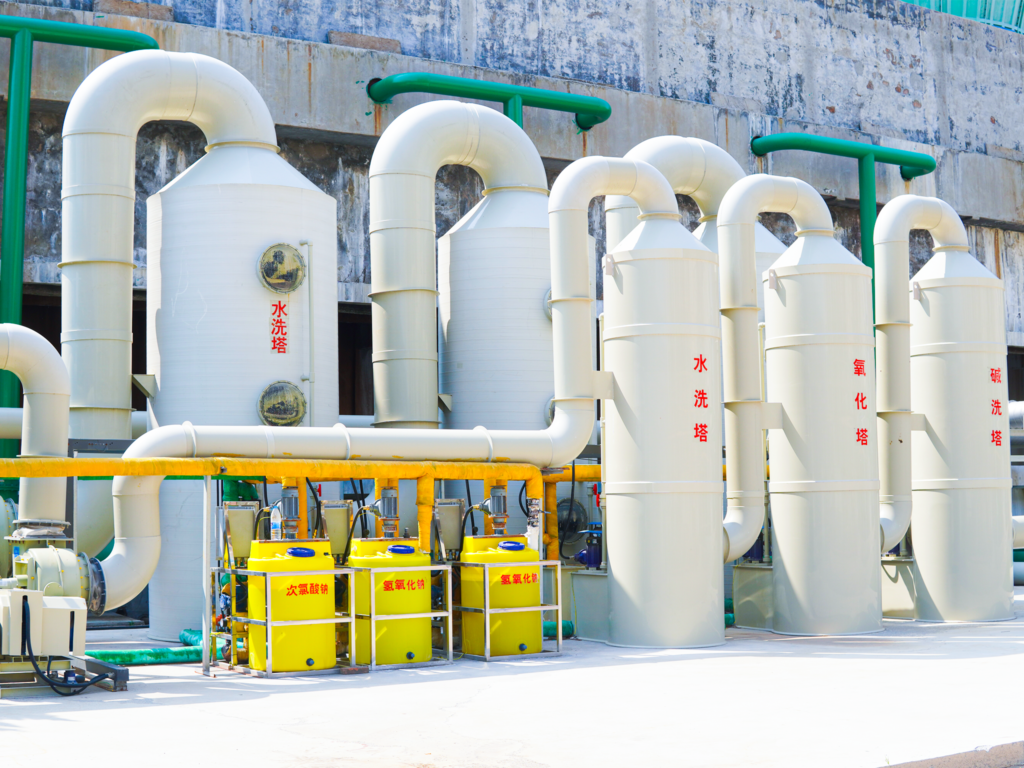
Introduction
The food processing industry generates a diverse range of acid waste gases during production operations, including acetic acid vapors from fermentation, hydrochloric acid mists from cleaning-in-place (CIP) systems, sulfur dioxide from sulfitation processes, and nitric acid emissions from passivation. These acid-laden exhaust streams, if left untreated, pose significant risks: corrosion of ductwork and structural steel, violation of increasingly stringent environmental regulations, and potential product quality impacts from cross-contamination. Dedicated acid and alkali pollution control systems are required to capture these corrosive streams safely.
While single-stage scrubbers are common in general industrial applications, a food industry acid scrubber must address unique challenges that demand a more sophisticated approach. The combination of spray tower and packed tower technologies in series has emerged as the preferred solution for achieving both high removal efficiency and operational reliability in food-grade environments.
This article provides a comprehensive technical guide to designing, operating, and maintaining an effective food industry acid scrubber using spray tower and packed tower combined systems, covering everything from emission source characterization to regulatory compliance strategies.
Acid Gas Sources and Characteristics in Food Processing
Understanding the specific characteristics of acid gas emissions in food processing is the first step toward effective system design. Unlike chemical or pharmaceutical industries where pollutant streams are relatively predictable, food processing presents a more complex and variable emission profile.
Primary Emission Sources
- Fermentation Tanks and Vessels: Acetic acid, lactic acid, and butyric acid vapors are released during microbial fermentation of carbohydrates and proteins. Concentrations typically range from 50 to 500 mg/m³, with significant variation depending on batch cycle stage and substrate composition.
- CIP (Clean-in-Place) Systems: Automated cleaning cycles use nitric acid (1-3% concentration) and phosphoric acid solutions at elevated temperatures (60-85°C). The resulting acid mists contain fine droplets (1-10 μm) that are challenging to capture with simple mist eliminators alone.
- Sulfitation Towers (Sugar Processing): SO₂ gas is used as a preservative and bleaching agent in sugar refining. Off-gas concentrations can reach 1,000-3,000 mg/m³ during peak operation, requiring robust scrubbing capacity.
- Smokehouses and Thermal Processing: Combustion of wood chips and thermal degradation of fats produce acidic compounds including formic acid and acetic acid, often mixed with particulate matter and tar-like condensates.
- Wastewater Treatment Areas: Anaerobic digestion and equalization tanks release hydrogen sulfide (H₂S) and volatile fatty acids that contribute to both acid gas loading and odor concerns.
Key Design Challenges Unique to Food Processing
Several factors distinguish an optimal food industry acid scrubber design from general industrial applications and must be addressed during design:
- Hygienic requirements: All equipment must meet food-grade material standards (typically AISI 316L stainless steel or higher), with sanitary design principles to prevent bacterial growth in sumps, piping, and packing media. Dead legs and crevices must be eliminated.
- Variable loading: Production schedules in food plants are often batch-oriented, creating significant diurnal and seasonal variations in gas flow rates and concentrations. A system sized only for peak conditions will operate inefficiently during normal production periods.
- Odor control priority: Beyond regulatory emission limits, food processors face intense pressure from neighboring communities regarding odor nuisances. Acid gases often carry characteristic odors (vinegary for acetic acid, pungent for SO₂) that must be eliminated to near-zero sensory thresholds.
- Condensate management: High humidity in food processing exhaust (often 80-100% RH) leads to significant condensate formation in ductwork and tower internals, requiring proper drainage design and corrosion-resistant materials throughout.
- Organic fouling potential: Proteinaceous aerosols and fat droplets co-emitted with acid gases can deposit on packing surfaces and nozzle orifices, accelerating fouling rates compared to purely inorganic industrial exhaust streams.
Why Combined Spray Tower + Packed Tower Systems
The combined approach addresses the inherent limitations of single-stage scrubbing by deploying two distinct mass transfer mechanisms in series, each optimized for a specific function within the treatment chain.
Spray Tower: The First Stage
The spray tower serves as the primary contactor in a wet scrubber system, designed to handle high inlet loads and remove the bulk of acid gases through direct liquid-gas contact in an open spray chamber. Key advantages in this position include:
- High liquid-to-gas ratio (L/G = 3-8 L/m³): Provides rapid neutralization of high inlet concentrations. The generous liquid flow also provides effective quenching of hot exhaust streams.
- Open internal structure: The absence of packing in the spray section means minimal risk of clogging from particulate matter or biological growth – a critical consideration in food environments where organic aerosols are present in the exhaust.
- Low pressure drop (150-400 Pa): Reduces fan energy consumption, which is a significant operating cost factor over the lifetime of the equipment.
- Quenching capability: Hot exhaust from CIP systems and thermal processes is cooled to near-adiabatic saturation temperature, protecting downstream packed tower components from thermal degradation.
Packed Tower: The Polishing Stage
The packed tower provides the high-efficiency polishing stage for residual acid gases that escape the spray section. Its structured or random packing creates extensive surface area for gas-liquid contact, enabling high mass transfer efficiency at lower concentrations:
- High specific surface area (100-250 m²/m³): Achieves greater than 95% removal for inlet concentrations below 200 mg/m³, pushing outlet values well below regulatory limits.
- Counter-current flow configuration: Maximizes the concentration driving force for absorption at the lean end of the column, where the cleanest scrubbing liquor meets the cleanest gas.
- Mist elimination integration: A high-efficiency chevron or mesh pad demister at the packed bed outlet captures entrained droplets down to 5 μm, critical for food facilities where chemical carryover could contaminate surrounding process areas.
Synergistic Benefits of the Two-Stage Configuration
The two-stage configuration delivers performance that neither technology can achieve independently:
- Turndown capability: During low-production periods, the packed tower alone can maintain compliance, while both stages engage during peak loads. This staged operation reduces chemical and pump energy consumption.
- Operational redundancy: If the spray section requires maintenance (nozzle cleaning is periodic in CIP-heavy food environments), the packed tower provides partial treatment capacity, avoiding a complete production shutdown.
- Scrubbing liquor optimization: The spray tower can operate with recirculated, higher-conductivity scrubbing solution (reducing NaOH consumption), while the packed tower receives fresh makeup water, preventing scaling on packing surfaces that would reduce mass transfer efficiency over time.
Key Design Parameters and Engineering Calculations
System Sizing Fundamentals
Proper sizing of the combined system begins with accurate characterization of the waste gas stream and proceeds through established chemical engineering design methods:
Design Gas Flow Rate (Q): Typically 5,000-80,000 m³/h for medium to large food processing facilities. A safety factor of 1.1-1.2 should be applied to the maximum measured flow rate to account for future production expansion and measurement uncertainty.
Tower Diameter (D): Determined by the allowable superficial gas velocity, which should be maintained at 1.0-1.8 m/s for spray towers and 0.8-1.5 m/s for packed towers to prevent flooding and excessive pressure drop. The diameter is calculated as:
D = √(4Q / πv)
where Q is the volumetric flow rate (m³/s) and v is the design superficial velocity (m/s). For most food processing applications, velocities at the lower end of these ranges are preferred to accommodate variable gas flows.
Packed Bed Height: Typically 1.5-3.0 m for structured packing and 2.0-4.0 m for random packing in food-grade applications. The height is calculated using the Number of Transfer Units (NTU) method:
Z = HTU × NTU
where HTU (Height of Transfer Unit) ranges from 0.3-0.8 m for typical acid gas scrubbing applications with modern random or structured packing.
Scrubbing Chemistry and Reagent Consumption
The scrubbing liquor is a dilute sodium hydroxide (NaOH) solution maintained at pH 8-10 for acid gas neutralization. The relevant neutralization reactions include:
- HCl + NaOH → NaCl + H₂O
- CH₃COOH + NaOH → CH₃COONa + H₂O
- SO₂ + 2NaOH → Na₂SO₃ + H₂O
- 2HNO₃ + Na₂CO₃ → 2NaNO₃ + H₂O + CO₂ (when sodium carbonate is used as a cost-reduction strategy)
NaOH consumption can be estimated at 1.1-1.3 kg NaOH per kg of acid gas removed, representing the stoichiometric requirement plus 10-30% excess to ensure complete neutralization. A pH controller with automated NaOH dosing pump and inline conductivity monitoring maintains optimal scrubbing efficiency while minimizing chemical waste.
Liquid Distribution Design
In food processing applications, liquid distribution design requires particular attention due to the organic fouling potential of the exhaust stream:
- Spray nozzles (spray tower): Full-cone or hollow-cone types with non-clogging orifices (minimum 6 mm diameter) to handle organic particulate loading. Quick-release mounting facilitates periodic cleaning without tower entry.
- Liquid distributor (packed tower): Trough-type or orifice-pan distributors with drip-point density ≥ 60 points/m² for structured packing and ≥ 100 points/m² for random packing to ensure uniform wetting.
- Materials of construction: 316L stainless steel for all wetted distributor components, with PTFE or PVDF nozzle tips if chloride concentrations in the scrubbing liquor exceed 500 ppm.
Mist Elimination Design
Two-stage mist elimination is strongly recommended for food processing applications:
- Primary stage – Chevron-type vane demister at spray tower outlet, capturing droplets larger than 20 μm with low pressure drop (50-100 Pa).
- Secondary stage – Mesh pad demister (wire diameter 0.15-0.28 mm, specific surface area 150-200 m²/m³) at packed tower outlet, capturing droplets down to 5 μm.
Outlet mist concentration should be maintained below 50 mg/m³ to prevent visible plume formation and downstream ductwork corrosion.
Materials of Construction
Material selection is critical for longevity in food processing environments where both chemical attack and hygienic requirements must be satisfied simultaneously:
- Tower shell: FRP (fiberglass-reinforced plastic) with vinyl ester resin for excellent acid resistance and cost-effectiveness, or 316L stainless steel if food-grade surface finish is mandated by the facility HACCP plan.
- Internal supports and grids: FRP or polypropylene (PP) for operating temperatures below 80°C; 316L stainless steel for higher temperature applications.
- Packing media: PP Pall rings or structured packing sheets for the packed bed; ceramic saddles for applications above 80°C. Never use carbon steel in any wetted zone.
- Pumps and piping: 316L stainless steel with mechanical seals rated for caustic service; schedule 80 minimum wall thickness for all recirculation piping.
- Recirculation tank: Integral sump design providing 15-20 minutes of liquid residence time with weir overflow for continuous blowdown to control dissolved solids.
Case Study: Dairy Processing Facility Retrofit
A large dairy processing plant in Southeast Asia was experiencing two persistent problems with their existing single-stage spray tower: (1) acetic acid odor complaints from nearby residential areas occurring 4-5 times per month, and (2) outlet HCl concentration of 45 mg/Nm³ consistently exceeding the local regulatory limit of 30 mg/Nm³ during CIP cycles.
Existing conditions at time of assessment:
- Gas flow rate: 35,000 m³/h (design), 22,000-38,000 m³/h (operating range)
- Inlet HCl concentration: 350 mg/Nm³ peak during CIP, 120 mg/Nm³ average
- Inlet acetic acid concentration: 180 mg/Nm³
- Existing system: Single spray tower, 2.4 m diameter × 6 m height, 3 spray levels with hollow-cone nozzles
- Scrubbing liquor: NaOH solution, manual pH adjustment
Upgrade solution implemented:
- Retained existing spray tower as first stage after nozzle replacement with 316L full-cone type (8 mm orifice) and installation of automated pH control
- Added downstream packed tower: 2.4 m diameter × 7 m height, 2.5 m bed height with 50 mm PP Pall rings (specific surface area 110 m²/m³)
- Installed pH-controlled NaOH dosing system with inline conductivity monitoring and data logging
- Added two-stage mist elimination: chevron vane at spray tower outlet, wire mesh pad at packed tower outlet
- Installed VFD-controlled recirculation pumps for both stages to enable turndown during low-production periods
Six-month performance results:
- Outlet HCl concentration: 8 mg/Nm³ (73% below the 30 mg/Nm³ regulatory limit)
- Outlet acetic acid concentration: 15 mg/Nm³ (91.7% removal efficiency)
- Odor complaints: Reduced from 5 per month to zero
- NaOH consumption: 28 kg/day average (15% reduction compared to single-stage operation due to counter-current optimization)
- Total system pressure drop: 680 Pa (380 Pa spray section + 300 Pa packed section), well within existing fan capacity
- Payback period: 14 months based on reduced chemical costs and eliminated regulatory penalties
Operation and Maintenance Best Practices
Daily Operational Checks
- Verify recirculation pump discharge pressure for both stages; deviation greater than 15% from baseline indicates nozzle clogging or pump impeller wear
- Check scrubbing liquor pH (maintain 8.0-10.0); readings below 7.0 indicate insufficient NaOH dosing requiring immediate corrective action
- Inspect blowdown line for scaling, blockage, or biological growth
- Monitor differential pressure across the packed bed; an increase greater than 20% from the clean-bed baseline indicates developing fouling
Weekly Preventive Maintenance
- Visual inspection of spray nozzles through access ports, looking for uneven spray patterns that indicate partial clogging
- Check demister pad differential pressure and inspect for solids accumulation or biological growth on demister surfaces
- Test emergency eyewash and safety shower stations located near the chemical dosing area
- Verify NaOH bulk storage tank level and place replenishment order if below 30% of capacity
Monthly Scheduled Maintenance
- Remove, inspect, and clean spray nozzles showing reduced flow or uneven spray distribution
- Inspect packing bed surface for channeling, fouling, or settlement using a borescope through upper access ports
- Calibrate pH probe and conductivity sensor against certified buffer standards; document calibration results
- Check all flange gaskets and access door seals for leaks using a portable gas detector
- Lubricate fan bearings per manufacturer specifications and check drive belt tension
Quarterly and Semi-Annual Maintenance
- Chemical cleaning of packing bed if pressure drop has increased more than 30% above baseline: circulate 5-10% citric acid solution for 4-6 hours, followed by thorough rinsing
- Thorough internal inspection during scheduled production shutdown: check for corrosion pitting on vessel walls, packing media degradation, and structural integrity of internal supports
- Replace pH probe assembly as preventive measure (typical service life is 6-12 months in hot caustic service)
- Inspect exhaust stack interior and sampling ports for corrosion or deposit accumulation
Common Troubleshooting Scenarios
High pressure drop across packed bed: Investigate packing fouling from biological growth or scale formation. Check for liquid distributor blockage causing uneven wetting. Chemical cleaning or partial packing replacement may be required if cleaning is ineffective.
Poor removal efficiency despite normal operating pH: Suspect gas channeling due to uneven liquid distribution or packing settlement. Verify liquid distributor leveling and inspect packing bed surface for gaps or depressions indicating settlement.
Visible plume from exhaust stack: Indicates mist eliminator failure, bypass, or flooding. Inspect demister pad elements and sealing surfaces; verify that actual gas velocity does not exceed the demister design rating.
Foaming in recirculation tank: Common in food processing applications due to organic surfactants and proteins in the wastewater fraction of the exhaust. Consider automatic antifoam agent injection or increasing the blowdown rate to reduce surfactant concentration.
Regulatory Compliance and Emission Standards
Food processing facilities operating acid gas scrubbers must comply with both general industrial emission standards and food-sector-specific regulations. Key reference standards include:
- EU Best Available Techniques (BAT) Reference Document for Food, Drink and Milk Industries: Establishes emission limit values for HCl typically in the range of 10-30 mg/Nm³, with BAT-associated emission levels at the lower end.
- US EPA NESHAP (National Emission Standards for Hazardous Air Pollutants): HCl emission limit of 20 ppmv for major sources under applicable subparts.
- Local odor regulations: Many jurisdictions enforce odor concentration limits at sensitive receptors (e.g., 5-10 OU/m³) that effectively require high-efficiency acid gas removal to avoid nuisance complaints.
Continuous emission monitoring (CEM) for HCl and SO₂ may be required depending on facility size and local regulatory framework. Even when CEM is not mandated, periodic stack testing on a semi-annual basis is strongly recommended to verify ongoing system performance and document compliance history.
Conclusion
The spray tower plus packed tower combined system represents the current industry best practice for acid waste gas treatment in food processing facilities. By leveraging the bulk removal capability of the spray section and the high-efficiency polishing of the packed bed, this configuration reliably achieves outlet concentrations well below typical regulatory limits while providing the operational flexibility needed in batch-oriented food production environments.
Key success factors for food industry applications include: accurate characterization of the emission profile across all production cycles and CIP events, proper material selection that balances corrosion resistance with food-grade hygiene requirements, and diligent preventive maintenance focused on nozzle cleanliness and packing bed condition. For existing single-stage systems struggling with compliance or odor issues, a packed tower retrofit downstream of the existing spray tower offers a cost-effective upgrade path with proven results across multiple food processing sectors.
As environmental regulations continue to tighten globally and community expectations around industrial odor control rise, food processors who invest in robust, well-designed multi-stage acid gas scrubbing systems will be well-positioned for long-term operational stability and full regulatory compliance.
For inquiries, contact Yfep@yf-ep.com | www.xxyuanfang.cn