
Introduction
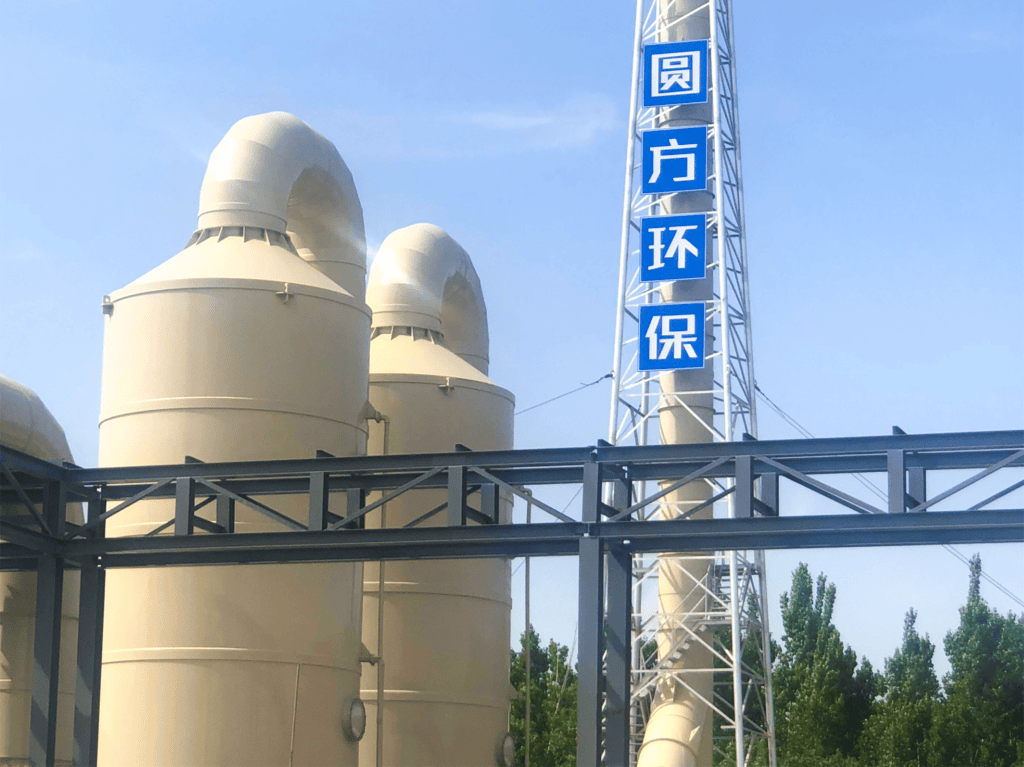
In industrial acid-alkali waste gas treatment, the spray tower (also known as a wet scrubber or spray scrubber) is the workhorse of emission control systems across chemical manufacturing, pharmaceutical production, electroplating, and food processing facilities. Engineers spend countless hours optimizing nozzle configurations, liquid-to-gas ratios, and packing media selection — yet one component receives disproportionately little attention until it fails: the sump tank (also called the recirculation tank or water tank).
Wet scrubber corrosion follows a pattern that’s familiar to any plant maintenance manager: two identical spray towers installed side by side. One sump tank develops pinhole leaks within six months, forcing unplanned shutdowns and emergency patch repairs. The other runs quietly for a decade without incident. What accounts for this factor-of-20 difference in service life? The answer lies not in luck, but in material selection, fluid dynamics design, and operational discipline — three areas where informed engineering decisions make the difference between chronic failure and maintenance-free operation.
The Corrosion Triangle: Chemistry, Temperature, and Flow
When diagnosing wet scrubber corrosion in sump tanks, failures rarely result from a single cause. Instead, they emerge from the intersection of three interacting factors that form what process engineers call the corrosion triangle:
1. Chemical Aggressiveness of the Scrubbing Liquor
The liquid circulating through a spray tower sump is not benign water — it is a progressively concentrated chemical solution. As scrubbing proceeds, absorbed acids (HCl, H2SO4, HF, HNO3) or alkalis (NaOH, NH4OH) accumulate in the recirculating liquid. If blowdown rates are insufficient, the sump becomes a reservoir of corrosive chemistry.
Key chemical factors affecting sump tank life:
- pH extremes: Continuous operation below pH 2 or above pH 12 accelerates corrosion rates exponentially across most materials
- Chloride ion concentration: In HCl scrubbing systems, chloride levels exceeding 500 ppm dramatically increase pitting corrosion risk in stainless steel
- Mixed acid environments: Combined HNO3/HF systems create uniquely aggressive conditions that defeat standard material specifications
- Oxidizing species: Dissolved oxygen, hypochlorite bleach dosing, or peroxide injection for odor control all increase the corrosion potential of the liquid
2. Thermal Cycling and Temperature Gradients
Industrial scrubber sumps experience thermal conditions that most tank designs were never intended to handle. Hot exhaust gas entering at 80-120°C transfers significant thermal energy into the scrubbing liquid. The resulting temperature gradients create differential thermal expansion stresses at tank joints, welds, and nozzle connections.
Worse still, batch processes create thermal cycling — repeated heating and cooling that fatigues material interfaces. A pharmaceutical reactor may discharge hot off-gas for 8 hours, then go cold for 16. Over 2,000 such cycles in a single year, micro-cracks at weld seams propagate into leaks that no coating can seal.
3. Flow-Induced Erosion and Solids Accumulation
The pump suction zone at the bottom of a sump tank is a high-turbulence region. Recirculation pumps pulling 50-200 m³/h create localized velocities that scour tank walls. If suspended solids — crystallized salts, particulate carryover, or biological sludge — are present in the liquid, the resulting slurry erosion can remove protective passivation layers or tank linings within months.
Simultaneously, dead zones in the sump’s corners accumulate settled solids that create under-deposit corrosion. This localized cell formation, where the area beneath a sludge pile becomes anodic relative to the surrounding clean metal, produces deep pitting that penetrates tank walls from the inside out.
Material Selection: The Foundation of Sump Tank Longevity
Material choice is the single most consequential decision when specifying a corrosion-resistant wet scrubber, and the most important factor for sump tank service life. The following table summarizes real-world performance data across common material options:
FRP (Fiberglass-Reinforced Plastic) — The Gold Standard
For the vast majority of acid-alkali scrubbing applications, FRP tanks with vinyl ester resin matrices deliver 10-15+ year service lives with minimal maintenance. The key is specifying the correct resin chemistry for the specific chemical environment: isophthalic polyester for general acid service, vinyl ester for oxidizing acids and solvents, and epoxy vinyl ester for the most aggressive mixed-acid systems.
Critical FRP construction details that separate decade-lasting tanks from early failures:
- Corrosion barrier thickness: A minimum 2.5 mm resin-rich inner layer (veil + mat) with 90%+ resin content
- Joint fabrication: Butt-and-strap joints with staggered overlay plies, never simple adhesive bonds
- UV protection: UV-stabilized gel coat or external painting for outdoor installations; UV degradation of exposed polyester resin causes surface crazing that initiates chemical attack
PP/PE (Polypropylene/Polyethylene) — The Budget Option with Caveats
Thermoplastic sump tanks offer excellent chemical resistance at lower capital cost than FRP, but come with structural limitations that shorten service life if ignored:
- Temperature derating: PP tanks rated for 80°C at zero pressure may only withstand 50-60°C under the hydrostatic head of a 2-meter liquid column. Exceeding these limits causes creep deformation and eventual weld failure
- Weld integrity: Extrusion-welded PP joints are the primary failure point. Automated CNC welding with qualified procedures consistently outperforms manual welding by 3-5× in service life
- UV sensitivity: Unstabilized PP embrittles after 2-3 years of outdoor sun exposure unless carbon black or UV stabilizers are incorporated
Stainless Steel — When It Works and When It Doesn’t
304 and 316L stainless steel sump tanks are common in pharmaceutical and food-grade applications where plastic materials raise contamination concerns. However, their corrosion performance in acid scrubbing service is highly specific:
- 316L performs adequately in dilute sulfuric acid service above pH 3 and below 40°C, where the molybdenum content provides meaningful pitting resistance
- 316L fails catastrophically in HCl service at any concentration due to chloride stress corrosion cracking (Cl-SCC)
- Duplex stainless steels (2205, 2507) bridge the gap, offering chloride resistance approaching super-austenitic grades at a fraction of the cost — a viable option for mixed-acid systems where FRP is unacceptable
Rubber-Lined Carbon Steel — The Heavy Industry Workhorse
For large scrubber installations (5+ meter diameter sumps), rubber-lined carbon steel remains cost-competitive. The lining — typically 3-5 mm of chlorobutyl or bromobutyl rubber, applied by autoclave vulcanization — provides chemical resistance while the steel shell supplies structural strength. Service lives of 8-12 years are routine if the lining remains intact. The Achilles’ heel is mechanical damage: a dropped tool during maintenance that gouges the rubber creates a corrosion initiation point that undercuts the lining from within.
Design Features That Extend Sump Tank Life
Proper Blowdown and Makeup Water Management
The single most cost-effective action an operator can take is maintaining adequate blowdown rates. Continuous blowdown at 2-5% of recirculation flow — automatically controlled by conductivity measurement — prevents dissolved solids from concentrating to corrosive levels. In HCl scrubbing, targeting a maximum chloride concentration of 2,000 ppm in the sump (through blowdown rate adjustment) can extend 316L tank life from months to years.
Internal Coatings and Linings for Retrofit
When replacing a sump tank is not immediately feasible, internal protective coatings can buy 2-3 years of additional service life:
- Flake-glass vinyl ester coatings: Applied at 500-1000 μm dry film thickness, these create a tortuous path barrier against chemical permeation
- Spray-applied polyurea: Fast-curing elastomeric linings that bridge existing pinhole leaks; effective for pH 2-12 range but susceptible to solvent attack from organic contaminants
- Ceramic-filled epoxy: Best choice when erosion from suspended solids is the dominant failure mode; the ceramic filler provides 3-5× the abrasion resistance of unfilled epoxy
Level Control and Pump Protection
A significant percentage of “tank failures” are actually pump cavitation events caused by low liquid level that are misdiagnosed as leaks. Installing redundant level transmitters with pump auto-shutdown at low-low level prevents the pump from running dry, overheating mechanical seals, and causing localized thermal damage at the tank outlet nozzle — a common leak initiation point that propagating cracks can eventually breach the tank shell.
Inspection and Preventive Maintenance
A structured inspection program catches sump tank degradation before it becomes a leak:
- Quarterly: Visual inspection of exterior surfaces, weld seams, and nozzle connections for discoloration, blistering, or chemical staining
- Semi-annual: Ultrasonic thickness gauging at designated grid points on the tank shell (for metallic tanks) or Barcol hardness testing (for FRP tanks, to detect chemical degradation of the resin matrix)
- Annual shutdown: Internal inspection after draining and cleaning; spark testing of rubber linings or FRP corrosion barriers to detect pinholes; repair of any defects before they propagate
- Continuous monitoring: Conductivity or pH sensors on the sump overflow line to detect sudden chemistry changes that indicate a process upset with corrosion consequences
Case Study: Chemical Plant HCl Scrubber Sump Tank Upgrade
A chlor-alkali facility in East China operated two identical HCl scrubbers with PP sump tanks. Tank A failed after 7 months with circumferential weld cracks at the mid-height seam. Tank B, installed 3 years earlier, remained leak-free upon inspection.
Investigation revealed the difference: Tank B received daily pH monitoring with automatic caustic dosing to maintain sump pH between 7-8, while Tank A relied on manual pH checks once per shift, with pH frequently dropping to 2-3 by shift end. The chronic low-pH cycling at Tank A caused progressive chemical attack at PP weld zones — the weakest microstructural points in the tank — until fatigue cracking occurred at the highest-stress weld.
The plant replaced Tank A with a vinyl ester FRP tank with 3 mm corrosion barrier, automated pH control, and continuous conductivity-based blowdown. After 4 years of operation, ultrasonic inspection shows zero measurable wall thinning, and the automated chemistry control has eliminated the operator-dependent variability that caused the original failure. This retrofit mirrors challenges we have solved across numerous acid waste gas treatment project cases involving highly corrosive HCl service.
Conclusion
The difference between a 6-month sump tank failure and a 10+ year service life comes down to four controllable factors: (1) selecting materials that match the specific chemical and thermal environment — not generic specifications, (2) designing for the real operating envelope including upset conditions and thermal cycling, (3) implementing automated chemistry control rather than relying on manual monitoring, and (4) establishing a risk-based inspection program that catches degradation early.
For engineers specifying new spray tower systems, the message is clear: the sump tank is not a commodity component to be selected from a catalog by lowest bid. It is a process-critical vessel whose failure shuts down the entire emission control system. The 20-30% premium for a properly specified FRP tank over a generic PP alternative pays for itself many times over by avoiding production downtime, environmental non-compliance penalties, and repeated emergency replacement costs over the installation’s lifecycle.
For inquiries about spray tower sump tank material selection, anti-corrosion design, or replacement engineering, contact Yfep@yf-ep.com | www.xxyuanfang.cn