
Introduction
In chemical manufacturing processes—including reactions, distillation, tank breathing, and acid washing—significant volumes of acid-alkali waste gases are continuously generated, primarily hydrogen chloride (HCl), sulfuric acid mist (H₂SO₄), hydrofluoric acid (HF), and ammonia (NH₃). China’s Air Pollution Prevention and Control Law and GB 16297-1996 Integrated Emission Standard of Air Pollutants impose strict limits on both emission concentration and rate. Spray towers (wet scrubbers) remain the most widely deployed technology in this domain—valued for high efficiency, operational stability, and adaptability. This article provides a systematic guide to spray tower sizing, key design parameters, and operational best practices for chemical industry applications.
- Introduction
- 1. Characteristics of Chemical Industry Acid-Alkali Waste Gas
- 1.1 Typical Sources and Composition
- 1.2 Key Physical Parameters
- 2. Technical Principles
- 2.1 Mass Transfer Mechanism
- 2.2 Chemical Reaction Absorption
- 2.3 Role of Packing Media
- 3. Key Design Parameters
- 3.1 Gas Flow Rate and Tower Diameter
- 3.2 Packing Bed Height
- 3.3 Liquid-to-Gas Ratio (L/G)
- 3.4 Residence Time
- 3.5 Mist Eliminator Design
- 3.6 Material Selection
- 4. Engineering Case Study
- Pesticide Intermediate Plant — HCl Mist Treatment
- 5. Common Design Pitfalls
- 6. O&M Recommendations
- Daily Checks:
- Scheduled Maintenance:
- Troubleshooting:
- 7. Conclusion
1. Characteristics of Chemical Industry Acid-Alkali Waste Gas
Unlike general VOCs or particulates, acid-alkali waste gases are defined by strong chemical reactivity and high corrosivity. Source characterization is essential before equipment selection.
1.1 Typical Sources and Composition
- HCl Acid Mist: From chlorination reactors, hydrochloric acid storage tank vents, and pickling baths. Concentrations typically 50–500 mg/m³. Highly hygroscopic—forms visible white mist on contact with moisture.
- Sulfuric Acid Mist (H₂SO₄): From sulfonation reactions and electroplating baths. Fine droplets (0.1–10 μm) with strong penetrating power.
- Hydrofluoric Acid (HF): From fluorination and glass etching. Extremely toxic; uniquely corrosive to silica-based materials.
- Ammonia (NH₃): From ammonia storage, neutralization reactions, and fertilizer production. Detection threshold as low as 5 ppm.
- Mixed Acid-Alkali Gases: Most common in practice—e.g., exhaust containing both HCl and NH₃ reacting in the gas phase to form ammonium chloride particulates.
1.2 Key Physical Parameters
Before design: collect gas flow rate (m³/h), inlet concentration, temperature (°C), relative humidity, dust content, and organic constituents. Temperature significantly affects absorption—inlet gas should remain below 60°C; above 80°C requires upstream cooling (quench tower or heat exchanger).
2. Technical Principles
2.1 Mass Transfer Mechanism
The spray tower operates on counter-current gas-liquid contact. Waste gas enters from the bottom, flows upward through packing while absorption liquid sprays downward from top nozzles. On the extensive liquid film covering packing surfaces, pollutant molecules diffuse across gas and liquid films, reacting chemically with the absorbent. For highly soluble gases (HCl, NH₃), gas-film resistance dominates; for less soluble gases (H₂S), liquid-film resistance is more critical.
2.2 Chemical Reaction Absorption
Taking NaOH absorbing HCl: HCl + NaOH → NaCl + H₂O. The chemical reaction drives free HCl concentration in the liquid phase to near zero, dramatically increasing the mass transfer driving force—the fundamental reason spray towers consistently achieve 95–99% removal for acid gases. For ammonia: 2NH₃ + H₂SO₄ → (NH₄)₂SO₄.
2.3 Role of Packing Media
Common packing types: Pall rings, cascade rings, Intalox saddles. DN50 polypropylene Pall rings: specific surface area ≈ 110 m²/m³, void fraction ≈ 90%. PP (polypropylene) suits conventional acid-alkali environments (<90°C); HF or high-temperature applications require PVDF (up to 150°C) or CPVC.
3. Key Design Parameters
3.1 Gas Flow Rate and Tower Diameter
Typical flow: 5,000–30,000 m³/h. Tower diameter: D = √(4Q / πv), where superficial gas velocity v = 0.8–1.5 m/s. For HCl: 0.8–1.2 m/s; for H₂SO₄ mist: 0.6–1.0 m/s. At 10,000 m³/h and 1.2 m/s: D ≈ 1.72 m → DN1800.
3.2 Packing Bed Height
Calculated as H = NTU × HTU. Highly soluble gases (HCl, NH₃): HTU ≈ 0.3–0.6 m. Moderately soluble (HF, SO₂): HTU ≈ 0.5–1.0 m. Standard: 1.5–3.0 m total, arranged in sections ≤ 1.5 m each with liquid redistributors. For ≥99% removal: two-stage series, each ≥ 1.5 m.
3.3 Liquid-to-Gas Ratio (L/G)
Recommend 2–5 L/m³. HCl: 2–3 L/m³; H₂SO₄: 3–4 L/m³; HF: 4–5 L/m³. NaOH solution at 5–10% with automatic pH control (7–9).
3.4 Residence Time
Standard: 2–5 seconds. Below 2s: insufficient contact. Above 5s: excessive height and investment. Mixed pollutants or variable concentrations: use upper range.
3.5 Mist Eliminator Design
Essential at tower outlet: mesh pad or chevron vane type. Mesh pads achieve >99% capture for ≥5 μm droplets at 2–4 m/s design velocity. Include regular flushing to prevent scaling.
3.6 Material Selection
- PP: ≤90°C, resistant to HCl, H₂SO₄, NaOH. Best cost-performance.
- FRP: ≤120°C, superior mechanical strength, comprehensive corrosion resistance.
- 316L SS: Low Cl⁻ only; not for hydrochloric acid.
Pumps: fluoroplastic-lined or 316L. Nozzles: PP or 316L spiral, 90°–120° spray angle.
4. Engineering Case Study
Pesticide Intermediate Plant — HCl Mist Treatment
Conditions: 8,000 m³/h, HCl 80–350 mg/m³, 45–55°C, trace chlorinated organics. Standard: HCl ≤ 30 mg/m³.
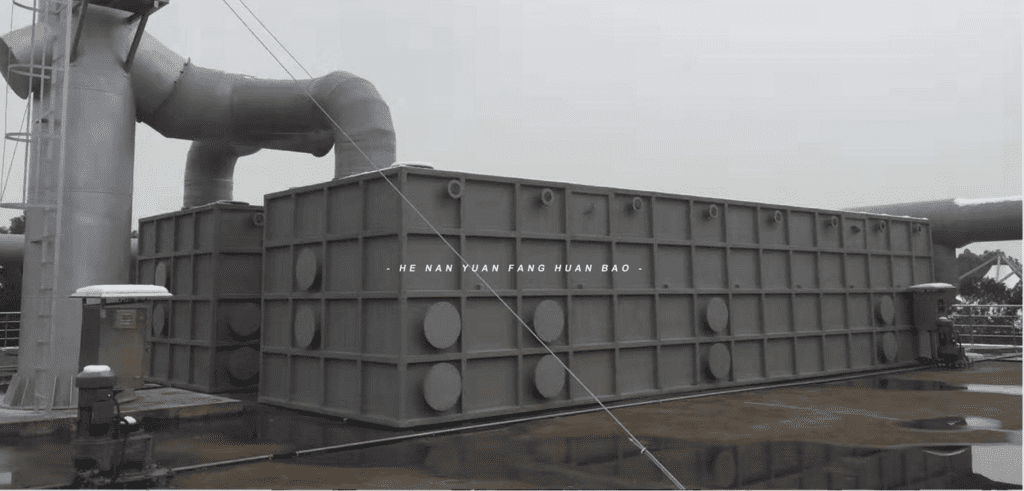
Solution: DN1600 × H6500mm PP spray tower, two-stage series:
- Stage 1: 2.0 m packing (DN50 PP Pall rings), L/G = 3 L/m³, 5% NaOH
- Stage 2: 1.8 m packing, L/G = 2 L/m³, polishing
- Two-stage mist elimination, 7.5 kW × 2 pumps, online pH control
Results: Stack HCl 8–15 mg/m³, >96% removal. Operating cost ~200 RMB/day.
5. Common Design Pitfalls
- “Taller = Better”: Beyond necessary height, returns diminish while pressure drop and power increase sharply. Calculate via NTU.
- Ignoring Pre-treatment: High-temp gas (>80°C) causes efficiency loss and thermal stress. Dust-laden gas needs cyclone/bag filtration first.
- Never Replacing Circulation Liquid: Salt accumulation causes salting-out effects, reducing efficiency and accelerating corrosion. Monitor conductivity.
- “Packing Lasts Forever”: Service life 3–5 years; shorter in fluoride environments. Regular inspection essential.
- Neglecting Winter Freeze Protection: Northern regions need indoor installation, heat tracing, or antifreeze.
6. O&M Recommendations
Daily Checks:
- Pump current, vibration, seal leakage — every shift
- pH and liquid level — every 2 hours
- Tower differential pressure — daily (abnormal rise = blockage/flooding)
- Nozzle spray pattern — weekly visual check
- Fan status, belt tension — weekly
Scheduled Maintenance:
- Monthly: Clean filters, flush mist eliminator, calibrate pH meter
- Quarterly: Inspect packing scaling, pump oil change, valve seal check
- Annually: Full shutdown—packing inspection/replacement, weld check, fan overhaul
Troubleshooting:
- Emission exceedance: Check pH → nozzles → L/G ratio → packing fouling
- High pressure drop: Packing blockage → flooding → mist eliminator clogging
- White plume: Mist eliminator → inlet temperature → consider plume abatement
7. Conclusion
Acid-alkali waste gas treatment is mandatory compliance for chemical enterprises. Spray tower performance depends critically on scientific sizing and standardized O&M. The optimal balance of L/G ratio (2–5 L/m³), superficial gas velocity (0.8–1.5 m/s), packing bed height (1.5–3.0 m), and proper material selection are key to long-term stable operation.
For complex compositions or stringent standards, two-stage or multi-stage combined processes (spray + activated carbon adsorption) are recommended. Each project differs—engage an experienced environmental engineering company for customized design with pilot validation.
For detailed solutions or project quotations, contact our technical team for one-on-one support.
— Henan Yuanfang Environmental Protection Equipment Co., Ltd. | Email: Yfep@yf-ep.com
Adapted from Chinese SEO content originally published on xxyuanfang.cn. Project image: 企业微信截图_17767607612398.png