
- 1. Pharmaceutical acid gas treatment Project Overview
- Project Information
- 2. Treatment Challenges: Mixed Acidic Exhaust and Corrosion Risks ,Pharmaceutical acid gas treatment
- 3. Pharmaceutical acid gas treatment Treatment Process: Three-Stage Falling Film Absorption + Two-Stage Scrubbing,
- Stage 1: Three-Stage Falling Film Absorption
- Stage 2: Water Washing
- Stage 3: Alkaline Scrubbing
- 4. Pharmaceutical acid gas treatment Key Engineering Considerations
- 5. Why Use a Multi-Stage Absorption System?
- 6. About YF-EP
- 7. Need an Acid Gas Treatment Solution for Your Pharmaceutical or Fine Chemical Plant?
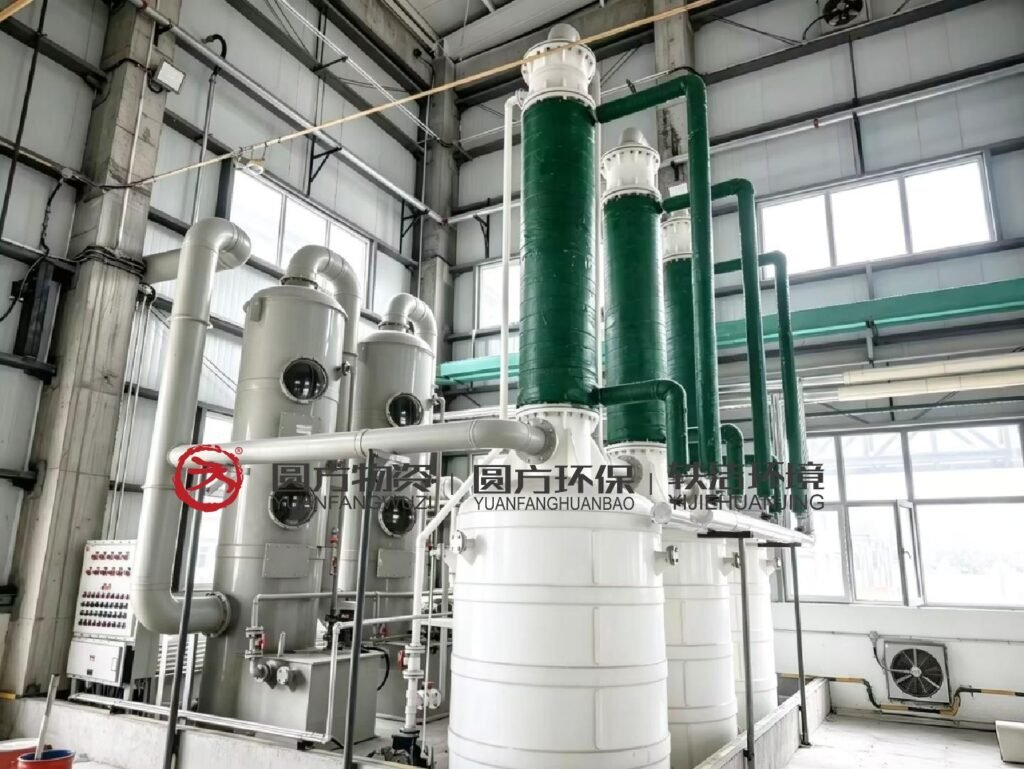
Multi-Stage Acid Gas Treatment System for Pharmaceutical Manufacturing,Pharmaceutical acid gas treatment
A 3,000 m³/h exhaust gas treatment system designed for mixed acidic emissions associated with thionyl chloride and phosphorus oxychloride production processes.
1. Pharmaceutical acid gas treatment Project Overview
Acidic exhaust gas treatment in pharmaceutical and fine chemical manufacturing can be challenging, particularly when different process streams contain highly corrosive components.
In this project, Henan Yuanfang Environmental Protection Equipment Co., Ltd. (YF-EP) provided an acid gas treatment system for an anonymized pharmaceutical manufacturing facility in Henan Province, China.
The project involved mixed acidic exhaust streams associated with production processes using thionyl chloride (SOCl₂) and phosphorus oxychloride (POCl₃). Hydrogen chloride (HCl) and sulfur dioxide (SO₂) were identified as the main target pollutants in the project treatment design.
The system was designed with a gas handling capacity of 3,000 m³/h and a multi-stage absorption configuration.
Project Information
| Item | Description |
|---|---|
| Project location | Henan Province, China |
| Industry | Pharmaceutical manufacturing |
| Process materials involved | Thionyl chloride and phosphorus oxychloride |
| Target pollutants | HCl and SO₂ |
| Design gas flow rate | 3,000 m³/h |
| Treatment configuration | Three-stage falling film absorption + two-stage scrubbing |
| Treatment approach | Water absorption followed by alkaline scrubbing |
| Project scope | Customized acid gas treatment system |
Note: The project is presented anonymously. The process-specific exhaust composition and individual stream contributions require confirmation against the final process data.
2. Treatment Challenges: Mixed Acidic Exhaust and Corrosion Risks ,Pharmaceutical acid gas treatment
Exhaust streams associated with pharmaceutical and fine chemical processes may vary significantly in composition, concentration, temperature, moisture content, and flow rate.
For this project, the treatment design focused on two target pollutants:
Hydrogen chloride (HCl)
HCl is highly soluble in water. Its absorption is exothermic, so absorption capacity, heat management, liquid distribution, and equipment corrosion resistance need to be considered.
Sulfur dioxide (SO₂)
SO₂ requires appropriate absorption and chemical treatment conditions. Alkaline scrubbing can be used to promote its absorption and neutralization, with performance depending on operating pH, liquid circulation, gas-liquid contact, and other process conditions.
When HCl and SO₂ are present in mixed acidic exhaust, a treatment system must consider the pollutant loading on each stage, the interaction between process streams, and the operating conditions of the entire system.
A single-stage washing arrangement may not provide sufficient flexibility for every high-load or variable operating condition. A staged treatment approach was therefore selected for this project design.
3. Pharmaceutical acid gas treatment Treatment Process: Three-Stage Falling Film Absorption + Two-Stage Scrubbing,
The proposed treatment route consists of:
Exhaust Gas Collection → Three-Stage Falling Film Absorption → First-Stage Water Scrubber → Second-Stage Alkaline Scrubber → Exhaust Discharge
Stage 1: Three-Stage Falling Film Absorption
The falling film absorption section is designed to provide intensive gas-liquid contact for the primary absorption of high-concentration HCl.
A liquid film flows along the heat- and corrosion-resistant absorption surfaces, allowing the gas to contact the absorbing liquid.
The three-stage configuration provides a staged absorption arrangement and is intended to reduce the HCl load entering the downstream treatment equipment.
The actual absorption performance depends on inlet concentration, liquid circulation, temperature control, equipment dimensions, and operating conditions.
Stage 2: Water Washing
After the falling film absorption section, the exhaust gas enters the first-stage water scrubber.
This stage provides additional gas-liquid contact and is intended to absorb residual water-soluble acidic components before the gas reaches the alkaline treatment stage.
Stage 3: Alkaline Scrubbing
The second-stage scrubber uses an alkaline absorption liquid, such as a sodium hydroxide solution, to neutralize residual acidic components.
Typical reactions include:
- HCl + NaOH → NaCl + H₂O
- SO₂ + 2NaOH → Na₂SO₃ + H₂O
The actual reagent consumption and operating conditions depend on the inlet pollutant loading, absorption efficiency, liquid chemistry, and operating control strategy.
4. Pharmaceutical acid gas treatment Key Engineering Considerations
1. Staged absorption for mixed acidic exhaust
The system combines falling film absorption, water washing, and alkaline scrubbing. Each section serves a different role within the overall treatment arrangement.
2. Corrosion-resistant equipment configuration
Material selection for the absorption equipment, internal components, piping, seals, pumps, and valves must consider the actual chemical composition, concentration, temperature, and operating conditions.
3. Coordination of multiple treatment stages
The gas flow, liquid circulation, pressure drop, and operating conditions of each stage need to be considered as part of the complete system rather than as independent equipment items.
4. Design for industrial operating conditions
The system was configured around a design gas flow rate of 3,000 m³/h. Final operating performance should be verified through commissioning and appropriate inlet/outlet testing under representative operating conditions.
5. Why Use a Multi-Stage Absorption System?
For pharmaceutical and fine chemical plants, acid gas treatment is not simply a matter of selecting a scrubber tower.
The process design needs to consider:
- The actual source and composition of each exhaust stream
- HCl and SO₂ inlet concentrations and mass loading
- Gas temperature, humidity, and flow fluctuations
- Absorption liquid selection and circulation
- Heat management and corrosion resistance
- Required emission limits and testing conditions
- Maintenance and operating requirements
A multi-stage configuration provides flexibility to allocate different treatment functions across the system. Its suitability and performance must be confirmed against the actual process data and project-specific design criteria.
6. About YF-EP
Henan Yuanfang Environmental Protection Equipment Co., Ltd. (YF-EP) specializes in industrial acid and alkali exhaust gas treatment equipment and customized absorption systems.
Our product and engineering scope includes:
- PP and PPH packed-bed wet scrubbers
- FRP acid gas absorption towers
- Industrial acid and alkali exhaust treatment equipment
- Falling film absorption systems
- Liquid chlorine emergency absorption systems
- Laboratory exhaust gas treatment equipment
- Corrosion-resistant tanks, pipelines, and associated equipment
YF-EP works with industrial end users and engineering contractors to review process conditions and develop suitable equipment configurations for corrosive exhaust treatment applications.
7. Need an Acid Gas Treatment Solution for Your Pharmaceutical or Fine Chemical Plant?
If your production process involves thionyl chloride, phosphorus oxychloride, HCl, SO₂, or other corrosive acidic exhaust streams, YF-EP can review your process information and discuss potential treatment configurations.
To support an initial technical assessment, please provide:
- Exhaust gas flow rate
- Gas composition and inlet concentrations
- Gas temperature and humidity
- Operating pattern and process variations
- Required outlet emission limits
- Project location and equipment supply scope