
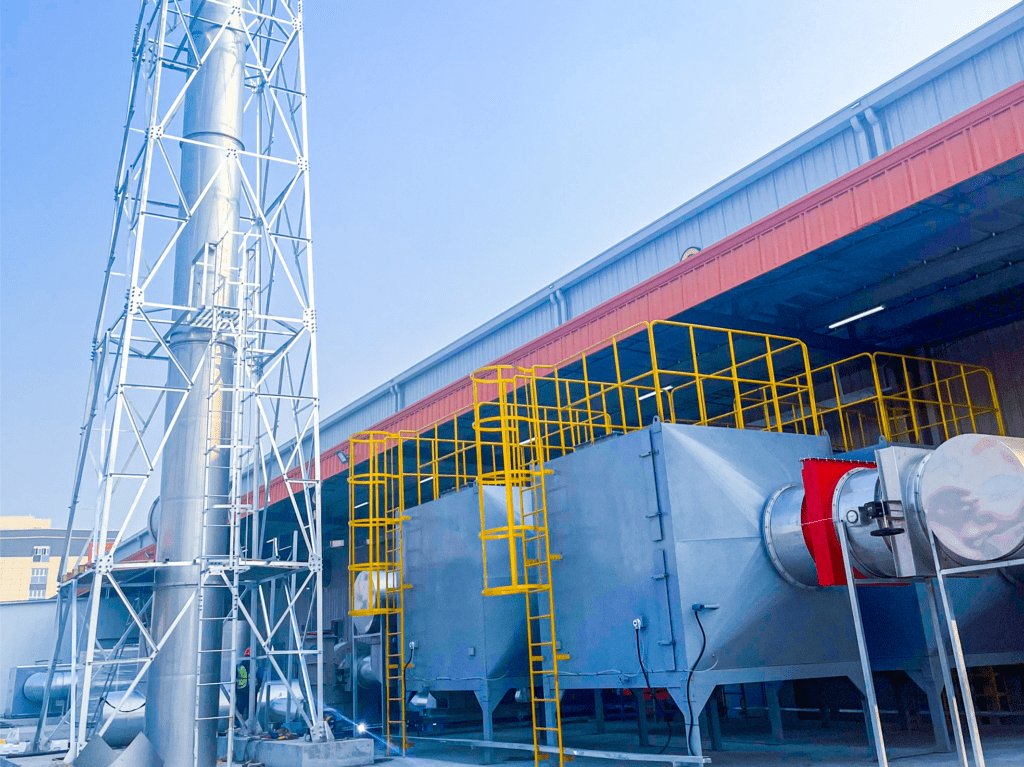
- Introduction: The Electroplating Emission Challenge
- Acid Mist Characteristics in Electroplating
- System Architecture: The Combined Approach
- Stage 1: Spray Tower (Pre-Treatment & Quenching)
- Stage 2: Packed Tower (Fine Mist Capture & Polishing)
- Material Selection for Corrosion Resistance
- Key Design Parameters and Sizing
- Gas Flow Rate Determination
- Scrubbing Liquid Chemistry
- Emission Performance
- Operation and Maintenance Best Practices
- Daily Checks
- Weekly / Bi-Weekly
- Monthly / Quarterly
- Annual Shutdown Maintenance
- Case Study: Automotive Parts Plating Facility Upgrade
- Conclusion: Engineering for Compliance and Reliability
Introduction: The Electroplating Emission Challenge
Electroplating operations generate some of the most corrosive industrial emissions encountered in manufacturing. Acid mist — primarily sulfuric acid (H₂SO₄), hydrochloric acid (HCl), nitric acid (HNO₃), and hydrofluoric acid (HF) — is released from pickling baths, anodizing lines, and plating tanks at temperatures ranging from ambient to 80°C. In the presence of moisture, these acid vapors form sub-micron mist droplets that are both a respiratory hazard for workers and a significant contributor to facility corrosion.
Regulatory frameworks across key markets — including the U.S. NESHAP for Chromium Electroplating (40 CFR Part 63), the EU Industrial Emissions Directive (IED 2010/75/EU), and China’s GB 21900-2008 emission standard for electroplating pollutants — have tightened permissible acid mist emission limits to below 10 mg/m³ in many jurisdictions. Achieving compliance at reasonable capital and operating cost requires a carefully engineered combination of wet scrubbing technologies, most commonly the spray tower and packed tower configuration.
This article provides a comprehensive technical analysis of spray tower + packed tower combined systems for electroplating acid mist treatment, covering process design, equipment sizing, material selection, and operational best practices.
Acid Mist Characteristics in Electroplating
Before selecting treatment equipment, engineers must understand the specific characteristics of electroplating acid mist:
- Particle size distribution: Acid mist droplets range from 0.1 μm to 50 μm. Sulfuric acid mist tends to form larger droplets (5-30 μm), while HCl and HF produce finer sub-micron aerosols due to their higher vapor pressure.
- Concentration range: Inlet acid concentration typically ranges from 50 to 500 mg/m³ depending on bath temperature, current density, and surface agitation.
- Corrosivity: The combination of multiple acid species creates aggressive chemical attack. H₂SO₄ mist is highly corrosive to carbon steel; HF attacks silica-based materials including glass; HNO₃ acts as a strong oxidizer.
- Temperature and humidity: Exhaust air from heated baths is typically saturated with moisture at 30-60°C. This influences scrubbing efficiency and demands appropriate material selection for the entire ductwork and scrubber system.
- Mixed contaminants: Many plating lines also release cyanide-containing mists (from cyanide-based plating baths) and chromium (VI) compounds, each requiring specific chemical treatment approaches.
These characteristics make single-stage treatment insufficient for modern compliance requirements. A two-stage or multi-stage approach — combining spray tower and packed tower technologies — has become the industry standard.
System Architecture: The Combined Approach
Stage 1: Spray Tower (Pre-Treatment & Quenching)
The spray tower serves as the first contact stage. Exhaust gas enters from the bottom or side of a vertical cylindrical vessel and flows upward through a counter-current spray of scrubbing liquid. Key functions include:
- Quenching: Hot exhaust gas (up to 80°C) is cooled to near the wet-bulb temperature, condensing some acid vapors before they reach downstream equipment.
- Coarse particle removal: Spray droplets (200-1000 μm) capture larger acid mist particles (>10 μm) through inertial impaction. Single-stage spray tower efficiency for particles >10 μm typically reaches 85-92%.
- Primary acid neutralization: Using a dilute alkaline scrubbing solution (commonly 5-10% NaOH), the spray tower neutralizes a significant fraction of acid gases through direct gas-liquid mass transfer.
- Flow distribution: The spray tower acts as a gas distribution chamber, providing uniform flow to the downstream packed bed.
Critical spray tower design parameters for electroplating applications include an empty-bed gas velocity of 1.0-1.8 m/s, a liquid-to-gas ratio (L/G) of 1.5-3.0 L/m³, and a residence time of 2-4 seconds. Nozzle selection is critical — spiral or tangential-entry full-cone nozzles with Sauter mean diameters in the 500-800 μm range provide optimal droplet size for acid mist capture while minimizing carryover.
Stage 2: Packed Tower (Fine Mist Capture & Polishing)
Downstream of the spray tower, the packed tower provides high-efficiency mass transfer for residual fine acid mist and acid gases. The packed bed consists of structured or random packing media that creates a large interfacial surface area for gas-liquid contact.
For electroplating acid mist applications, structured packing (e.g., PP or PVDF corrugated sheet packing with specific surface area of 125-250 m²/m³) is preferred over random packing for several reasons:
- Lower pressure drop: Structured packing typically operates at 50-150 Pa/m versus 200-400 Pa/m for random packing, reducing fan power consumption.
- Higher turndown ratio: Structured packing maintains efficiency at gas flow rates down to 40% of design, important for batch plating operations with variable exhaust rates.
- Better liquid distribution: The ordered geometry of structured packing provides more predictable liquid film formation and reduces channeling.
- Reduced fouling tendency: In electroplating applications where carryover solids (e.g., metal salts) may be present, structured packing is less prone to clogging than random packing.
The packed tower operates at a lower gas velocity (0.8-1.5 m/s empty-bed) with a liquid-to-gas ratio of 2.5-5.0 L/m³, providing sufficient wetting rate for the packing surface. A demister/mist eliminator (typically a chevron or mesh-pad type) is installed above the liquid distributor to capture entrained droplets before the stack discharge.
Material Selection for Corrosion Resistance
Material selection is arguably the most critical design decision for electroplating acid mist scrubbers. The wrong material choice leads to premature failure, unplanned downtime, and safety incidents.
| Component | Recommended Material | Rationale |
|---|---|---|
| Scrubber shell (≤60°C) | PP (Polypropylene) | Excellent resistance to H₂SO₄, HCl, HNO₃ at moderate temperatures; cost-effective |
| Scrubber shell (60-80°C) | PVDF (Polyvinylidene Fluoride) | Superior temperature resistance and chemical inertness; required for hot concentrated acid service |
| Spray nozzles | PP / PVDF / 316L SS | 316L suitable for NaOH spray; PP/PVDF for acid-resistant nozzles |
| Structured packing | PP (≤60°C) / PVDF (≤120°C) | PVDF required when HF is present due to PP’s susceptibility to fluoride attack at elevated temperatures |
| Demister / mist eliminator | PP or PVDF mesh / chevron | Must match or exceed shell material rating |
| Recirculation pump | PP mechanical seal pumps / PVDF-lined | Magnetic-drive pumps eliminate seal leakage in acid service |
| Ductwork | PP / FRP (Fiber-Reinforced Plastic) | FRP preferred for large-diameter ducts subject to external loads |
| pH / conductivity sensors | PVDF or PTFE body with glass electrode | Standard industrial pH probes with chemical-resistant housings |
For mixed-acid service including HF, PVDF is the recommended material throughout the system. While PP performs well against sulfuric and hydrochloric acids, the combination of fluoride ions at elevated temperatures can cause stress cracking in PP components. The incremental cost of PVDF (approximately 2-3x PP) is justified by extended service life and reduced maintenance intervals.
Key Design Parameters and Sizing
Gas Flow Rate Determination
System sizing begins with accurate exhaust volume calculation. For electroplating tanks, the capture velocity method is standard:
- Enclosed tanks: Exhaust rate = tank open surface area × 0.25-0.50 m/s face velocity at hood opening
- Open surface tanks (push-pull ventilation): Exhaust rate = tank width × tank length × 0.3-0.5 m/s cross-draft velocity
- Typical design margin: 10-15% above calculated requirement to account for system degradation over time
For a medium-sized plating line with 20 m² total tank surface area, a typical design exhaust volume ranges from 8,000 to 15,000 m³/h. This translates to a spray tower diameter of 1.2-1.6 m (at 1.5 m/s gas velocity) and a packed tower diameter of 1.4-1.8 m (at 1.0 m/s gas velocity).
Scrubbing Liquid Chemistry
The scrubbing solution is typically a 5-10% w/w NaOH solution circulated at the design L/G ratio. Key operational parameters:
- pH control setpoint: 7.5-9.0 (higher pH risks CO₂ absorption from ambient air, causing carbonate precipitation)
- Blowdown rate: Controlled by conductivity (typically 5,000-20,000 μS/cm maximum) to limit dissolved solids accumulation
- Makeup water: Deionized or softened water recommended to minimize scaling in packing and nozzles
- Chemical dosing: Automatic pH-controlled NaOH dosing pump with inline static mixer
Emission Performance
A properly designed two-stage system typically achieves:
- Total acid mist removal efficiency: 95-99.5%
- Outlet acid mist concentration: <5 mg/m³ (dry basis, standard conditions)
- H₂SO₄ mist removal: >99% for droplets >3 μm
- HCl/HNO₃ removal: >98% overall (gas phase absorption in packed bed)
- Pressure drop: 600-1,200 Pa total across both stages
- Power consumption: 3.0-5.5 kW per 10,000 m³/h (fan + pump combined)
Operation and Maintenance Best Practices
Daily Checks
- Verify recirculation pump discharge pressure and flow rate
- Check scrubbing liquid pH and conductivity
- Inspect demister pressure drop (increase indicates fouling or flooding)
- Visual inspection for leaks at flanges, sight glasses, and pump seals
Weekly / Bi-Weekly
- Clean spray nozzles (check spray pattern with inspection port)
- Test emergency backup pump (if installed)
- Verify NaOH dosing tank level and replenish as needed
- Check fan belt tension and bearing temperature
Monthly / Quarterly
- Inspect packing for fouling, channeling, or damage (use inspection ports or manway access)
- Clean or replace demister mesh pad if pressure drop exceeds 250 Pa
- Calibrate pH probe and conductivity sensor
- Inspect recirculation tank for sludge accumulation — drain and clean if sediment >50 mm
- Check ductwork for corrosion, especially at elbows and low-point drains
Annual Shutdown Maintenance
- Remove and inspect all spray nozzles; replace worn or damaged units
- Remove packing sections for thorough cleaning or replacement (typical packing life: 3-5 years for PP, 5-8 years for PVDF in acid service)
- Ultrasonic thickness measurement of scrubber shell wall (especially at liquid level interface where corrosion is most aggressive)
- Fan impeller inspection and dynamic balancing
- Replace all gaskets at flanged connections
- Full recalibration of all instrumentation
Case Study: Automotive Parts Plating Facility Upgrade
An automotive component electroplating facility in Southeast Asia operated a single-stage PP spray tower treating 12,000 m³/h of mixed acid exhaust from zinc plating, chrome plating, and pickling lines. The existing system was unable to meet the revised emission limit of 10 mg/m³ for total acid mist (down from 30 mg/m³ under previous regulations).
Challenges identified:
- Outlet acid mist concentration of 18-25 mg/m³ — exceeding the new limit
- Severe corrosion at the scrubber shell liquid level interface after 4 years of service
- Nozzle clogging from carbonate scale buildup due to hard makeup water
- Excessive demister carryover causing visible stack plume
Implemented solution:
- Retrofitted a PVDF structured packing bed (250 m²/m³ specific surface area, 1.8 m packing height) downstream of the existing spray tower
- Upgraded spray nozzles from hollow-cone to full-cone spiral type with larger orifice (8 mm) to reduce clogging
- Installed automatic NaOH dosing with pH control (setpoint 8.0 ± 0.3)
- Replaced the mesh-pad demister with a chevron-type PP demister with integrated wash spray
- Added a water softener for makeup water supply
- Replaced the corroded lower shell section with PVDF material (600 mm above and below liquid level)
Results after 6 months of operation:
- Outlet acid mist concentration: 3.5 mg/m³ — 65% below the compliance limit
- System pressure drop increased from 680 Pa to 1,050 Pa (well within fan capacity)
- Nozzle cleaning frequency reduced from weekly to quarterly
- Zero unplanned downtime since commissioning
- Total project cost: approximately $45,000 USD — recovered within 18 months through avoided fines and reduced maintenance
Conclusion: Engineering for Compliance and Reliability
The spray tower + packed tower combined system represents a proven, robust, and cost-effective solution for electroplating acid mist treatment. By leveraging the spray tower for quenching and coarse particle removal, then polishing with a high-efficiency packed bed, facilities can consistently achieve emission levels below 5 mg/m³ and meet the most stringent international standards.
The critical success factors — beyond sound process design — are correct material selection for the specific acid mixture, automated pH and conductivity control, and a disciplined preventive maintenance program. Investment in PVDF construction for mixed-acid service and structured packing for high-efficiency polishing pays back through extended equipment life, reduced downtime, and assured regulatory compliance.
As global emission standards continue to tighten — particularly for hexavalent chromium and cyanide-bearing mists — the integration of additional polishing stages such as wet electrostatic precipitators (WESP) downstream of the packed tower will become increasingly common. However, for the majority of electroplating operations today, a well-designed two-stage wet scrubbing system remains the optimal balance of performance, cost, and operational simplicity.
For inquiries about electroplating acid mist treatment systems, contact Yfep@yf-ep.com | www.xxyuanfang.cn