
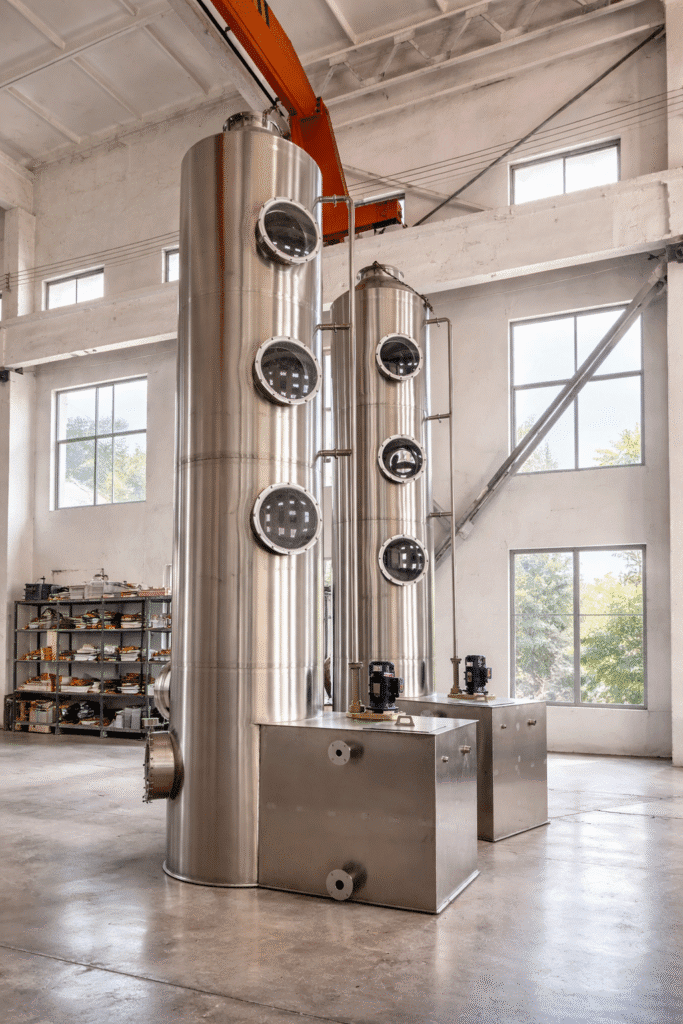
1. What Is an Industrial Wet Scrubber?
An industrial wet scrubber is a highly efficient air pollution control system designed to remove acid gases, particulate matter, and hazardous fumes from industrial exhaust streams. It uses a liquid (typically water or chemical solution) to capture and neutralize pollutants before clean air is released into the atmosphere .
- 1. What Is an Industrial Wet Scrubber?
- 2. Working Principle of Wet Scrubber
- Step-by-step process:
- 3. Types of Wet Scrubber Systems
- 3.1 Packed Bed Scrubber
- 3.2 Venturi Scrubber
- 3.3 Spray Tower Scrubber
- 4. Key Advantages of Wet Scrubbers
- 5. Applications in Acid and Alkali Waste Gas Treatment
- Typical applications:
- 6. Key Design Considerations
- 7. Why Choose a Professional Manufacturer?
- 8. Conclusion
Wet scrubbers are widely used in industries such as:
- Chemical processing
- Waste gas treatment systems
- Metallurgy and steel plants
- Pharmaceutical production
- Semiconductor manufacturing
2. Working Principle of Wet Scrubber
The core principle of a wet scrubber is gas-liquid mass transfer.
Step-by-step process:
- Gas Inlet
Polluted gas enters the scrubber tower from the bottom or side. - Liquid Injection
Scrubbing liquid is sprayed through nozzles or distributed via packing material. - Gas-Liquid Contact
Pollutants interact with liquid droplets through:- Impaction (dust removal)
- Absorption (acid gas removal)
- Chemical reaction (neutralization)
- Separation
Mist eliminators remove droplets before gas discharge. - Clean Air Discharge
Treated gas meets environmental emission standards and is released safely.
This process allows removal of SO₂, HCl, HF, NH₃, VOCs, and fine particles efficiently .
3. Types of Wet Scrubber Systems
3.1 Packed Bed Scrubber
- Best for acid gas absorption
- High efficiency due to large contact surface
- Ideal for chemical industries
3.2 Venturi Scrubber
- Designed for fine dust removal
- High-speed gas creates strong turbulence
- Suitable for high dust concentration environments
3.3 Spray Tower Scrubber
- Simple structure
- Low pressure drop
- Used for pre-treatment or large particles
4. Key Advantages of Wet Scrubbers
✔ High removal efficiency (up to 99%)
✔ Suitable for corrosive and high-temperature gases
✔ Simultaneous removal of gas + dust
✔ Flexible design for different industries
✔ Stable performance under variable conditions
Compared with dry systems, wet scrubbers are more effective for acidic and soluble pollutants.
5. Applications in Acid and Alkali Waste Gas Treatment
Wet scrubbers are the core equipment in acid/alkali exhaust treatment systems.
Typical applications:
- Acid pickling lines (HCl, H₂SO₄)
- Electroplating workshops
- Chemical reactors
- Battery manufacturing
- Laboratory exhaust systems
By adding alkaline solutions (e.g., NaOH), acidic gases can be neutralized efficiently.
6. Key Design Considerations
When selecting a wet scrubber, the following factors are critical:
- Gas flow rate (m³/h)
- Pollutant type and concentration
- Required removal efficiency
- Material selection (PP / FRP / Stainless Steel)
- Pressure drop and energy consumption
- Liquid circulation system design
A well-designed system ensures long service life + low operating cost.
7. Why Choose a Professional Manufacturer?
A reliable wet scrubber supplier should provide:
- Customized system design
- Corrosion-resistant materials
- Complete engineering support
- Stable and efficient operation
At YF Environmental Protection (yf-ep.com), we specialize in:
- Wet scrubbers (packed tower / spray tower)
- PP and FRP anti-corrosion equipment
- Complete acid gas treatment solutions
8. Conclusion
Industrial wet scrubbers remain one of the most effective technologies for acid gas and industrial exhaust treatment. With proper design and material selection, they provide:
- High efficiency
- Long-term stability
- Compliance with global environmental standards