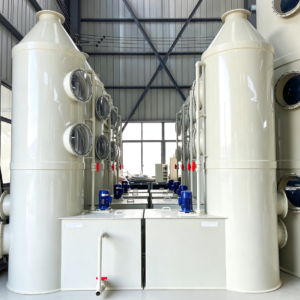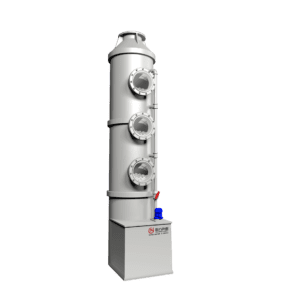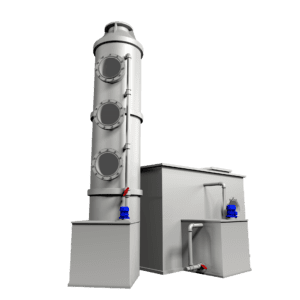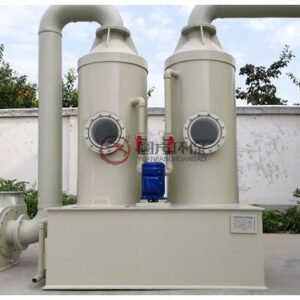
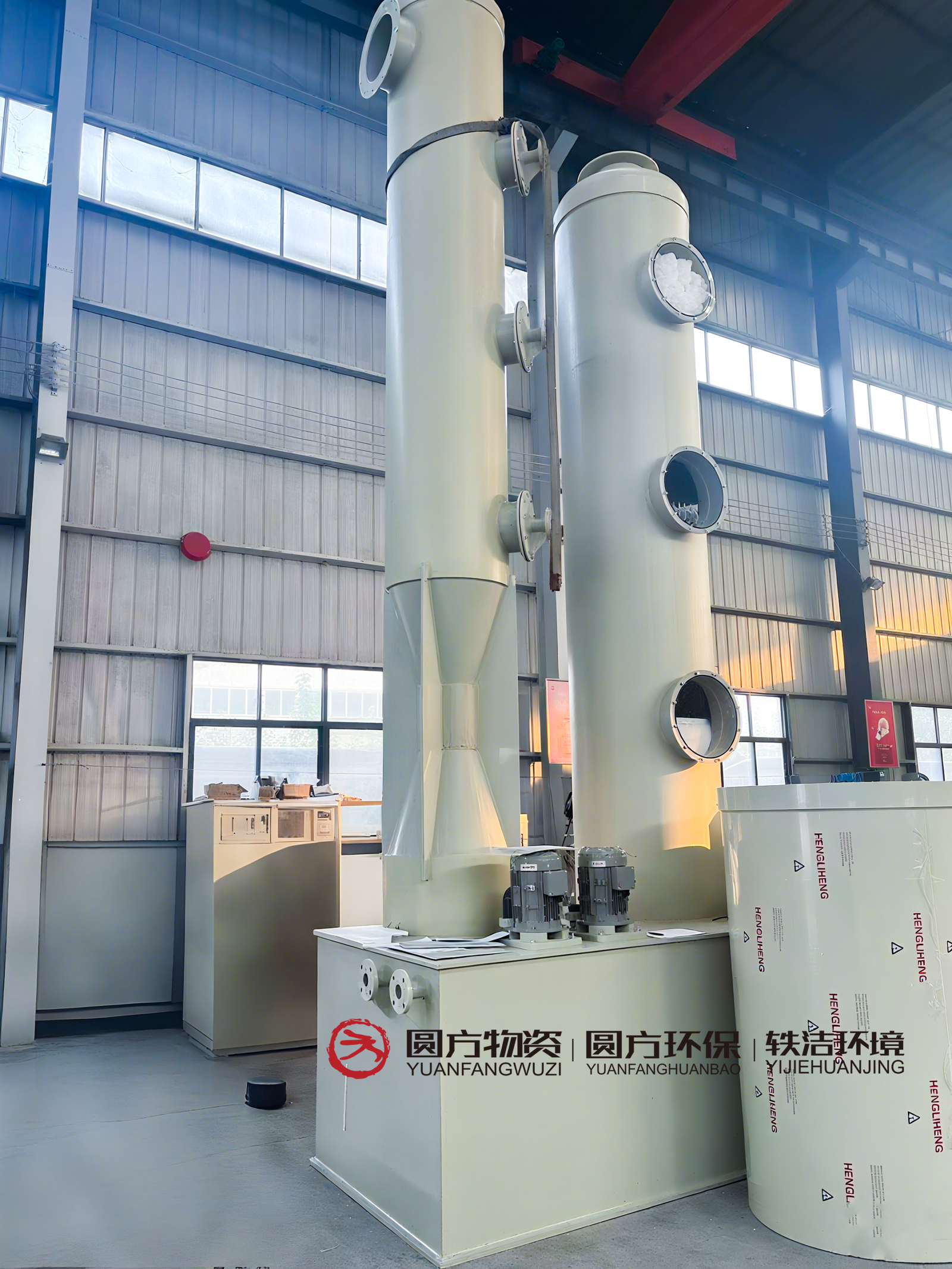
Venturi Wet Scrubber — a high-velocity throat scrubber that captures fine dust, mist, and sub-micron particulate from industrial exhaust more efficiently than packed-bed units. Gas accelerates through a converging-diverging throat, atomizing the scrubbing liquid into fine droplets that impinge and remove particles.
Compact footprint, handles high dust loads and sticky aerosols, and integrates ahead of packed-bed or carbon stages.
For VOC-laden streams, the Venturi works as pre-treatment paired with downstream activated carbon adsorption.
What Is a Venturi Wet Scrubber
A Venturi wet scrubber is a high-efficiency gas-cleaning device built around a converging-diverging throat. Unlike a packed-bed tower that relies on wetted packing surface, the Venturi accelerates the gas stream to high velocity through a narrow throat, where it shears the scrubbing liquid into a dense fog of fine droplets. Those droplets collide with and capture dust, mist, and fine particulate that slower packed-bed contact would miss.
How the Scrubber Works
Contaminated gas enters the converging section and speeds up as the cross-section narrows. Just before or at the throat, scrubbing liquid is injected; the high relative velocity between gas and liquid breaks the liquid into tiny droplets. Particles are captured by impaction, interception, and condensation as the mixture passes through the throat. The gas then expands in the diverging section and flows into a separator (cyclone or demister) where the dust-laden droplets are removed.
Core process steps
- Gas accelerates through the converging throat
- Liquid injected and atomized into fine droplets
- Particles captured by impaction in the throat
- Gas expands, then enters droplet separator
- Clean gas out, slurry drained for treatment
Why a Venturi Instead of a Packed-Bed Scrubber
The two designs cover different ranges of the problem:
- Fine particulate: Venturi reaches collection efficiency on sub-micron dust that packed beds struggle with.
- High dust load: handles heavy, sticky, or high-concentration aerosols without packing fouling.
- Footprint: compact, often combined with a separate separator rather than a tall tower.
- Pressure cost: higher pressure drop than a packed bed — the trade for high efficiency.
For soluble gas and odor removal at moderate loading, a packed-bed (PP/PPH or stainless) unit is usually the better fit. For fine dust and mist, the Venturi leads.
Typical Applications
- Metalworking, grinding, and foundry dust-laden exhaust
- Acid mist from pickling and surface-treatment lines
- Glass, ceramics, and mineral-processing fine dust
- Chemical and food/pharma powder-handling vent streams
- Pre-cleaning ahead of packed-bed or carbon stages
Technical Specifications
Throat geometry and duty are engineered per project. Typical configurable ranges:
| Parameter | Range / Option |
|---|---|
| Shell material | SS304 / SS316L / PP-PPH lined (confirm by gas) |
| Throat diameter | [ Customizable mm or inch ] |
| Gas flow rate | [ Customizable m³/h ] |
| Inlet particle size | [ Customizable µm range ] |
| Pressure drop | [ Customizable Pa / mbar ] |
| Separator type | [ Customizable cyclone / demister ] |
VOC Treatment Note
For VOC-bearing streams, the Venturi generally works as a pre-treatment or co-treatment step rather than a standalone solution. Pair it with an activated carbon adsorption box downstream for full treatment.
Related Equipment
- PP/PPH Packed Bed Wet Scrubber — for ambient acid/odor pre-treatment
- Stainless Steel Wet Scrubber — for high-temp / oxidizing / sanitary service
- Activated Carbon Adsorption Box — downstream VOC polishing
FAQ
Q: What makes a Venturi better than a packed-bed scrubber?
A: The high-velocity throat captures finer dust and mist at higher efficiency, at the cost of a larger pressure drop.
Q: Can it remove gases as well as dust?
A: It handles some soluble gases, but for gas/odor duty a packed-bed stage is usually added downstream.
Q: Is it enough for VOC compliance on its own?
A: Usually as pre-treatment. Combine with carbon adsorption for complete treatment.