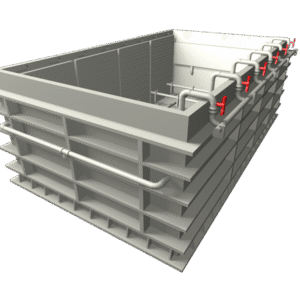
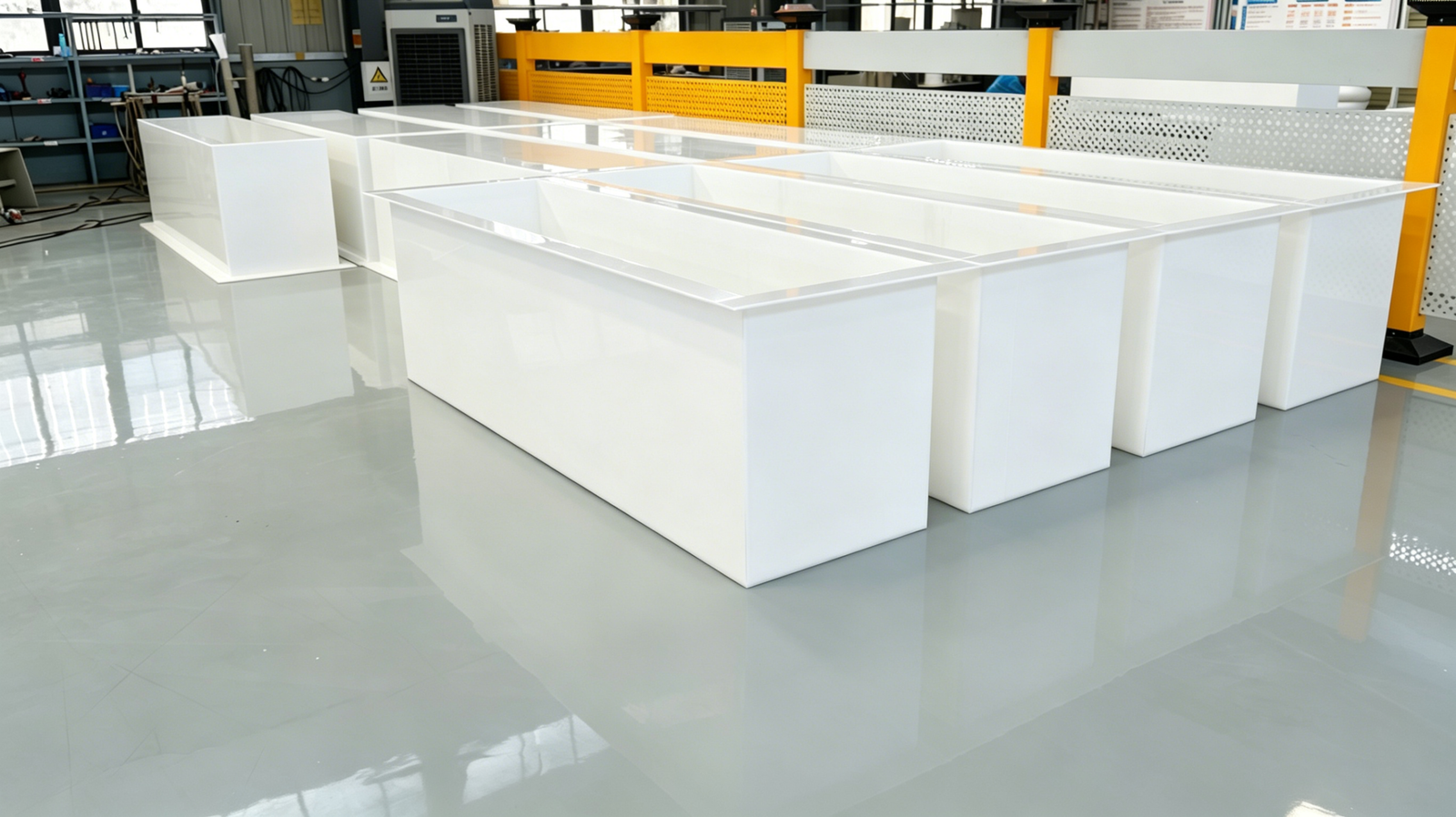
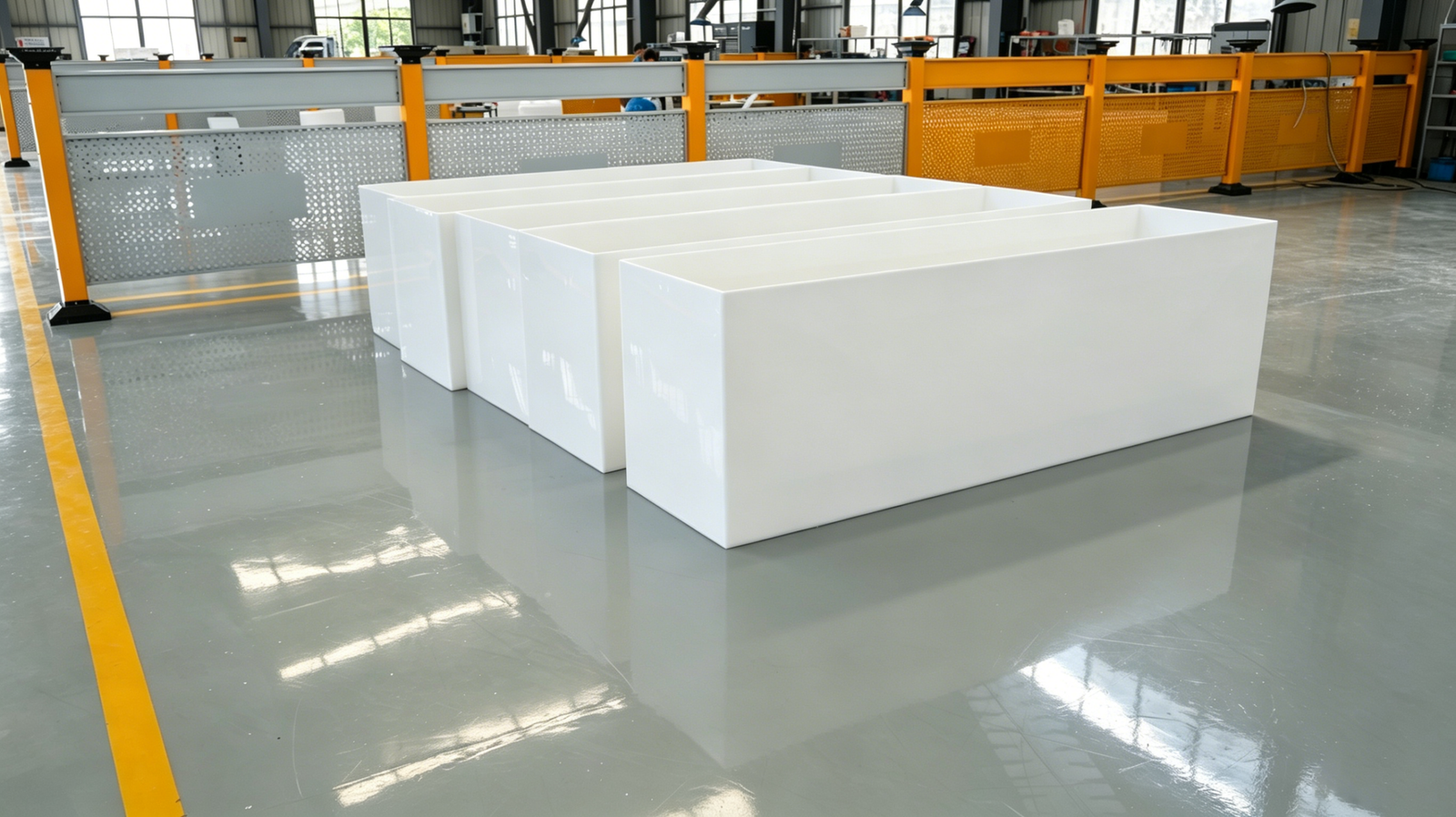
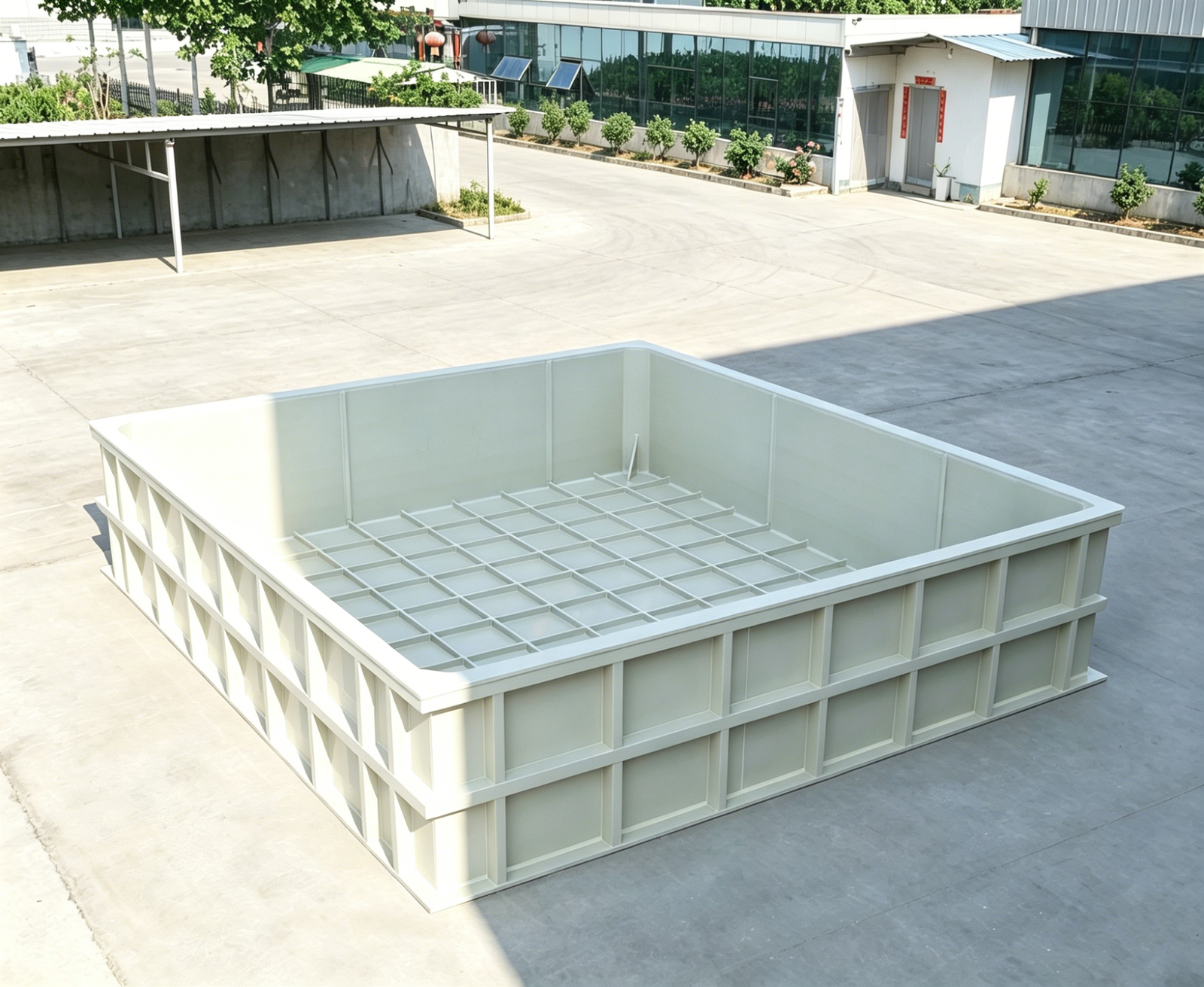
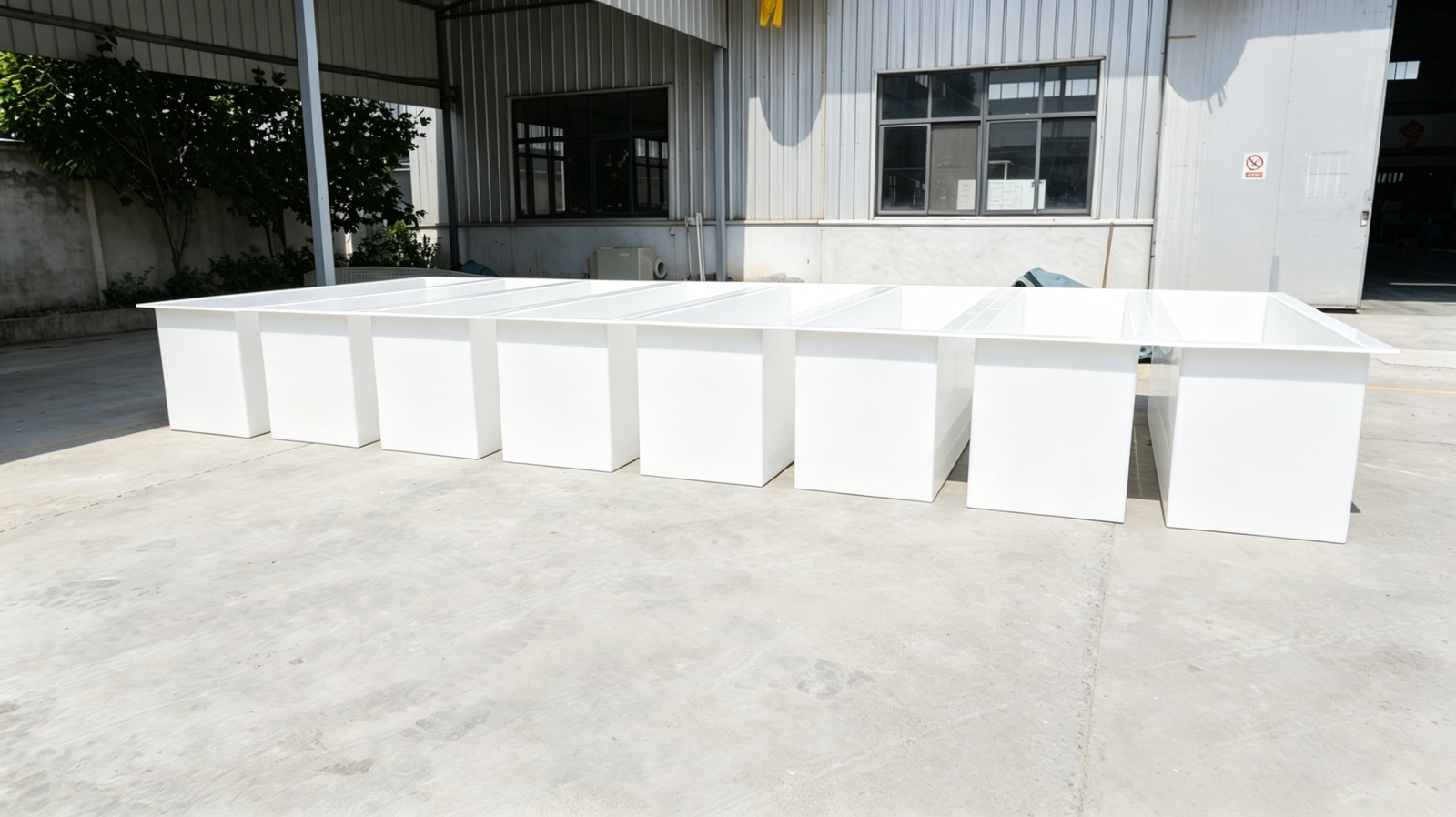
A PP/PPH plating tank is the welded polypropylene process vessel at the heart of an electroplating line. It holds the plating bath, supports heating, filtration, anode fixtures and fume extraction, and outlasts metals in acid/alkali service.
Plating Tank (PP/PPH Electroplating Tank)
A plating tank is the process vessel that holds the plating or surface-treatment bath. It is not a simple storage tank — it is a working tank that must accommodate heating/cooling, agitation, anode and cathode fixtures, filtration, overflow and, critically, fume extraction at the tank lip that ducts acid mist to a wet scrubber. YFEP builds PP/PPH plating tanks by welded polypropylene (PP) or polypropylene homopolymer (PPH), selected for excellent resistance to acids, alkalis and salt solutions at plating-line temperatures.
Why PP/PPH for the Plating Tank?
| Property | PP/PPH | PVC | FRP | Stainless steel |
|---|---|---|---|---|
| Resistance to inorganic acids / alkalis | Excellent | Good | Good–excellent (resin-dependent) | Limited; chloride/acid sensitive |
| Weldability / seamless construction | Excellent (hot-plate welded) | Adhesive / limited | Laminated | Welded, but attacked by many plating baths |
| Electrical insulation | Good | Good | Good | Conductive — can cause stray current |
| Operating temperature | Up to ~80 °C (PPH higher than PP) | Up to ~60 °C | ~80–120 °C by resin | High, but chemically unsuited to many baths |
| Custom shape / large rectangular tanks | Easy to fabricate | Limited | Good for round/standard shapes | Limited for rectangular pickling tanks |
| Typical use in plating | Process tanks, pickling tanks, rinse tanks | Chrome / high-oxidizer tanks | Large tanks, exhaust ducts | Not recommended for chrome, HCl, fluorides |
PP/PPH is the default choice for acid copper, nickel, zinc, tin and anodizing baths. It is not suitable for strong oxidizers (concentrated nitric acid, chromic acid at high concentration/temperature, permanganate) or chlorinated/aromatic solvents — for those duties, specify PVC, FRP vinyl ester or a specialty-lined tank.
Typical Tank Structure & Options
- Welded PP/PPH shell with external structural ribs / steel frames for large rectangular tanks.
- Reinforced bottom and sides to support bath weight and rack loads over long spans.
- Heating/cooling coil interface — titanium or PTFE coils for steam/hot-water or chiller connection.
- Anode hook bar / busbar slots and cathode rack supports.
- Filtration pump return port to keep bath clean and extend solution life.
- Overflow weir and level control for continuous rinsing or constant-level operation.
- Tank-edge fume-extraction lip / canopy ready to connect to a PP/PPH packed-bed wet scrubber.
- Optional cover, insulation jacket or drip tray.
Process Compatibility Guide
| Process | Typical bath chemistry | PP/PPH suitability | Notes |
|---|---|---|---|
| Acid copper plating | CuSO₄ + H₂SO₄ | Excellent | Standard PP/PPH duty |
| Alkaline copper plating | CuCN + alkaline | Excellent | Standard PP/PPH duty |
| Watt’s nickel / sulfamate nickel | NiSO₄ + NiCl₂ + H₃BO₃ | Excellent | Most common nickel line |
| Electroless nickel | Ni salt + hypophosphite | Good–excellent | Temperature up to ~90 °C — verify PPH grade |
| Acid zinc plating | ZnCl₂ + NH₄Cl / KCl | Excellent | Chloride zinc common |
| Alkaline zinc plating | ZnO + NaOH | Excellent | Caustic service |
| Tin plating (methane sulfonic, sulfate) | Sn salts + acid/sulfate | Excellent | Standard PP/PPH duty |
| Sulphuric anodizing | H₂SO₄ | Excellent | Standard PP/PPH duty |
| Decorative chrome (low-concentration) | CrO₃ + H₂SO₄ + fluoride | Usable with limits | Concentration < 250 g/L and temp < 50 °C; otherwise use PVC / FRP VE |
| Hard chrome (high-concentration, high-temp) | High CrO₃, >50 °C | Not recommended | Use PVC, FRP vinyl ester or specialty-lined steel |
| Chemical etching / pickling | HCl / H₂SO₄ / mixed acid | Good–excellent | Verify oxidizer content and temperature |
How It Links to the Rest of Your Line
- Acid-mist control: The tank fume lip ducts to a PP/PPH packed-bed wet scrubber for chromic/sulphuric/nitric mist.
- Organic vapour control: Solvent-based processes vent through an activated carbon adsorber downstream.
- Bath temperature: Heating/cooling coils connect to a heat exchanger (PP/PPH, stainless or titanium depending on bath).
- Chemical supply: Process liquors are stored in PP/PPH or FRP storage tanks before dosing to the plating line.
Typical Applications
- Electroplating lines (Cu, Ni, Cr, Zn, Sn)
- Electroless plating and conversion coating
- Sulphuric anodizing and colouring
- Acid pickling and chemical etching
- Rinse, dip and passivation tanks
- PCB plating and electronic finishing
Customization
Each plating tank is custom-engineered to your line: length × width × depth, plate thickness, rib spacing, heating/filtration interfaces, anode arrangement and fume-extraction lip are sized per your bath chemistry, temperature, rack dimensions and line throughput. Share your process sheet and tank layout and we fabricate accordingly.