
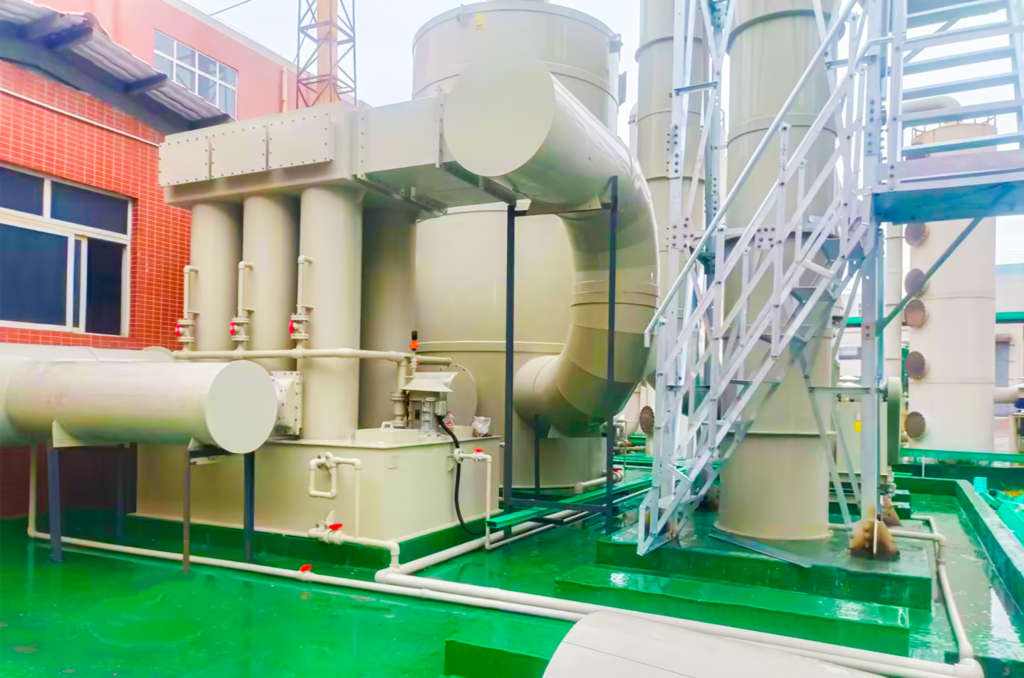
- Understanding the Chemical Absorption Mechanism
- Spray Tower Design Parameters and Selection Criteria
- Key Design Parameters
- Alkaline Scrubber (Packed Tower) Design Considerations
- Packing Selection
- Liquid Distribution
- Pressure Drop
- Spray Tower vs. Alkaline Scrubber: When to Use Which
- Combined Process: Spray Tower + Alkaline Scrubber in Series
- Material Selection for Corrosion Resistance
- Case Study: 20,000 m³/h HCl Scrubbing System
- Operational and Maintenance Best Practices
- Conclusion
Acid-alkali waste gas treatment is one of the most common and technically demanding challenges in chemical manufacturing. Whether you’re designing a new facility or retrofitting an existing one, choosing between a spray tower and an alkaline scrubber—or configuring them in series—requires a solid understanding of key design parameters. This guide breaks down the engineering fundamentals, compares equipment types, and provides actionable parameter selection criteria for process engineers and EPC professionals.
Understanding the Chemical Absorption Mechanism
Before diving into equipment selection, it’s essential to understand the underlying mass transfer process. Acid gas scrubbing relies on gas-liquid absorption, where acidic pollutants (HCl, SO₂, HF, NOₓ, H₂S) are neutralized by an alkaline scrubbing solution—typically sodium hydroxide (NaOH) at 5–15% concentration—inside a packed or spray contact zone.
The absorption efficiency is governed by three primary factors:
- Gas-liquid contact area: Larger interfacial area per unit volume directly increases mass transfer rate.
- Residence time: Sufficient gas retention time in the reaction zone ensures pollutant removal reaches equilibrium.
- Liquid-to-gas ratio (L/G): The volumetric ratio determines reagent availability; typical design values range from 1.5 to 5.0 L/m³ depending on pollutant concentration and target removal efficiency.
The neutralization reactions are straightforward but exothermic. For hydrochloric acid mist: HCl + NaOH → NaCl + H₂O. For sulfur dioxide: SO₂ + 2NaOH → Na₂SO₃ + H₂O. The heat of reaction is typically managed by the circulating liquid volume itself, though high-concentration inlet streams may require intermediate cooling in the recirculation loop.
Spray Tower Design Parameters and Selection Criteria
The spray tower (also called a spray scrubber or open spray chamber) is the workhorse of acid gas treatment. Its design is conceptually simple: contaminated gas flows upward through an open tower while scrubbing liquid is atomized downward through multiple spray nozzles arranged in one or more stages.
Key Design Parameters
1. Superficial Gas Velocity
The empty-tower gas velocity typically ranges from 0.6 to 1.8 m/s. Operating below 0.6 m/s increases the tower diameter unnecessarily, driving up capital cost. Exceeding 1.8 m/s risks entrainment—liquid droplets being carried out with the exhaust gas—and reduces contact time. For high-efficiency applications targeting >95% removal, design velocities of 1.0–1.3 m/s are recommended.
2. Liquid-to-Gas Ratio (L/G)
For spray towers treating acid gases at inlet concentrations of 100–500 mg/m³, the L/G ratio should be 1.5–3.0 L/m³. At higher inlet loads (500–2000 mg/m³), increase to 3.0–5.0 L/m³. The L/G ratio directly affects pumping power and reagent consumption, so it must be optimized rather than simply maximized.
3. Nozzle Configuration
Spiral or full-cone nozzles made from 316L stainless steel or PTFE are preferred for acid service. Nozzle spacing should provide 100% spray coverage with 20–30% overlap at the plane of spray intersection. Typical droplet size of 500–1000 µm balances surface area against entrainment risk. Multi-stage spraying (2–4 stages) with independent headers allows partial turndown during low-load operation.
4. Tower Height and Diameter
For a given gas flow rate Q (m³/s) and design velocity v (m/s), the tower cross-section is A = Q / v. For a 10,000 m³/h (2.78 m³/s) flow at 1.2 m/s:
- Tower diameter D = 1.72 m (round to 1.8 m standard)
- Tower height H = 6–9 m, with 1.5 m for inlet distribution, 3–5 m for spray zone, 1–1.5 m for mist elimination, 0.5 m for outlet transition
5. Mist Eliminator
A high-efficiency chevron or mesh pad demister is essential downstream of the spray zone to prevent liquid carryover. Design face velocity through the demister should not exceed 3–4 m/s for chevron type and 2–3 m/s for mesh type to avoid re-entrainment.
Alkaline Scrubber (Packed Tower) Design Considerations
The alkaline scrubber, typically a packed tower configuration, offers higher mass transfer efficiency per unit volume compared to an open spray tower, making it ideal for high-concentration or low-emission-limit applications.
Packing Selection
The choice of packing material and geometry is critical:
- Pall rings or saddle rings in PP (polypropylene) or PVDF for temperatures up to 80°C and dilute acid service.
- For higher temperatures or concentrated acid environments, CPVC or FRP structured packing is preferred.
- Packing size: 25 mm for high-efficiency (>98%) applications, 38–50 mm for medium-duty service where lower pressure drop is prioritized.
The packing depth is determined from the required number of transfer units (NTU), which in turn depends on inlet/outlet concentration and the Henry’s law constant of the pollutant. A typical packed bed depth for HCl or SO₂ scrubbing is 1.5–3.0 m in a single stage, with multi-stage configurations used when removal efficiency exceeds 99%.
Liquid Distribution
Unlike spray towers that rely on nozzle atomization, packed towers require a liquid distributor that spreads scrubbing liquid evenly across the packing surface. Distribution density of 40–100 distribution points per m² ensures adequate wetting. Trough-type or orifice-pan distributors are standard.
Pressure Drop
Packed tower pressure drop ranges from 200 to 600 Pa per meter of packing depth, depending on gas velocity and liquid load. Total system pressure drop, including inlet/outlet transitions, demister, and ducting, should be kept under 1500 Pa to minimize fan power consumption.
Spray Tower vs. Alkaline Scrubber: When to Use Which
The decision matrix below summarizes the selection logic:
| Criterion | Spray Tower | Alkaline Scrubber (Packed Tower) |
|---|---|---|
| Inlet concentration | Low to medium (<500 mg/m³) | Medium to high (>200 mg/m³) |
| Target removal efficiency | 85–95% | 95–99.5% |
| Pressure drop | Low (200–500 Pa total) | Moderate (500–1500 Pa) |
| Particulate tolerance | Good (open structure resists clogging) | Poor (packing clogs with solids) |
| Capital cost | Lower | Higher (packing + distributor) |
| Turndown ratio | Wide (30–100% with staged nozzles) | Narrower (50–100% due to wetting limits) |
| Best for | Large gas volumes, moderate removal, dusty streams | Stringent emission limits, high-efficiency polishing |
Combined Process: Spray Tower + Alkaline Scrubber in Series
For demanding applications—such as chemical plants with variable HCl/SO₂ loads or facilities subject to emission limits below 10 mg/Nm³—a two-stage series configuration delivers the best of both worlds:
- Stage 1 – Spray Tower: Handles high inlet loads (500–2000 mg/m³), removes the bulk of pollutants, and captures particulates. Operates at moderate L/G ratio (2–3 L/m³) with lower-grade scrubbing solution.
- Stage 2 – Alkaline Packed Scrubber: Polishes the remaining low-concentration acid gases, ensures compliance with stringent emission standards, and uses fresh NaOH solution at controlled pH (8–10).
This arrangement achieves >99% overall removal efficiency while minimizing chemical consumption, since the second stage only treats the residual pollutant load. The recirculation tanks of both stages can be cascaded, with make-up water added to the second stage and overflow directed to the first stage, reducing fresh water demand by approximately 30–40%.
Material Selection for Corrosion Resistance
Acid gas service demands careful material selection throughout the system:
- Tower shell: PPH (polypropylene homopolymer) for continuous service up to 90°C; PP (polypropylene) for standard service up to 70°C; FRP (fiberglass-reinforced plastic) with corrosion-resistant resin for large-diameter towers or HF-containing streams.
- Internals: PP or PVDF packing; 316L or Hastelloy for metal components exposed to wet acid; PTFE gaskets throughout.
- Piping & pumps: PP or PVDF piping with mechanical joints (avoid glued joints that degrade under thermal cycling); magnetic-drive or mechanical-seal pumps with PP or PVDF wetted parts.
- Recirculation tank: PP or FRP with level control, pH monitoring, and overflow weir. Include a dosing port for automated NaOH makeup.
Note: For applications involving hydrofluoric acid (HF), avoid any silica-containing materials (glass, standard FRP with glass fiber). Use PVDF or graphite-impregnated PP instead.
Case Study: 20,000 m³/h HCl Scrubbing System
A specialty chemical plant in eastern China was generating 20,000 m³/h of exhaust air with HCl concentrations averaging 300 mg/m³ (peaking at 800 mg/m³ during reactor charging). The local emission limit was 10 mg/Nm³.
Solution: A two-stage system comprising a 2.4 m diameter × 8 m tall PPH spray tower (Stage 1) followed by a 2.0 m diameter × 7 m PP packed tower with 25 mm PP Pall rings (Stage 2). The spray tower was designed for 1.2 m/s superficial velocity with 3 spray stages; the packed tower operated at 1.0 m/s with 2.5 m packing depth.
Performance: After 12 months of continuous operation, outlet HCl concentration averaged 3.2 mg/Nm³, well within permit limits. NaOH consumption was 18% lower than the original single-stage packed tower design, due to the staging benefit and counter-current flow optimization.
Operational and Maintenance Best Practices
To maintain long-term performance and avoid unplanned shutdowns:
- pH control: Maintain recirculation liquid pH between 7.5 and 9.5. Below 7.0, absorption efficiency drops sharply. Above 10.5, NaOH is wasted and scaling may increase. Install an online pH controller with automated dosing.
- Nozzle inspection: Inspect spray nozzles quarterly for wear, clogging, or uneven spray patterns. Clogged nozzles reduce effective contact area and compromise removal efficiency.
- Demister cleaning: The mist eliminator accumulates salt deposits (NaCl, Na₂SO₃) over time. Schedule semi-annual cleaning or replacement to prevent excessive pressure drop and liquid carryover.
- Blowdown management: Continuously bleed a portion of the recirculation liquid to prevent salt accumulation, which increases density and reduces pump efficiency. Typical blowdown rate is 2–5% of circulation flow.
- Packing inspection: For packed towers, monitor pressure drop trends. A gradual increase often indicates packing fouling; a sudden drop may indicate packing collapse or channeling. Plan annual internal inspection.
- Fan VFD optimization: Use variable frequency drives on the exhaust fan to match airflow to actual process demand, reducing energy consumption during turndown operation.
Conclusion
Selecting between a spray tower and an alkaline scrubber—or combining both—comes down to inlet conditions, emission targets, and total cost of ownership. The spray tower excels at handling large volumes, particulates, and moderate pollutant loads with low pressure drop and maintenance requirements. The packed alkaline scrubber delivers high removal efficiency for stringent compliance. For most chemical plant applications with variable emissions and tight limits, the two-stage spray-tower-plus-packed-scrubber configuration offers the optimal balance of performance, reliability, and operating cost.
When specifying equipment, pay close attention to L/G ratio, gas velocity, material compatibility, and instrumentation—these parameters determine whether the system meets both day-one performance targets and long-term reliability expectations.
For inquiries, contact Yfep@yf-ep.com | www.xxyuanfang.cn