
- Why Single-Stage Scrubbing Falls Short for Chlorine Gas
- Multi-Stage Scrubbing Architecture: The Five-Stage Model
- Stage 1: Water Quench & Pre-Scrubber
- Stage 2: Primary Alkaline Packed Tower
- Stage 3: Secondary Alkaline Packed Tower (Polishing)
- Stage 4: Hypochlorite Decomposition Reactor
- Stage 5: Emergency Backup & Mist Eliminator
- Key Design Parameters
- Real-World Case Study: Chlorination Workshop Retrofit
- Material Selection for Chlorine Service
- O&M Best Practices for Chlorine Scrubber Systems
- Daily Checks
- Weekly Preventive Maintenance
- Monthly and Quarterly Tasks
- Shutdown and Restart Procedures
- Economic Considerations
- Conclusion
Chlorine gas is among the most hazardous airborne contaminants generated by chemical manufacturing facilities. In chlor-alkali plants, chlorination workshops, and downstream derivative production lines, uncontrolled Cl₂ emissions pose immediate threats to worker safety, corrode structural steel and instrumentation, and trigger severe regulatory penalties under both Chinese GB standards and international frameworks such as the US EPA NESHAP for major source facilities. This article examines the engineering rationale behind multi-stage scrubbing systems for chlorine-laden exhaust streams, presents a real-world case study of a five-stage scrubbing installation at a large-scale chlorination workshop, and offers actionable guidance on process design, material selection, and long-term operational maintenance.
Why Single-Stage Scrubbing Falls Short for Chlorine Gas
Chlorine gas exhibits moderate solubility in water (approximately 7.3 g/L at 20°C), but its hydrolysis equilibrium limits practical single-pass absorption efficiency to roughly 60–75% in a conventional packed or spray tower. The reaction pathway proceeds as:
Cl₂ + H₂O ⇌ HOCl + HCl
This equilibrium is pH-dependent. Under acidic conditions (the inevitable result of HCl accumulation in the scrubbing liquor), the forward reaction is suppressed and chlorine breakthrough occurs. Single-stage alkaline scrubbing with NaOH can achieve higher efficiency via:
Cl₂ + 2NaOH → NaCl + NaOCl + H₂O
However, even alkali-based single-stage systems struggle with fluctuating inlet concentrations, gas flow surges during batch operations, and the gradual depletion of caustic reagent — all common in real-world production environments. Regulatory emission limits for chlorine (typically ≤ 5 mg/Nm³ in many jurisdictions, and as low as ≤ 3 mg/Nm³ under China’s GB 16297-1996 for new sources) demand removal efficiencies exceeding 99%, which necessitates a multi-stage approach.
Multi-Stage Scrubbing Architecture: The Five-Stage Model
A robust multi-stage chlorine scrubbing system typically follows this cascade architecture, which we successfully deployed at a 120,000-ton annual capacity chlorination facility:
Stage 1: Water Quench & Pre-Scrubber
The incoming gas stream (typically 40–60°C, saturated with moisture and trace HCl) enters a counter-current water spray tower. This stage serves three functions: cooling the gas below 30°C to improve downstream absorption, washing out HCl mist that would otherwise consume expensive caustic reagent in later stages, and capturing approximately 30–40% of the Cl₂ load through physical dissolution. The quench tower is fabricated from FRP (fiberglass-reinforced plastic) with a PVC internal spray header, operating at a liquid-to-gas ratio (L/G) of 3–5 L/m³.
Stage 2: Primary Alkaline Packed Tower
The cooled gas enters a counter-current packed tower charged with 15–20% NaOH solution circulating at an L/G ratio of 5–8 L/m³. Packing media — typically 50 mm polypropylene Pall rings or structured packing with a specific surface area of 120–180 m²/m³ — provides the mass transfer interface. This stage achieves 85–92% Cl₂ removal. The scrubbing liquor is recirculated and bled off when the effective alkalinity drops below 5% (monitored via inline conductivity and pH sensors).
Stage 3: Secondary Alkaline Packed Tower (Polishing)
A second, identically configured packed tower operates with fresh 10–15% NaOH solution to capture residual chlorine from the primary stage effluent. The polishing tower typically handles concentrations of 50–200 mg/Nm³ at the inlet and reduces them to below 10 mg/Nm³. This redundancy ensures compliance even during primary tower maintenance or reagent depletion events.
Stage 4: Hypochlorite Decomposition Reactor
A critical but often overlooked component: the sodium hypochlorite generated in alkaline scrubbing stages (NaOCl) can decompose under acidic conditions downstream, releasing chlorine gas. The decomposition reactor uses catalytic decomposition with activated carbon or thermal decomposition at 70–80°C to convert NaOCl into NaCl and O₂ before the spent liquor enters the wastewater treatment system. This prevents secondary emissions and ensures effluent COD compliance.
Stage 5: Emergency Backup & Mist Eliminator
A high-efficiency mesh demister (stainless steel 316L wire mesh, 99%+ removal for droplets >3 μm) is installed at the stack inlet, followed by a continuously-monitored emergency scrubber charged with 20% NaOH that activates automatically via a chlorine detector interlock when stack concentration exceeds 1 ppm. The system also includes an emergency vent that can divert the entire gas stream through a backup packed tower if the primary train trips.
Key Design Parameters
- Gas flow rate: 8,000–15,000 Nm³/h (system designed for 120% of peak production load)
- Inlet Cl₂ concentration: 500–2,000 mg/Nm³ (typical); surge capacity up to 5,000 mg/Nm³
- Outlet Cl₂ target: ≤ 3 mg/Nm³ (compliant with GB 16297-1996 Class II new-source limits)
- System pressure drop: ≤ 1,200 Pa across all stages (requires ID fan rated for 2,500 Pa at design flow)
- Packing height per tower: 3.5–4.0 m (2 beds of 1.75–2.0 m each with intermediate liquid redistribution)
- Superficial gas velocity: 1.0–1.5 m/s through the packed bed (below 70% of flooding velocity)
- Caustic consumption: ~0.9 kg NaOH per kg Cl₂ removed (theoretical stoichiometric ratio: 1.13 kg/kg)
- Makeup water: 0.3–0.5 m³/h per tower to compensate for evaporation and blowdown
- Materials of construction: FRP/FRP-lined carbon steel for tower shells; PVC/CPVC for internal distribution piping; PP for packing; PTFE gaskets throughout; Hastelloy C-276 for instrumentation wetted parts
Real-World Case Study: Chlorination Workshop Retrofit
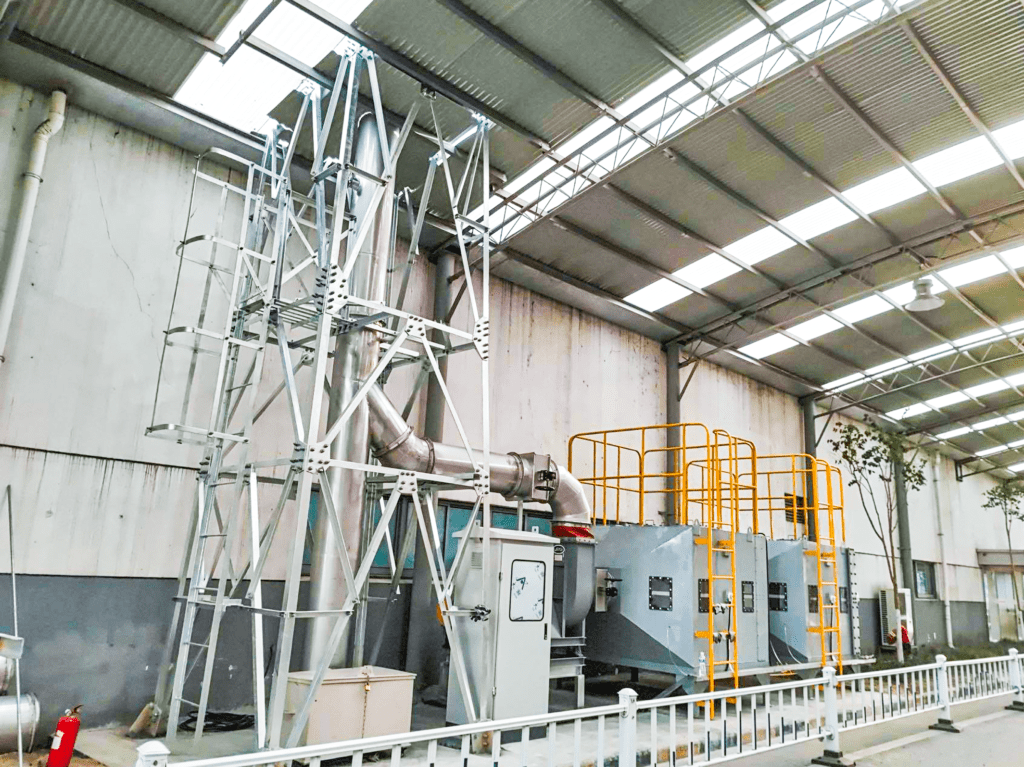
A large chemical enterprise in eastern China operating a 120,000-ton annual capacity chlorination facility was struggling with its legacy single-stage spray tower system. The original installation, commissioned in 2012, consisted of a single FRP spray tower (2.5 m diameter × 6 m height) with 10% NaOH circulation. While the system initially met the 65 mg/Nm³ emission limit then in force, tightening regulations and plant expansion drove the need for a comprehensive upgrade.
Pre-retrofit conditions:
- Stack Cl₂ concentration averaging 28–45 mg/Nm³ under normal operation
- Excursions to 120+ mg/Nm³ during batch reactor purging cycles
- Annual caustic consumption: 480 tons (excessive due to poor pH control and HCl co-absorption)
- Corrosion damage to downstream ductwork and ID fan requiring biannual replacement of carbon steel components
- Five odor complaints from neighboring communities over 18 months
Implemented solution — the five-stage system described above:
The retrofit was completed over a 14-week shutdown period. Key modifications included installation of a water quench tower upstream, addition of a secondary packed tower in series, integration of a NaOCl decomposition reactor, and full instrumentation upgrade with distributed PLC control (Siemens S7-1500) for automated caustic dosing based on real-time ORP (oxidation-reduction potential) measurement in the recirculation loops.
Post-retrofit results (12-month performance data):
- Stack Cl₂ concentration: 1.2–2.8 mg/Nm³ (average 1.9 mg/Nm³) — well below the 3 mg/Nm³ target
- System availability: 99.4% (excluding planned maintenance shutdowns)
- Caustic consumption reduced to 265 tons/year (45% reduction) through staged reagent use and ORP-controlled dosing
- Zero odor complaints and zero regulatory non-compliance events
- Annual maintenance cost reduced by 60% due to elimination of corrosion-related repairs
- ROI achieved in 2.3 years (including CAPEX amortization over 10 years)
Material Selection for Chlorine Service
Chlorine environments — especially wet chlorine and hypochlorite solutions — are aggressively corrosive. Material selection is often the difference between a system that lasts 20 years and one that fails in 18 months. Key recommendations from field experience:
- Tower shells and large-diameter ducting: FRP with vinyl ester resin (Derakane 470 or equivalent) rated for wet chlorine service at temperatures up to 80°C. Carbon steel with FRP lining is acceptable for large-diameter sections where structural strength is needed.
- Internal spray headers and nozzles: CPVC (chlorinated PVC) for temperatures up to 90°C; PVDF for higher-temperature applications or where organic solvent carryover is possible.
- Packing media: Polypropylene is adequate and cost-effective for operating temperatures below 80°C. For higher temperatures or oxidative environments with elevated hypochlorite concentrations, PVDF or PTFE packing should be specified.
- Pumps: Mechanical seals with PTFE secondary seals; wetted parts in Hastelloy C-276 or titanium (Grade 2) for hypochlorite service. Magnetic drive pumps eliminate seal leakage risks entirely.
- Instrumentation: pH and ORP probes must use chemically resistant glass bodies with PTFE junctions. Standard glass electrodes fail within weeks in concentrated hypochlorite. Redundant sensors with automated cleaning cycles (dilute HCl flush) are strongly recommended.
- Gaskets and seals: Expanded PTFE (ePTFE) or PTFE-envelope gaskets throughout. Avoid EPDM and other elastomers which degrade rapidly in the presence of wet chlorine and hypochlorite.
O&M Best Practices for Chlorine Scrubber Systems
Daily Checks
- Verify caustic tank level and replenish as needed (automated dosing pumps should trigger low-level alarms at 30% capacity)
- Check recirculation pump discharge pressure and motor current — trending changes indicate packing fouling or nozzle blockage
- Record stack chlorine analyzer readings and compare against the DCS trend; investigate any upward drift exceeding 0.5 mg/Nm³ per week
- Inspect pH and ORP readings in each recirculation loop; target pH 10–12 for alkaline stages
Weekly Preventive Maintenance
- Visually inspect demister pads through access ports for signs of scaling or damage
- Backflush spray nozzles if pressure drop across any tower stage has increased by more than 15% from baseline
- Check all flange connections for signs of leakage — chlorine gas leaks produce characteristic white fume (ammonium chloride) when tested with an ammonia swab
- Verify emergency scrubber auto-start sequence via simulated chlorine detector trigger
Monthly and Quarterly Tasks
- Send recirculating liquor samples for laboratory analysis: alkalinity, chloride concentration, hypochlorite concentration, and suspended solids
- Calibrate stack chlorine analyzer using certified span gas (typically 10 ppm Cl₂ in nitrogen)
- Inspect packing bed for channeling, fouling, or settlement — open the tower manway and visually assess the top bed surface; record bed height for settlement tracking
- Clean or replace ORP sensor junctions; verify readings against a laboratory reference electrode
- Inspect ID fan impeller for chemical attack or solids buildup; imbalance caused by material loss or deposit accumulation is the leading cause of fan bearing failure
Shutdown and Restart Procedures
Never shut down the scrubber while the process is generating chlorine gas. During planned shutdowns, flush all recirculation loops with fresh water for 30 minutes to prevent hypochlorite crystallization in piping — NaOCl·5H₂O precipitates below 25°C in concentrated solutions and can completely block small-bore instrument lines and pump suction strainers. Before restart, verify all recirculation pumps are primed and the caustic tanks are at minimum 60% capacity. Allow the system to reach stable operating pH in all stages before introducing process gas.
Economic Considerations
A properly designed five-stage chlorine scrubbing system for a mid-scale chlorination facility (8,000–15,000 Nm³/h) typically involves a CAPEX of $350,000–$650,000 USD, depending on materials of construction, instrumentation sophistication, and site-specific installation complexity. Operating costs are dominated by caustic consumption ($80–120/ton NaOH, 50% solution) and electricity for recirculation pumps and the ID fan (total installed motor power typically 45–75 kW). At current reagent and energy prices in the Asian market, the total operating cost ranges from $12–18 per operating hour.
When evaluated against the costs of non-compliance — which can include production shutdowns, fines of $15,000–$50,000 per incident under various national regimes, community relations damage, and accelerated equipment corrosion — the investment case is unambiguous. Most facilities achieve full payback within 2–4 years through avoided compliance costs alone, without even accounting for the extended service life of downstream equipment.
Conclusion
Chlorine gas scrubbing presents unique engineering challenges that demand a systematic, multi-stage approach. A well-designed five-stage system — incorporating water quench, dual alkaline packed towers, hypochlorite decomposition, and emergency backup — can reliably achieve stack concentrations below 3 mg/Nm³ while reducing operating costs through staged reagent consumption and automated process control. Material selection must be rigorous, with FRP, PVC/CPVC, and PTFE dominating the construction palette. The investment is substantial but the alternative — regulatory exposure, community impact, and progressive equipment destruction — is far more costly.
For facilities planning new installations or retrofitting legacy single-stage systems, early engagement with experienced scrubber manufacturers during the FEED (front-end engineering design) phase is essential to ensure the system is sized correctly for both current production and foreseeable expansion, and that the selected materials are compatible with the full range of process conditions.
For inquiries, contact Yfep@yf-ep.com | www.xxyuanfang.cn